7.1 Polarization and electric susceptibility

⚛️Solid State Physics Unit 7 Review
7.1 Polarization and electric susceptibility
⚛️ Solid State Physics
Electric polarization
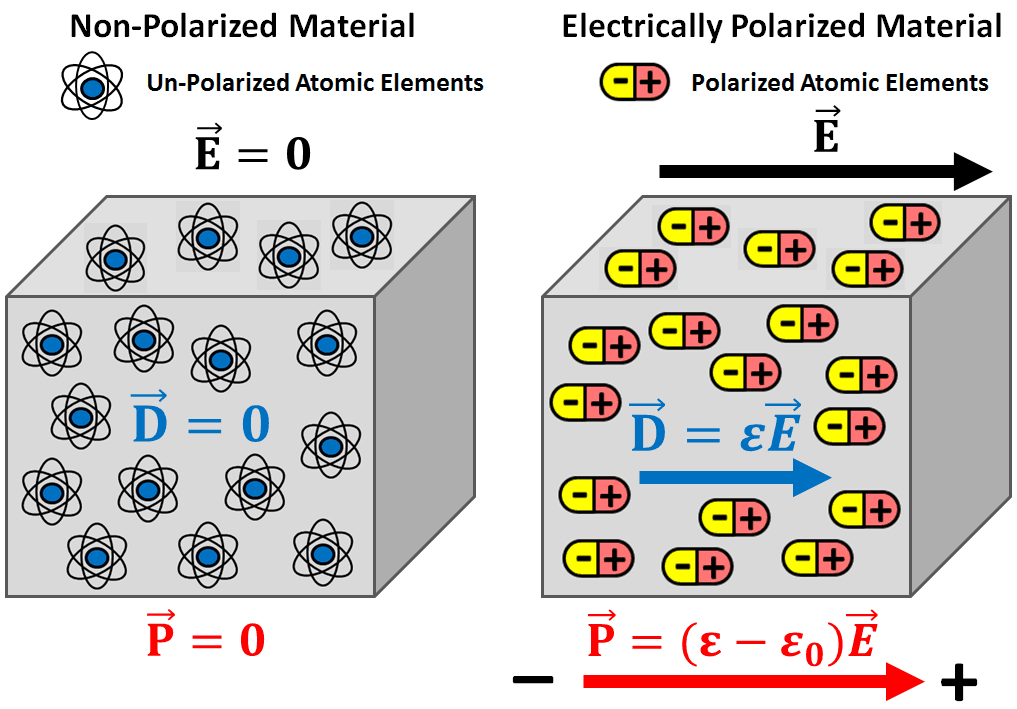
Electric polarization describes how materials respond to applied electric fields. When an electric field acts on a material, positive and negative charges shift in opposite directions, creating electric dipoles throughout the material. The strength and direction of this polarization depend on both the material's properties and the field intensity.
Three main polarization mechanisms exist: electronic, ionic, and orientational. Each operates on different timescales and contributes differently to a material's dielectric constant, susceptibility, and loss characteristics. These concepts are foundational for understanding capacitors, sensors, and a wide range of electronic devices.

Top images from around the web for Polarization definition
The electric dipole moment (p) in the water molecule | TikZ example View original
Is this image relevant?
Dielectric Permittivity — Electromagnetic Geophysics View original
Is this image relevant?
Polarization | Physics View original
Is this image relevant?
The electric dipole moment (p) in the water molecule | TikZ example View original
Is this image relevant?
Dielectric Permittivity — Electromagnetic Geophysics View original
Is this image relevant?
Polarization definition
Polarization is the electric dipole moment per unit volume of a material. It's a vector quantity denoted by and measured in .
For a volume containing many dipoles, polarization is:
where is the charge and is the position vector of the -th charge. In practice, you can also think of this as , where is the number density of dipoles and is the average dipole moment.
Polarization mechanisms
There are three main mechanisms of polarization in materials:
- Electronic polarization: displacement of electron clouds relative to atomic nuclei
- Ionic polarization: relative displacement of positive and negative ions in a crystal lattice
- Orientational polarization: alignment of permanent dipoles with the applied field
Each mechanism dominates in different frequency ranges and material types, which becomes important when you consider the frequency dependence of dielectric properties.
Electronic polarization
Electronic polarization occurs when an applied electric field displaces the electron cloud relative to the nucleus. Every material exhibits this mechanism, since every material has electrons.
This is the fastest polarization mechanism, with response times on the order of s (femtoseconds), meaning it can follow fields up to optical frequencies. The induced dipole moment is proportional to the field through the electronic polarizability :
Materials with larger, more loosely bound electron clouds (like heavy atoms) tend to have higher electronic polarizability.
Ionic polarization
Ionic polarization occurs in materials with ionic bonds, such as alkali halides (NaCl, KBr) and many ceramics. Under an applied field, positive and negative ions in the lattice shift in opposite directions, creating a net dipole moment.
The magnitude of ionic polarization depends on:
- The charge of the ions
- The ionic radii and masses
- The strength of the interionic bonds (stiffer bonds resist displacement)
Ionic polarization is slower than electronic polarization, with response times around to s, so it contributes to the dielectric response up to infrared frequencies but not at optical frequencies.
Orientational polarization
Orientational (or dipolar) polarization occurs in materials that have permanent electric dipoles, such as water molecules or polar polymers. Without an applied field, thermal agitation randomizes the dipole orientations, giving zero net polarization.
When a field is applied, the dipoles partially align along the field direction, producing a net polarization. The degree of alignment depends on the competition between the electric field energy and thermal energy . The Langevin function describes this competition, and for typical lab fields at room temperature, the alignment is only partial.
Orientational polarization is the slowest of the three mechanisms, with response times ranging from to s or even longer, depending on the viscosity of the medium and the size of the dipolar units.
Polarization vs electric field
The relationship between polarization and the applied electric field is:
where is the permittivity of free space ( F/m), is the electric susceptibility, and is the applied field.
For linear dielectrics, is a constant, so polarization scales linearly with the field. Most common dielectrics behave linearly for moderate field strengths.
For nonlinear dielectrics (including ferroelectrics), the relationship becomes more complex. The polarization may include higher-order terms like and , and the response can exhibit hysteresis.
Dielectric materials
Dielectric materials are electrical insulators that can be polarized by an applied electric field. Rather than conducting current, they store electrical energy in the form of polarization. This property makes them essential components in capacitors, insulation systems, and many electronic devices.
Dielectric properties
The key dielectric properties you need to know are:
- Dielectric constant (relative permittivity, ): measures a material's ability to store electrical energy relative to vacuum. For example, silicon dioxide has , while barium titanate can exceed 1000.
- Dielectric loss: the energy dissipated as heat when the material is subjected to an alternating electric field.
- Breakdown strength: the maximum electric field the material can withstand before it becomes conducting. For polyethylene, this is roughly kV/mm.
Polar vs nonpolar dielectrics
Dielectric materials are classified based on whether their molecules carry permanent dipole moments:
- Polar dielectrics (e.g., water, HCl, PVDF) have permanent electric dipoles. All three polarization mechanisms contribute to their response.
- Nonpolar dielectrics (e.g., diamond, noble gas solids, polyethylene) lack permanent dipoles. Only electronic and ionic polarization contribute.
Both types can be polarized by an applied field, but polar dielectrics generally have higher static dielectric constants because of the additional orientational contribution.
Ferroelectric materials
Ferroelectric materials are a special subclass of polar dielectrics that exhibit spontaneous polarization even without an applied field. This spontaneous polarization arises from a structural phase transition below the Curie temperature .
Key characteristics:
- They contain ferroelectric domains, which are regions of uniform polarization direction
- The polarization can be switched by applying a sufficiently strong external field, producing a characteristic hysteresis loop
- Common examples include barium titanate (, ) and lead zirconate titanate (PZT)
Ferroelectrics find applications in memory devices, sensors, and actuators.
Piezoelectric effect
The piezoelectric effect is the generation of electric charge in response to applied mechanical stress. It occurs in materials that lack a center of inversion symmetry in their crystal structure.
- The direct effect converts mechanical stress into electric charge (used in sensors)
- The converse effect converts an applied electric field into mechanical strain (used in actuators)
Common piezoelectric materials include quartz, PZT, and polyvinylidene fluoride (PVDF). Applications range from ultrasonic transducers to energy harvesting devices. Note that all ferroelectrics are piezoelectric, but not all piezoelectrics are ferroelectric.
Pyroelectric effect
The pyroelectric effect is the generation of electric charge in response to a change in temperature. It occurs in materials that have a unique polar axis, meaning their spontaneous polarization changes with temperature.
Pyroelectric materials like lithium tantalate () and triglycine sulfate (TGS) are used in infrared detectors and thermal imaging. The relationship between these effects follows a hierarchy: all ferroelectrics are pyroelectric, and all pyroelectrics are piezoelectric, but the reverse is not true.

Electric susceptibility
Electric susceptibility quantifies how easily a material becomes polarized under an applied electric field. It connects the macroscopic polarization to the field that causes it and is central to determining a material's dielectric behavior.
Susceptibility definition
Electric susceptibility is defined by:
It's dimensionless. For linear dielectrics, is a constant independent of field strength. For nonlinear dielectrics, it depends on . Typical values range from near zero (vacuum) to several thousand (high- ferroelectrics near their Curie temperature).
Susceptibility tensor
In anisotropic materials (most crystals that aren't cubic), the polarization response depends on the direction of the applied field. The susceptibility becomes a second-rank tensor , so the relationship is:
Each component describes how a field applied along direction produces polarization along direction . The tensor can be diagonalized by choosing the principal axes of the crystal, simplifying the description.
Isotropic vs anisotropic susceptibility
- Isotropic materials (cubic crystals, glasses, polycrystalline materials with random grain orientation): susceptibility is a scalar. The polarization always points in the same direction as the applied field.
- Anisotropic materials (hexagonal, tetragonal, orthorhombic, etc.): susceptibility is a tensor. Applying a field along one direction can produce polarization components along other directions.
This distinction matters for optical applications, where anisotropic susceptibility leads to birefringence.
Frequency dependence of susceptibility
The susceptibility of a material varies with the frequency of the applied field because different polarization mechanisms have different response times:
- At low frequencies (below ~ Hz), all three mechanisms (electronic, ionic, orientational) contribute, giving the highest susceptibility
- At infrared frequencies (~ to Hz), orientational polarization can no longer follow the field, so susceptibility drops
- At optical frequencies (~ Hz), only electronic polarization remains
Each "turn-off" of a mechanism produces a step-like decrease in the real part of susceptibility and a peak in the imaginary part (absorption). This frequency-dependent behavior is the basis of dielectric spectroscopy.
Complex susceptibility
When dielectric loss is present, susceptibility becomes complex:
- (real part): represents the in-phase response, related to energy storage
- (imaginary part): represents the out-of-phase response, related to energy dissipation
The complex susceptibility connects to the complex permittivity through:
so and .
Dielectric constant
The dielectric constant (relative permittivity) tells you how much better a material stores electrical energy compared to vacuum. It's one of the most commonly tabulated material properties and directly determines capacitor performance.
Dielectric constant definition
The dielectric constant is defined as:
where is the absolute permittivity of the material. Since it's a ratio, is dimensionless and always . A parallel-plate capacitor filled with a dielectric of constant has capacitance times larger than the same capacitor with vacuum between the plates.
Dielectric constant vs susceptibility
The dielectric constant and susceptibility are related by:
The "1" accounts for the vacuum contribution to the displacement field. In linear dielectrics, both quantities are independent of field strength. For nonlinear dielectrics, both become field-dependent, and this simple relation still holds at each value of the field, but itself is no longer constant.
Static dielectric constant
The static dielectric constant is the value measured at zero frequency (DC) or very low frequencies. It includes contributions from all polarization mechanisms and is therefore the largest value of for a given material.
For example:
- Water: (large orientational contribution)
- NaCl:
- Silicon:
The static dielectric constant is the relevant parameter for DC and low-frequency applications like power capacitors and cable insulation.
High-frequency dielectric constant
The high-frequency (optical) dielectric constant is measured at frequencies where only electronic polarization can respond (typically optical frequencies, ~ Hz).
It's related to the refractive index by:
For water, (compared to 80 at DC), which shows just how large the orientational contribution is at low frequencies. This quantity matters for optical device design and high-speed electronics.
Dielectric constant measurement techniques
Different frequency ranges require different measurement approaches:
- Low frequency (Hz to MHz): capacitance measurements using an LCR meter or impedance analyzer. You place the sample between parallel plates and measure the capacitance change.
- Microwave frequencies (GHz): waveguide methods such as the cavity perturbation technique, where inserting a sample into a resonant cavity shifts the resonant frequency.
- Optical frequencies: ellipsometry or reflectance measurements, which determine the refractive index and hence .
- Broadband characterization: dielectric spectroscopy sweeps across a wide frequency range, revealing relaxation peaks and the contributions of each polarization mechanism.

Dielectric loss
Dielectric loss is the dissipation of electrical energy as heat when a dielectric material is subjected to an alternating electric field. Minimizing loss is critical for high-frequency applications, while understanding its origins helps in material selection and device design.
Dielectric loss mechanisms
Three main mechanisms contribute to dielectric loss:
- Conduction losses: free charge carriers (electrons or ions) move under the applied field, dissipating energy through resistive heating. This dominates at low frequencies and high temperatures.
- Polarization (relaxation) losses: the polarization response lags behind the alternating field. Energy is absorbed as dipoles or ions try to follow the oscillating field but can't keep up perfectly.
- Resonance losses: at frequencies matching natural vibrational or electronic transition frequencies, the material absorbs energy resonantly. These appear as sharp absorption peaks.
Dielectric loss tangent
The loss tangent quantifies the ratio of energy dissipated to energy stored per cycle:
where is the angle between the displacement current and the total current in a phasor diagram. Low-loss materials have values on the order of or less (e.g., high-purity alumina), while lossy materials can have values approaching 1. For high-frequency capacitors and microwave substrates, you want as small as possible.
Dielectric relaxation
Dielectric relaxation is the time-dependent process by which polarization adjusts to a changing electric field. When the field is suddenly applied or removed, the polarization doesn't respond instantaneously but approaches its equilibrium value exponentially with a characteristic relaxation time .
After the field is removed, the polarization decays as:
The relaxation time depends on the polarization mechanism, temperature, and the local environment of the dipoles. Orientational relaxation in viscous media can be very slow (milliseconds or longer), while ionic relaxation is typically much faster.
Debye relaxation model
The Debye model describes the simplest case of dielectric relaxation: a single relaxation time for a polar material. The complex permittivity is:
where is the static permittivity and is the high-frequency permittivity.
Separating real and imaginary parts:
The imaginary part peaks at , which is where maximum energy absorption occurs. The Debye model works well for simple polar liquids but real solids often show broader relaxation peaks, requiring models like Cole-Cole or Havriliak-Negami that account for a distribution of relaxation times.
Dielectric breakdown
Dielectric breakdown occurs when the applied electric field exceeds the material's breakdown strength, causing it to suddenly become conducting. This is typically irreversible and destructive.
The main breakdown mechanisms are:
- Intrinsic (electronic) breakdown: electrons gain enough energy from the field to ionize atoms, triggering an avalanche of free carriers
- Thermal breakdown: dielectric losses heat the material faster than heat can dissipate, leading to thermal runaway
- Electromechanical breakdown: electrostatic forces compress the dielectric until it fails mechanically
Breakdown strength depends on material purity, thickness, temperature, and the duration of the applied field. Thinner samples generally show higher breakdown fields due to reduced probability of defect-initiated failure.
Polarization applications
Electric polarization underpins a wide range of technologies. The ability to control how materials store, convert, and respond to electric fields enables devices from everyday displays to advanced memory systems.
Capacitors and energy storage
Capacitors store energy in the electric field between two conducting plates separated by a dielectric. The stored energy density is:
Higher means more energy stored for the same field. Ceramic capacitors using materials like achieve high capacitance in small volumes. Polymer nanocomposites combining high- ceramic fillers with high-breakdown-strength polymer matrices are an active area of research for pulse power and energy storage applications.
Electro-optic effect
The electro-optic effect is the change in a material's refractive index when an electric field is applied. The Pockels effect (linear electro-optic effect) produces a refractive index change proportional to the field, while the Kerr effect (quadratic) scales with .
Materials like lithium niobate () and potassium dihydrogen phosphate (KDP) exhibit strong Pockels effects and are used in optical modulators, Q-switches for lasers, and fiber-optic communication systems where signals must be switched at GHz rates.
Liquid crystal displays (LCDs)
LCDs exploit the orientational polarization of liquid crystal molecules. These rod-shaped molecules have anisotropic polarizability, so their optical properties depend on their orientation.
Applying an electric field across a liquid crystal cell reorients the molecules, changing the polarization state of transmitted light. Combined with polarizing filters, this controls whether each pixel appears bright or dark. The low voltage required (a few volts) and low power consumption make LCDs dominant in displays from phones to televisions.
Ferroelectric memory devices
Ferroelectric RAM (FeRAM) stores binary data using the two stable polarization states of a ferroelectric material. A "1" corresponds to polarization in one direction, and a "0" to the opposite direction.
FeRAM advantages over flash memory include:
- Faster write speeds (nanoseconds vs. microseconds)
- Lower write voltage
- Much higher write endurance ( cycles vs. for flash)
- Non-volatile storage (data retained without power)
The trade-off is lower storage density compared to flash, which limits FeRAM to niche applications like smart cards and automotive systems.
Piezoelectric sensors and actuators
Piezoelectric devices convert between mechanical and electrical energy:
- Sensors (direct effect): a pressure sensor generates a voltage proportional to applied force. Quartz crystal microbalances can detect mass changes as small as nanograms.
- Actuators (converse effect): applying a voltage produces precise mechanical displacement. PZT actuators in atomic force microscopes achieve sub-nanometer positioning.
- Transducers: ultrasonic imaging systems use piezoelectric elements to both generate and detect sound waves at MHz frequencies.
Applications span automotive (knock sensors), aerospace (vibration monitoring), medical imaging (ultrasound), and industrial automation.
See Fiveable more often in Google
Mark Fiveable as a preferred source and Google is more likely to show you our guides in Top Stories, with a "preferred" badge in AI Mode and AI Overviews.