11.4 Defect formation and migration

⚛️Solid State Physics Unit 11 Review
11.4 Defect formation and migration
⚛️ Solid State Physics
Types of defects
Defects are irregularities in a crystal's periodic structure. Even a small number of them can dramatically change a material's mechanical, electrical, and optical behavior, so classifying them is the first step toward understanding their effects.

Top images from around the web for Point defects
Frontiers | Topological Point Defects of Liquid Crystals in Quasi-Two-Dimensional Geometries View original
Is this image relevant?
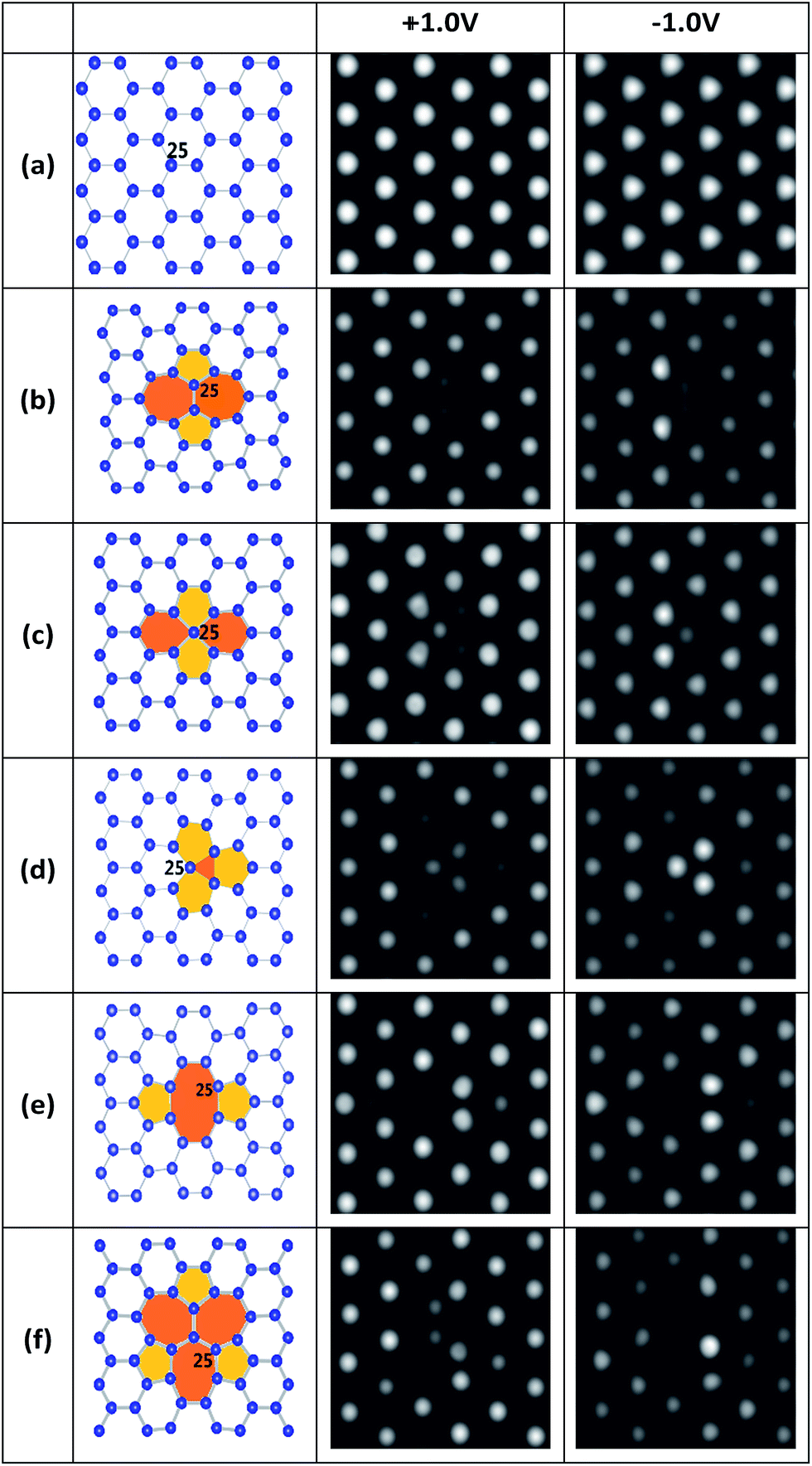
The structures and diffusion behaviors of point defects and their influences on the electronic ... View original
Is this image relevant?
The Solid State of Matter | Chemistry View original
Is this image relevant?
Frontiers | Topological Point Defects of Liquid Crystals in Quasi-Two-Dimensional Geometries View original
Is this image relevant?
The structures and diffusion behaviors of point defects and their influences on the electronic ... View original
Is this image relevant?
Point defects
Point defects are localized disruptions involving one or a few atomic sites. The three main types are:
- Vacancies — missing atoms that leave an empty lattice site. Every crystal above 0 K contains some vacancies because they increase configurational entropy.
- Interstitials — extra atoms squeezed into spaces between regular lattice sites. These introduce significant local strain because the surrounding atoms must accommodate the extra atom.
- Substitutional defects — foreign atoms sitting on sites normally occupied by host atoms. A classic example is a phosphorus atom replacing silicon in a semiconductor lattice.
Point defects alter local bonding, introduce strain fields, and create or remove electronic states. They're also the primary vehicles for solid-state diffusion.
Line defects
Line defects (dislocations) extend along a line through the crystal. They are the main reason metals can deform plastically at stresses far below the theoretical shear strength.
- Edge dislocations — an extra half-plane of atoms inserted into the lattice. The dislocation line runs along the bottom edge of that half-plane.
- Screw dislocations — atoms are displaced in a helical ramp around the dislocation line, like a spiral staircase.
Most real dislocations have mixed character (part edge, part screw). Dislocations move through the lattice under applied stress, and their interactions with each other and with other defects largely determine a material's mechanical response.
Planar defects
Planar defects are two-dimensional and extend across a surface within the crystal.
- Grain boundaries — interfaces where two crystallites of different orientation meet. In polycrystalline materials, grain boundaries strongly influence strength (Hall-Petch relationship), diffusion, and corrosion behavior.
- Stacking faults — disruptions in the normal stacking sequence of close-packed planes (e.g., ...ABCABC... becomes ...ABCBCABC... in FCC).
- Twin boundaries — mirror-symmetry planes where the crystal orientation is reflected. Twins can form during growth or deformation.
Volume defects
Volume defects occupy three-dimensional regions inside the material.
- Voids — empty cavities, often formed by vacancy clustering or gas entrapment during processing.
- Precipitates — second-phase particles that nucleate within the matrix, such as precipitates in age-hardened aluminum alloys.
- Inclusions — foreign particles (e.g., oxide particles trapped during casting).
Volume defects can act as stress concentrators and crack initiation sites, but precipitates are also deliberately used for strengthening.
Defect formation
Defects aren't just accidents of processing. Thermodynamics actually requires a nonzero defect concentration at any temperature above absolute zero. Understanding why and how many defects form is central to controlling material properties.
Thermodynamics of defect formation
The equilibrium state of a crystal minimizes the Gibbs free energy:
Creating a defect costs enthalpy () because you break bonds and distort the lattice. But it also increases the configurational entropy of the system (), which lowers through the term. At any finite temperature, the competition between these two terms produces a minimum in at some nonzero defect concentration. That's why a "perfect" crystal at K is thermodynamically unstable.
Defect formation energy
The formation energy () is the energy cost of creating one defect in an otherwise perfect lattice. Typical values give you a sense of scale:
- Vacancy formation energy in copper: ~1.0 eV
- Vacancy formation energy in aluminum: ~0.68 eV
- Interstitial formation energy in metals: typically 2–4 eV (much higher than vacancies, which is why interstitials are rarer at equilibrium)
Formation energies can be calculated from first principles using density functional theory (DFT) or estimated from molecular dynamics simulations. The value depends on the defect type, the host material, and the local bonding environment.
Equilibrium defect concentration
The equilibrium concentration of defects follows an Arrhenius relation:
where is a pre-exponential factor (related to the number of available sites and entropy contributions), is the formation energy, is Boltzmann's constant, and is absolute temperature.
Because of the exponential dependence, defect concentration rises steeply with temperature. For example, the vacancy fraction in copper near its melting point (~1358 K) is roughly , while at room temperature it drops to negligibly small values.
Non-equilibrium defect concentration
Real materials often contain far more defects than the equilibrium formula predicts. This happens when defects are introduced faster than they can anneal out:
- Rapid quenching — cooling a metal quickly from high temperature "freezes in" the high-temperature vacancy concentration.
- Ion implantation — bombarding a semiconductor with energetic ions creates cascades of vacancies and interstitials.
- Irradiation — neutron or electron irradiation in reactor environments displaces atoms from lattice sites (Frenkel pair production).
- Severe plastic deformation — processes like cold rolling generate enormous dislocation densities.
These non-equilibrium populations are metastable. Given enough time and thermal energy, the system will relax toward equilibrium through defect migration and annihilation.
Defect migration
Once defects exist, they can move. Defect migration is the atomic-scale mechanism behind macroscopic diffusion, and it controls processes like creep, sintering, oxidation, and dopant redistribution.
Diffusion mechanisms
Atoms move through a crystal by two primary mechanisms, both involving defects:
- Vacancy mechanism — an atom on a regular site jumps into an adjacent vacancy. The vacancy effectively moves in the opposite direction.
- Interstitial mechanism — a small interstitial atom hops from one interstitial site to the next without needing a vacancy.
A third mechanism, the interstitialcy (kick-out) mechanism, involves an interstitial atom displacing a lattice atom into a new interstitial position. This is relevant in some semiconductor systems.

Vacancy diffusion
In vacancy diffusion, an atom and a neighboring vacancy swap positions. For this jump to occur, the atom must have enough thermal energy to push past the surrounding atoms (the "saddle point" configuration).
- Dominant in close-packed structures (FCC, HCP) where interstitial sites are small and hard to occupy.
- The diffusion rate depends on both the vacancy concentration and the jump frequency.
- Activation energy for vacancy diffusion = formation energy + migration energy: .
Interstitial diffusion
Small atoms (H, C, N, O) often dissolve interstitially and diffuse by hopping between interstitial sites. This is generally much faster than vacancy diffusion because:
- No vacancy is needed — the mechanism doesn't require waiting for a rare vacancy to appear nearby.
- The migration barrier is lower for small atoms moving through relatively open interstitial channels.
A well-known example: carbon diffuses interstitially through BCC iron (-Fe) with an activation energy of about 0.87 eV, which is significantly lower than the self-diffusion activation energy of iron (~2.5 eV via vacancies).
Diffusion coefficients
The diffusion coefficient quantifies how fast mass transport occurs. For a random walk in three dimensions:
where is the jump frequency (jumps per second) and is the jump distance. This equation connects the microscopic picture (individual atomic jumps) to the macroscopic diffusion rate that appears in Fick's laws.
Temperature dependence of diffusion
Diffusion coefficients follow Arrhenius behavior:
where is the pre-exponential factor and is the activation energy for diffusion.
To extract experimentally, you plot versus . The slope of this line equals . A steeper slope means a higher activation energy and stronger temperature sensitivity.
Practical consequence: raising the temperature during semiconductor processing (annealing) dramatically increases dopant diffusion rates, which is why thermal budgets must be carefully controlled during device fabrication.
Defect interactions
Defects don't exist in isolation. They interact with each other, with impurities, with dislocations, and with grain boundaries. These interactions often dominate the macroscopic behavior of the material.
Defect-defect interactions
- Vacancy-interstitial recombination — a Frenkel pair (vacancy + interstitial created together) can recombine and restore the perfect lattice. This is a major annihilation pathway in irradiated materials.
- Vacancy clustering — multiple vacancies can aggregate into divacancies, trivacancies, or larger clusters. Divacancies in metals are more mobile than single vacancies and can eventually collapse into dislocation loops or voids.
- Interstitial clustering — excess interstitials can form dumbbell configurations or small interstitial loops.
Defect-impurity interactions
Impurity atoms and point defects often attract each other because their strain fields partially cancel.
- In semiconductors, dopant atoms (substitutional impurities) can form complexes with vacancies. For instance, the E-center in silicon is a phosphorus-vacancy pair. These complexes affect dopant activation and carrier concentration.
- In metals, solute atoms can segregate to vacancy-rich regions, and impurity-vacancy binding can either enhance or suppress diffusion depending on the system.
Defect-dislocation interactions
This category is critical for mechanical properties:
- Solid solution strengthening — solute atoms create local strain fields that impede dislocation glide. The dislocation must exert extra force to break free, raising the yield stress.
- Cottrell atmospheres — interstitial atoms (like carbon in steel) diffuse to and "decorate" dislocation cores, pinning them. This is responsible for the yield point phenomenon in low-carbon steel.
- Dislocation climb — edge dislocations can absorb or emit vacancies, allowing them to move perpendicular to their glide plane. Climb is thermally activated and becomes important during high-temperature creep.
Defect-grain boundary interactions
Grain boundaries are high-energy, disordered regions that act as both sources and sinks for point defects.
- Vacancies and interstitials are readily absorbed at grain boundaries, which reduces their bulk concentration. This is why nanocrystalline materials (with a high density of grain boundaries) are more radiation-tolerant.
- Impurities tend to segregate to grain boundaries because the disordered structure can accommodate misfit atoms more easily. This segregation can be beneficial (e.g., improved corrosion resistance) or harmful (e.g., grain boundary embrittlement by sulfur in nickel).
- Diffusion along grain boundaries is typically orders of magnitude faster than through the bulk lattice, because the more open structure lowers migration barriers.
Defect characterization techniques
Identifying and quantifying defects requires specialized experimental methods. No single technique gives a complete picture, so multiple methods are often combined.
X-ray diffraction
X-ray diffraction (XRD) probes the average crystal structure and is sensitive to anything that disrupts long-range periodicity.
- Peak broadening — dislocations and small crystallite sizes both broaden diffraction peaks. Williamson-Hall analysis or Warren-Averbach methods can separate size and strain contributions.
- Peak shifts — uniform strain (e.g., from a high concentration of solute atoms) shifts peak positions according to Bragg's law.
- Superlattice reflections — ordering of defects or impurities can produce extra diffraction peaks.
XRD is non-destructive and works well for bulk samples, but it gives averaged information and can't image individual defects.

Electron microscopy
Electron microscopy provides direct, real-space images of defects.
- TEM (Transmission Electron Microscopy) — can image individual dislocations, stacking faults, and precipitates with sub-nanometer resolution. Diffraction contrast imaging makes dislocations visible as dark or bright lines. High-resolution TEM (HRTEM) can resolve atomic columns.
- SEM (Scanning Electron Microscopy) — lower resolution than TEM but excellent for surface topography, grain structure, and fracture surfaces. Often combined with energy-dispersive X-ray spectroscopy (EDS) for chemical analysis.
The main limitation is sample preparation: TEM requires electron-transparent specimens (typically < 100 nm thick).
Positron annihilation spectroscopy
Positrons are antimatter counterparts of electrons. When injected into a solid, they preferentially become trapped at open-volume defects (vacancies, vacancy clusters, voids) because these sites have reduced electron density.
- Positron lifetime — longer lifetimes indicate larger open volumes. A single vacancy in a metal gives a characteristic lifetime increase of ~50–100 ps compared to the defect-free bulk.
- Doppler broadening — the energy spectrum of annihilation gamma rays reflects the momentum distribution of electrons at the annihilation site, providing chemical information about the defect environment.
This technique is uniquely sensitive to vacancy-type defects at concentrations as low as per atom.
Electrical resistivity measurements
Defects scatter conduction electrons, increasing resistivity. This makes resistivity a simple but powerful probe of defect concentration.
- Quenching experiments — measure the resistivity increase after quenching a metal from high temperature. The excess resistivity is proportional to the quenched-in vacancy concentration. From the temperature dependence, you can extract the vacancy formation energy.
- Isochronal annealing — after introducing defects (by quenching or irradiation), the sample is annealed at progressively higher temperatures. Each recovery stage corresponds to a specific defect type becoming mobile, allowing you to determine migration energies.
- Matthiessen's rule — total resistivity is the sum of contributions from phonons, impurities, and defects: .
Defect engineering
Rather than treating defects as problems to eliminate, modern materials science deliberately introduces and controls them to achieve target properties.
Intentional defect introduction
- Ion implantation — accelerated ions are driven into a substrate to create specific dopant profiles. This is the standard method for doping semiconductors in microelectronics. Implantation energies (typically 1 keV to several MeV) and doses control the depth and concentration of introduced species.
- Irradiation — neutron, electron, or heavy-ion irradiation creates displacement damage. In polymers, controlled irradiation induces crosslinking that improves mechanical strength and thermal stability.
- Mechanical deformation — cold working introduces high dislocation densities (up to to ), which strengthens the material through work hardening.
- Rapid quenching — traps excess vacancies that can later drive precipitation or phase transformations during aging treatments.
Defect control during processing
Processing conditions determine which defects form and how many survive:
- Thermomechanical processing — sequences of deformation and annealing control grain size and dislocation density. Recrystallization annealing after cold work produces a new, low-defect grain structure with a controlled grain size.
- Atmosphere control — sintering ceramics in oxidizing or reducing atmospheres adjusts the oxygen vacancy concentration. For example, sintering in a reducing atmosphere creates oxygen vacancies that increase electronic conductivity, while sintering in oxygen suppresses them.
- Growth conditions — in single-crystal growth (Czochralski, Bridgman), pull rate and thermal gradients determine the density of grown-in defects like vacancies, interstitials, and dislocations.
Defect-mediated properties
Many technologically important properties exist only because of defects:
- Plastic deformation — metals deform plastically because dislocations can glide through the lattice. Without dislocations, metals would be brittle.
- Ionic conductivity — in solid electrolytes like yttria-stabilized zirconia (YSZ), oxygen ions move through the lattice via oxygen vacancies. Adding to creates these vacancies by charge compensation, enabling ionic conductivities high enough for solid oxide fuel cells.
- Color centers — vacancies that trap electrons in alkali halides (F-centers) absorb visible light and give the crystal color. This is the origin of the purple color in irradiated NaCl.
- Photoluminescence — defect states within the bandgap of wide-gap semiconductors (e.g., GaN) can produce efficient light emission.
Defect-based devices
- Nitrogen-vacancy (NV) centers in diamond — a nitrogen atom adjacent to a vacancy in the diamond lattice creates a quantum defect with spin states that can be optically initialized and read out at room temperature. NV centers are actively developed for quantum sensing (magnetometry with nanoscale resolution) and quantum computing.
- Memristors — resistance-switching devices based on the migration of oxygen vacancies in metal oxides (e.g., , ). Applying voltage drives vacancies to form or dissolve conductive filaments, switching the device between high- and low-resistance states. These are promising for neuromorphic computing architectures.
Defects in specific materials
Different material classes have characteristic defect populations and sensitivities. The same type of defect can play very different roles depending on the bonding and structure of the host.
Defects in metals
Metals are close-packed with metallic bonding, so:
- Vacancies are the dominant equilibrium point defect (interstitials have much higher formation energies).
- Dislocations are highly mobile on close-packed slip planes, giving metals their characteristic ductility.
- Grain boundaries in polycrystalline metals follow the Hall-Petch relationship: yield strength increases as grain size decreases ().
- Under irradiation (e.g., in nuclear reactor components), vacancy and interstitial clusters can cause swelling, hardening, and embrittlement.
Defects in semiconductors
Defects in semiconductors are especially consequential because even parts-per-billion impurity levels can change electrical behavior:
- Dopants are intentional substitutional defects. Phosphorus in silicon donates an electron (n-type); boron accepts one (p-type).
- Deep-level defects introduce states near the middle of the bandgap and act as recombination centers, reducing carrier lifetime. These are usually detrimental for devices like solar cells and LEDs.
- Misfit dislocations form at interfaces between lattice-mismatched layers (e.g., on ) when the strained layer exceeds a critical thickness.
- Defect engineering in semiconductors requires extreme precision because device performance depends on defect concentrations controlled to the level of –.
Defects in ceramics
Ceramics have ionic or covalent bonding, which constrains defect behavior:
- Point defects must maintain charge neutrality. Schottky defects (paired cation and anion vacancies) and Frenkel defects (ion displaced to an interstitial site) are the characteristic equilibrium defects.
- Kröger-Vink notation is used to describe charged defects: denotes a doubly-positive oxygen vacancy, for example.
- Oxygen vacancies in oxides like , , and are central to applications in fuel cells, catalysis, and resistive switching.
- Porosity (a volume defect) is common in sintered ceramics and strongly affects mechanical strength, thermal conductivity, and optical transparency.
Defects in polymers
Polymers lack long-range crystalline order in most regions, so "defects" have a different character:
- Chain ends — each polymer chain has two ends where the regular repeat-unit sequence terminates. Shorter chains mean more chain ends per unit volume and lower mechanical strength.
- Entanglements — physical knots between chains that act as temporary crosslinks and dominate the viscoelastic response above the entanglement molecular weight.
- Voids and crazes — voids can nucleate during processing (injection molding, extrusion) or under mechanical stress. Crazes are networks of voids bridged by fibrils that form ahead of crack tips.
- Irradiation effects — depending on the polymer and dose, irradiation can cause chain scission (reducing molecular weight) or crosslinking (increasing it). Crosslinked polyethylene, for instance, is used in joint replacements because of its improved wear resistance.
See Fiveable more often in Google
Mark Fiveable as a preferred source and Google is more likely to show you our guides in Top Stories, with a "preferred" badge in AI Mode and AI Overviews.