11.3 Planar defects and grain boundaries

⚛️Solid State Physics Unit 11 Review
11.3 Planar defects and grain boundaries
⚛️ Solid State Physics
Types of Planar Defects
Planar defects are two-dimensional imperfections that extend over a significant area within a crystal. Unlike point defects (vacancies, interstitials) or line defects (dislocations), these span entire planes of atoms. They profoundly affect mechanical, electrical, and chemical properties because they disrupt the periodicity of the lattice across a broad region.
The four main types are grain boundaries, stacking faults, twin boundaries, and antiphase boundaries.

Top images from around the web for Grain boundaries vs stacking faults
Crystal structure and stacking faults in the layered honeycomb, delafossite-type materials Ag 3 ... View original
Is this image relevant?
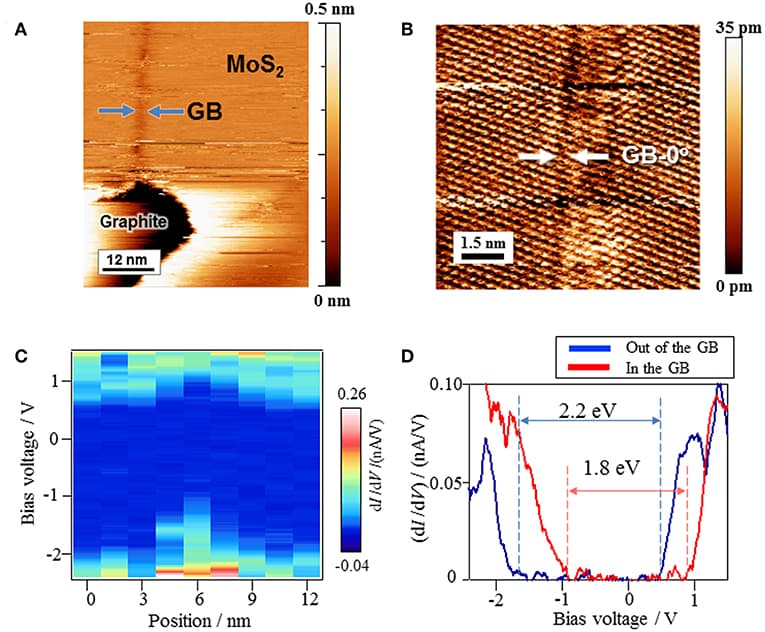
Frontiers | The Atomic and Electronic Structure of 0° and 60° Grain Boundaries in MoS2 View original
Is this image relevant?
Crystal structure and stacking faults in the layered honeycomb, delafossite-type materials Ag 3 ... View original
Is this image relevant?
Frontiers | The Atomic and Electronic Structure of 0° and 60° Grain Boundaries in MoS2 View original
Is this image relevant?
Grain boundaries vs stacking faults
Grain boundaries form where two grains (crystallites) with different crystallographic orientations meet. The region between them contains atomic mismatch and disorder. They're classified by misorientation angle:
- Low-angle grain boundaries: misorientation < 15°. These can be described as arrays of dislocations accommodating the small tilt or twist between grains.
- High-angle grain boundaries: misorientation > 15°. These have more complex, disordered atomic structures that can't be neatly described by dislocation arrays.
Stacking faults are errors in the regular stacking sequence of close-packed atomic planes. In an FCC crystal, the normal sequence is ABCABC. A stacking fault disrupts this:
- Intrinsic stacking fault: a plane is removed (e.g., ABCABC → ABC|BC, equivalent to a missing A layer)
- Extrinsic stacking fault: an extra plane is inserted (e.g., ABCABC → ABCBABC)
These typically form by the passage of partial dislocations through the lattice.
Twin boundaries
A twin boundary forms when two crystal regions share a common crystallographic plane, but one region is a mirror reflection of the other across that plane. The two types arise from different formation mechanisms:
- Mechanical (deformation) twins form under applied stress, especially in HCP metals like magnesium where slip systems are limited.
- Annealing twins form during recrystallization or grain growth in heat treatment, commonly seen in FCC metals like copper and brass.
The characteristic misorientation angle depends on crystal structure: 60° about for FCC, and 86.3° about for BCC. Twin boundaries tend to be low-energy, highly coherent interfaces, which is why they can actually enhance ductility rather than just blocking dislocation motion.
Antiphase boundaries
Antiphase boundaries (APBs) are specific to ordered alloys, where different atomic species occupy distinct sublattice sites. An APB separates two domains that have the same ordered crystal structure but are shifted (out of phase) relative to each other. Across the boundary, atoms that should be on one sublattice end up on the wrong one, creating unfavorable nearest-neighbor bonds.
APBs can form during ordering transformations (when the alloy cools through its order-disorder transition) or through plastic deformation when superlattice dislocations pass through the crystal. Classic examples include ordered intermetallics like and .
Structure of Grain Boundaries
Low-angle vs high-angle boundaries
Low-angle grain boundaries (misorientation < 15°) have a well-understood structure: they consist of periodic arrays of dislocations.
- A tilt boundary is built from edge dislocations, while a twist boundary is built from screw dislocations.
- The spacing between dislocations in a symmetric tilt boundary follows , where is the Burgers vector magnitude and is the misorientation angle. As misorientation increases, dislocation spacing decreases until the cores overlap.
High-angle grain boundaries (misorientation > 15°) can't be described this way. The dislocation cores would overlap so heavily that the boundary becomes a region of generalized atomic disorder. More sophisticated structural models are needed.
Coincidence site lattice (CSL) model
Not all high-angle boundaries are equally disordered. The CSL model identifies special high-angle boundaries where a relatively high fraction of lattice sites from both grains coincide.
- The value is the reciprocal of the fraction of coinciding sites. A boundary means 1 in 3 lattice sites coincide, a means 1 in 5, and so on.
- The boundary corresponds to the coherent twin boundary in FCC metals.
- Lower values generally correlate with lower boundary energy and better properties (higher resistance to corrosion, cracking, etc.) compared to random high-angle boundaries.
Microscopic degrees of freedom
A grain boundary has five macroscopic degrees of freedom:
- Three describe the relative misorientation between the two grains (expressible as an axis-angle pair).
- Two describe the orientation of the boundary plane itself (its normal direction).
These five parameters together determine the atomic structure, energy, and properties of the boundary. Grain boundary engineering is fundamentally about controlling these degrees of freedom through processing to achieve a favorable distribution of boundary types.
Energy of Grain Boundaries
Elastic strain energy
Grain boundaries introduce elastic strain into the surrounding lattice because atoms near the boundary are displaced from their ideal positions. For low-angle boundaries, this strain comes directly from the dislocation arrays. The elastic strain energy increases with misorientation angle up to roughly 15°, at which point the boundary transitions to a high-angle character and the energy levels off.
Chemical energy
Beyond elastic strain, there's a chemical contribution to boundary energy arising from the disrupted bonding environment at the interface. Atoms at the boundary have different coordination numbers and bond lengths compared to the bulk.
Solute atoms can segregate to grain boundaries and lower this chemical energy, effectively stabilizing the boundary. This is one reason why certain alloying additions dramatically change grain boundary behavior.
Relationship between energy and misorientation angle
The Read-Shockley model describes the energy of low-angle boundaries:
where and are material constants and is the misorientation angle. Energy rises with up to about 15°, then plateaus for general high-angle boundaries.
Within the high-angle regime, cusps (local energy minima) appear at special misorientations corresponding to low- CSL boundaries. The boundary plane orientation also matters: certain planes are more closely packed and therefore lower in energy.
Mechanical Properties of Grain Boundaries
Strengthening mechanisms
Grain boundaries act as obstacles to dislocation motion because a dislocation gliding in one grain can't simply continue into a neighboring grain with a different orientation. Two key consequences:
- Dislocation pile-up: Dislocations accumulate at a grain boundary under applied stress, creating a stress concentration at the boundary. When this concentrated stress is large enough, it can activate dislocation sources in the adjacent grain, transmitting plastic deformation.
- Hall-Petch strengthening: Smaller grains mean more boundaries per unit volume, so dislocations pile up over shorter distances and the material resists yielding more strongly.

Hall-Petch relationship
The Hall-Petch equation relates yield strength to grain size:
- = yield strength
- = lattice friction stress (resistance to dislocation motion in a single crystal)
- = Hall-Petch coefficient (material-dependent, units of )
- = average grain diameter
This dependence holds well for grain sizes from millimeters down to roughly 20 nm. Below ~20 nm, the relationship breaks down (the "inverse Hall-Petch" regime), because grain boundary sliding and other mechanisms begin to dominate over dislocation pile-up.
Grain boundary sliding and creep
At elevated temperatures (typically above ~0.4 , where is the absolute melting temperature), grains can slide past each other along their boundaries. This sliding is accommodated by diffusion or dislocation activity near the boundary.
- Grain boundary sliding is a major contributor to creep, the slow, time-dependent deformation under constant load at high temperature.
- Fine-grained materials are more susceptible to grain boundary sliding because they have a higher boundary area per unit volume.
- This is why high-temperature structural alloys (like turbine blade superalloys) are often designed with coarse grains or even single-crystal forms to minimize creep.
Kinetic Properties of Grain Boundaries
Grain boundary diffusion
Atoms diffuse much faster along grain boundaries than through the bulk lattice. The disordered, open structure of boundaries provides lower-energy pathways for atomic migration.
- The activation energy for grain boundary diffusion is typically 0.4–0.7 times that of bulk (lattice) diffusion.
- This enhanced diffusion is critical for processes like sintering (powder consolidation), Coble creep (diffusion-controlled creep along boundaries), and superplasticity.
- At lower temperatures, where bulk diffusion is sluggish, grain boundary diffusion can be the dominant transport mechanism.
Grain boundary migration and grain growth
Grain boundaries migrate to reduce the total boundary area and thus the system's free energy. The driving force comes from boundary curvature: a curved boundary experiences a pressure proportional to , where is the boundary energy and is the radius of curvature. Convex boundaries move toward their center of curvature.
The result is grain growth: larger grains consume smaller ones over time. The kinetics follow:
- = average grain size at time
- = initial grain size
- = grain growth exponent (ideally 2 for pure, single-phase materials; often 3–4 in practice due to solute drag and pinning)
- = rate constant that increases with temperature (Arrhenius-type)
Second-phase particles (Zener pinning), solute atoms, and texture effects can all slow or arrest grain growth.
Grain boundary segregation
Solute atoms tend to accumulate at grain boundaries because the disordered boundary structure can better accommodate size-misfit atoms, relieving lattice strain. This is described thermodynamically by the McLean segregation isotherm.
Segregation effects can be beneficial or detrimental:
- Detrimental: Bismuth segregation in copper causes severe grain boundary embrittlement. Sulfur and phosphorus segregation in steels promotes temper embrittlement.
- Beneficial: Boron segregation in nickel-based superalloys strengthens grain boundary cohesion. Carbon microalloying in certain steels improves boundary toughness.
Characterization Techniques for Grain Boundaries
Electron microscopy (TEM, SEM, EBSD)
- Transmission electron microscopy (TEM) provides atomic-resolution imaging of grain boundary structure. It can reveal dislocation arrays at low-angle boundaries, segregation at the boundary plane, and the presence of secondary phases. High-resolution TEM (HRTEM) can directly image the atomic arrangement across a boundary.
- Scanning electron microscopy (SEM) images grain boundaries on sample surfaces after etching (chemical or thermal). It's useful for measuring grain size distributions and studying fracture surfaces for evidence of intergranular failure.
- Electron backscatter diffraction (EBSD) maps the crystallographic orientation of every grain in a scanned area. From this data, you can determine misorientation across every boundary, identify CSL boundaries, and construct grain boundary character distribution (GBCD) maps. EBSD is the workhorse technique for grain boundary engineering studies.
X-ray diffraction
X-ray diffraction (XRD) provides bulk-averaged information about grain size and microstrain. The Scherrer equation relates peak broadening to grain size:
- = average crystallite size
- = shape factor (typically ~0.9)
- = X-ray wavelength
- = full width at half maximum (FWHM) of the diffraction peak (in radians), corrected for instrumental broadening
- = Bragg angle
XRD can also reveal preferred orientation (texture) through pole figure measurements, which indirectly reflects the grain boundary distribution.
Atomic force microscopy (AFM)
AFM is a scanning probe technique that maps surface topography with nanometer resolution. After thermal or chemical etching, grain boundaries appear as grooves on the surface, and AFM can measure groove geometry to estimate boundary energy.
AFM can also probe local mechanical properties (stiffness, adhesion) at and near grain boundaries using force spectroscopy modes. It's particularly useful for studying early-stage grain growth and boundary interactions with precipitates or dislocations at surfaces.
Technological Applications of Grain Boundaries
Nanocrystalline materials
Nanocrystalline materials have grain sizes below 100 nm, meaning a substantial volume fraction of the material is grain boundary or near-boundary region. This leads to distinctive properties:
- Mechanical: Very high hardness and strength (Hall-Petch), but often limited ductility due to difficulty sustaining dislocation activity within tiny grains.
- Electrical/magnetic: Altered electrical resistivity and magnetic coercivity compared to coarse-grained counterparts.
- Ceramic nanocrystals: Can exhibit enhanced ductility and toughness compared to their conventionally brittle coarse-grained forms.
Properties can be tuned by controlling grain size and boundary character through processing routes like severe plastic deformation, electrodeposition, or mechanical alloying.
Grain boundary engineering
Grain boundary engineering (GBE) aims to increase the fraction of "special" low- CSL boundaries (particularly boundaries) through controlled thermomechanical processing. A typical GBE process involves:
- Apply a small amount of cold deformation (5–30% strain).
- Anneal at a temperature that promotes recrystallization and twin formation.
- Repeat the strain-anneal cycle multiple times to build up a high fraction of twin-related boundaries.
GBE materials show improved resistance to intergranular corrosion, stress corrosion cracking, and creep. Applications include nickel-based superalloys for jet engines and stainless steels for nuclear reactor components.
Role in corrosion and stress corrosion cracking
Grain boundaries are preferential sites for corrosion because of their higher energy, faster diffusion, and potential solute depletion or enrichment (e.g., chromium depletion in sensitized stainless steels).
- Intergranular corrosion (IGC): Selective dissolution along grain boundaries, often triggered by precipitate formation that depletes protective elements from the adjacent matrix.
- Stress corrosion cracking (SCC): Cracks nucleate and propagate along grain boundaries under the combined action of tensile stress and a corrosive environment. This is particularly dangerous because it can cause sudden failure at stresses well below the yield strength.
Mitigation strategies include:
- Grain boundary engineering to increase the fraction of corrosion-resistant CSL boundaries
- Controlling heat treatment to avoid sensitization
- Adding stabilizing alloying elements (e.g., Ti or Nb in stainless steels to prevent chromium carbide formation at boundaries)
- Applying corrosion-resistant coatings
See Fiveable more often in Google
Mark Fiveable as a preferred source and Google is more likely to show you our guides in Top Stories, with a "preferred" badge in AI Mode and AI Overviews.