2.4 Fourier analysis of periodic structures

⚛️Solid State Physics Unit 2 Review
2.4 Fourier analysis of periodic structures
⚛️ Solid State Physics
Fourier analysis basics
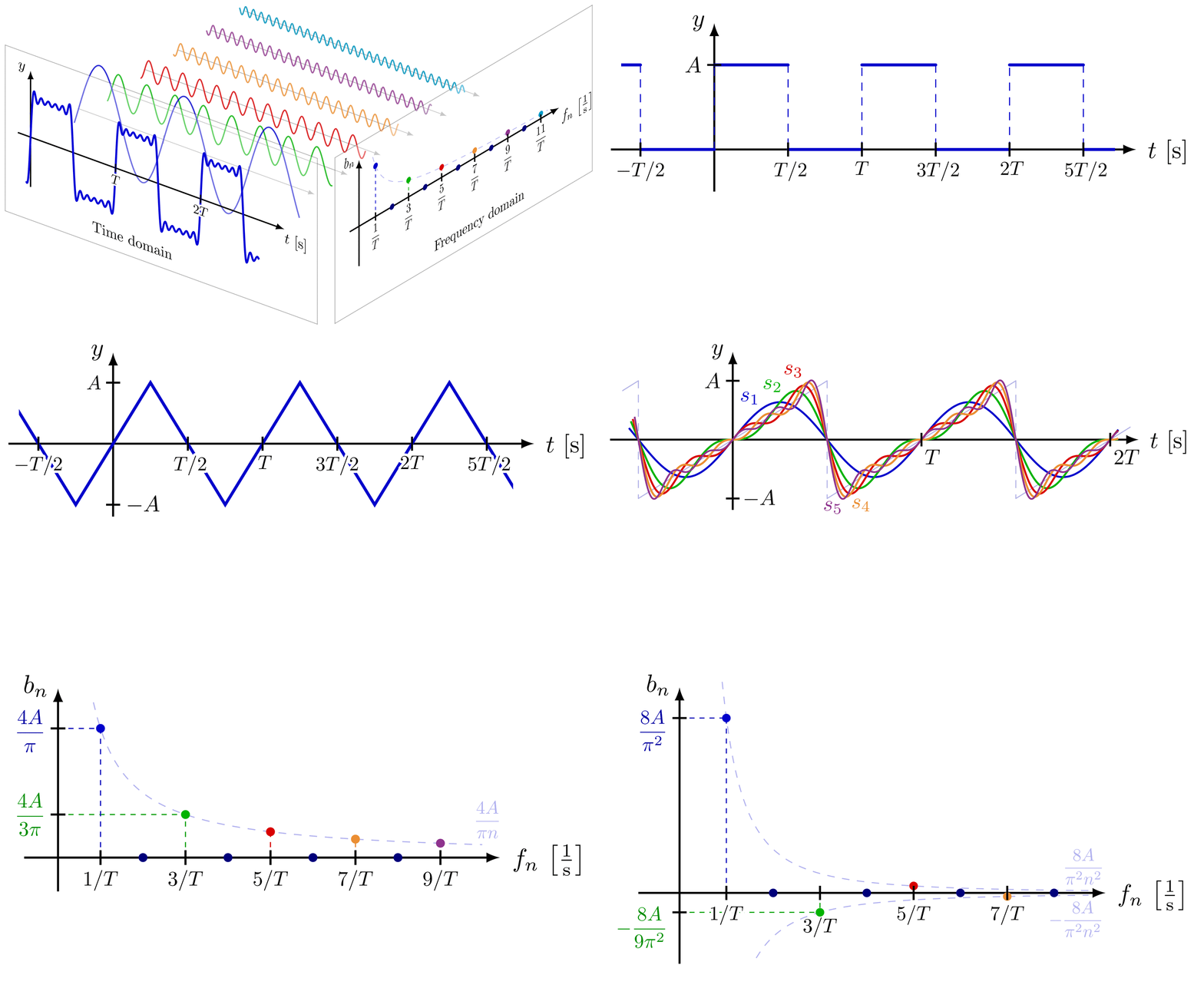
Fourier analysis lets you decompose any complex periodic function into a sum of simple sine and cosine waves. In solid state physics, this is how you move between a real-space picture of a crystal and its reciprocal-space description, connecting atomic arrangements to diffraction patterns and electronic properties.
Fourier series representation
A periodic function with period matching the lattice can be written as an infinite sum of sinusoidal terms. Each term has a specific frequency (set by a reciprocal lattice vector), an amplitude, and a phase. In a crystal, this means you can express a periodic potential, an electron density, or a lattice vibration pattern as a sum over reciprocal lattice vectors :
where are the Fourier coefficients. The key idea: a complicated spatial pattern becomes a list of coefficients, one for each .
Fourier transforms vs Fourier series
- Fourier series apply to functions that repeat periodically. You get a discrete set of frequency components (one per reciprocal lattice vector).
- Fourier transforms extend this to non-periodic (aperiodic) functions, producing a continuous spectrum of frequencies.
In crystallography, you use Fourier series for anything with the periodicity of the lattice (like the crystal potential). You use Fourier transforms when dealing with finite objects, like a single unit cell's electron density or an aperiodic defect.
Complex exponential form
Fourier series are most naturally written using complex exponentials rather than separate sines and cosines. This form is more compact and makes the math far cleaner. Each complex exponential encodes both amplitude and phase in a single complex coefficient :
- gives the amplitude
- gives the phase
Negative and positive vectors together reproduce the real-valued function when .
Amplitude and phase spectra
The full set of Fourier coefficients splits into two pieces of information:
- Amplitude spectrum: the magnitude of each component, telling you how strongly that spatial frequency contributes.
- Phase spectrum: the phase angle of each , telling you where the wave crests sit relative to the origin.
Both are needed to reconstruct the original function. In X-ray crystallography, detectors measure intensities (proportional to ), but the phase information is lost. This is the famous phase problem in crystallography.
Periodic structures and lattices
Crystals are defined by long-range periodic order. Lattices give you the mathematical scaffolding to describe that periodicity, and Fourier analysis is the tool that connects lattice geometry to measurable physical quantities.
Bravais lattices in crystals
A Bravais lattice is an infinite array of discrete points generated by a set of primitive translation vectors . Every lattice point is reached by:
where are integers. There are exactly 14 distinct Bravais lattice types in 3D, classified by their symmetry. Common examples: simple cubic (SC), body-centered cubic (BCC), and face-centered cubic (FCC).
Lattice with a basis
Most real crystals aren't just single atoms sitting on Bravais lattice points. A basis is the set of atoms you attach to each lattice point. The full crystal structure = Bravais lattice + basis.
- Diamond: FCC lattice with a two-atom basis (atoms at and )
- NaCl: FCC lattice with a two-atom basis (Na and Cl offset by half a lattice constant along one axis)
This distinction matters for Fourier analysis because the basis directly determines the structure factor, which controls which diffraction peaks appear and how strong they are.
Real space vs reciprocal space
- Real space: the physical space where atoms sit, described by lattice vectors .
- Reciprocal space: the Fourier-transformed counterpart, described by reciprocal lattice vectors .
The reciprocal lattice vectors satisfy . Each reciprocal lattice vector is perpendicular to a family of real-space lattice planes, and its magnitude is , where is the interplanar spacing. Reciprocal space is where diffraction patterns and band structures live.

Brillouin zones in reciprocal space
A Brillouin zone is the Wigner-Seitz cell of the reciprocal lattice. It's the region of reciprocal space closer to the origin than to any other reciprocal lattice point.
- The first Brillouin zone contains all unique wave vectors you need to describe waves in the crystal (everything else is related by a reciprocal lattice vector).
- Its boundaries correspond to Bragg planes, where diffraction conditions are satisfied.
- Electronic band structures and phonon dispersion curves are conventionally plotted within the first Brillouin zone.
Fourier analysis of periodic structures
This is where the math meets the physics. You take a periodic quantity in a crystal, expand it in a Fourier series over reciprocal lattice vectors, and extract the coefficients that determine measurable properties.
Fourier series for periodic potentials
The potential energy experienced by an electron in a crystal has the same periodicity as the lattice: for any lattice vector . You expand it as:
The Fourier coefficients encode the strength of the potential at each reciprocal lattice vector. These coefficients directly determine how energy bands split at zone boundaries. A large means a large band gap at the corresponding Bragg plane.
Fourier coefficients and structure factors
The structure factor connects the atomic arrangement in the unit cell to the Fourier coefficients. For a unit cell with atoms at positions and atomic form factors :
- is generally complex, carrying both amplitude and phase.
- If for some , the corresponding diffraction peak vanishes. These are called systematic absences (or extinction rules). For example, BCC lattices have when is odd.
- The measured diffraction intensity is proportional to .
Fourier transforms of Bravais lattices
The Fourier transform of a Bravais lattice (a sum of delta functions at all lattice points ) is itself a set of delta functions, but located at reciprocal lattice points :
This is a central result. It tells you that a perfect infinite lattice in real space produces sharp, discrete spots in reciprocal space, which is exactly what you see in a diffraction experiment on a well-ordered crystal.
Fourier transforms of lattices with a basis
When the crystal has a basis, the Fourier transform factorizes:
The lattice part gives you delta functions at each (determining where diffraction peaks appear), and the structure factor modulates their intensities (determining how bright each peak is, or whether it appears at all). This factorization is why the structure factor is so important: it's the bridge between the geometry of the basis and the observed diffraction pattern.
Applications of Fourier analysis
X-ray diffraction and Bragg's law
X-ray diffraction is the primary experimental technique for determining crystal structures. Bragg's law gives the condition for constructive interference:
where is the X-ray wavelength, is the interplanar spacing, is the diffraction angle, and is an integer.
The diffraction pattern is the Fourier transform of the electron density . In principle, if you could measure both the amplitudes and phases of all diffracted beams, you could invert the Fourier transform to reconstruct directly. In practice, you measure only intensities (), so the phase must be recovered by other methods (direct methods, Patterson methods, etc.).
Electron diffraction in crystals
Electron diffraction works on the same Fourier-transform principle, but electrons interact with the electrostatic potential rather than the electron density. Because electrons interact much more strongly with matter than X-rays do, electron diffraction is useful for thin films and surfaces. The diffraction pattern is the Fourier transform of the crystal potential, and its analysis follows the same structure-factor formalism.
Phonon dispersion relations
Phonons are quantized lattice vibrations. To find the phonon dispersion relation , you:
- Write the equations of motion for atoms in the crystal, using interatomic force constants.
- Assume plane-wave solutions with wave vector (this is a Fourier decomposition of the atomic displacements).
- Construct the dynamical matrix , whose elements are Fourier transforms of the force constants.
- Diagonalize to find the eigenfrequencies .
The resulting dispersion curves, plotted along high-symmetry directions in the first Brillouin zone, reveal acoustic and optical branches. These determine thermal conductivity, specific heat, and other thermodynamic properties.
Band structure calculations
The electronic band structure describes allowed electron energies as a function of wave vector. Fourier analysis enters through the nearly free electron model and more generally through plane-wave expansion methods:
- Express the periodic potential as a Fourier series: .
- Expand the electron wavefunction in plane waves: .
- Substitute into the Schrödinger equation to get a matrix eigenvalue problem coupling different components.
- Solve for the eigenvalues and eigenvectors (the coefficients ).
The Fourier coefficients control the size of band gaps at zone boundaries. Larger means a larger gap. This framework underpins modern computational methods like the pseudopotential method and density functional theory (DFT) plane-wave codes.
Computational methods
Fast Fourier Transform (FFT) algorithms
The FFT is an algorithm that computes the discrete Fourier transform of data points in operations instead of the naive . For a typical calculation with grid points, that's roughly a factor of 50 speedup. FFTs are essential in plane-wave DFT codes, where you constantly switch between real-space and reciprocal-space representations of charge densities and potentials.
Discrete Fourier Transform (DFT)
The Discrete Fourier Transform (not to be confused with Density Functional Theory, which shares the same acronym) converts a finite, sampled sequence into its frequency components. For a sequence of values :
This is the computational workhorse behind structure factor calculations, numerical band structures, and phonon calculations. The FFT is simply a fast algorithm for evaluating this sum.
Numerical Fourier analysis of periodic structures
In practice, you work with finite grids and discrete sampling. Typical steps:
- Define the crystal potential or electron density on a real-space grid within the unit cell.
- Apply a 3D FFT to obtain Fourier coefficients at reciprocal lattice points.
- Use these coefficients in the Schrödinger equation (for band structures) or in the dynamical matrix (for phonons).
- Inverse-FFT back to real space when needed (e.g., to compute forces or charge densities).
The accuracy depends on the grid density (the plane-wave energy cutoff), and convergence testing is a standard part of any calculation.
Fourier filtering and image processing
Fourier filtering manipulates data in reciprocal space to enhance or suppress certain spatial frequencies. In solid state physics, this is used to:
- Remove noise from experimental diffraction patterns or microscopy images
- Isolate periodic features in STM or AFM images of crystal surfaces
- Enhance contrast for specific lattice periodicities
The process involves transforming the image to reciprocal space, applying a filter (e.g., keeping only frequencies near expected Bragg peaks), and transforming back. This is a standard post-processing step in surface science experiments.
See Fiveable more often in Google
Mark Fiveable as a preferred source and Google is more likely to show you our guides in Top Stories, with a "preferred" badge in AI Mode and AI Overviews.