3.5 Anharmonic effects

⚛️Solid State Physics Unit 3 Review
3.5 Anharmonic effects
⚛️ Solid State Physics
Anharmonic potential energy
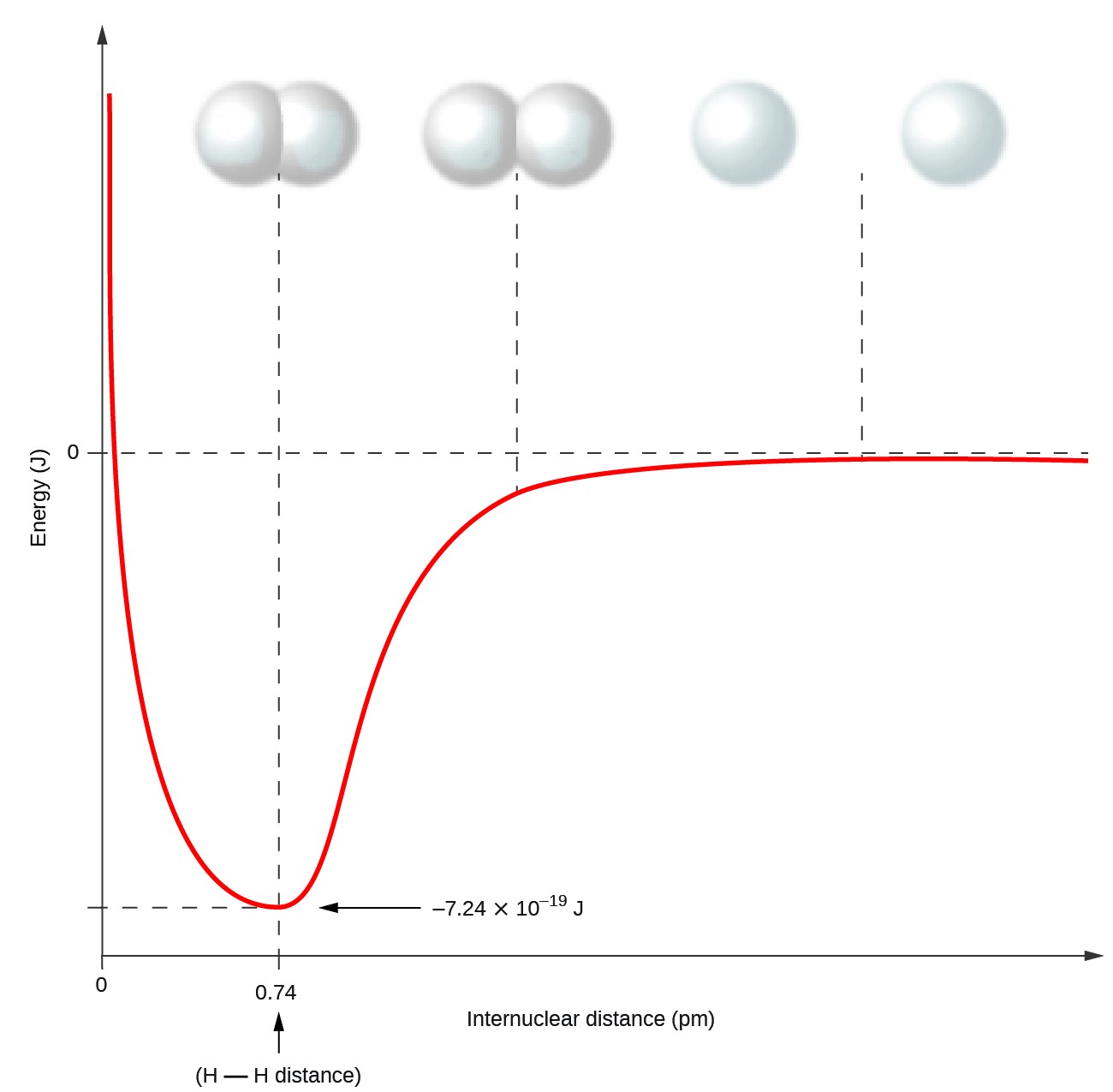
The harmonic approximation treats atoms in a crystal as if they sit in perfectly symmetric potential wells with equally spaced energy levels. Real interatomic potentials aren't symmetric, though. The repulsive wall at short distances is much steeper than the attractive side at large distances. Anharmonic effects capture this asymmetry and its consequences: thermal expansion, phonon-phonon interactions, finite thermal conductivity, and multiphonon absorption. Without anharmonicity, you couldn't explain why materials expand when heated or why thermal conductivity drops at high temperatures.
Morse potential
The Morse potential models a diatomic interaction more realistically than a simple parabola. It accounts for the fact that bonds can dissociate at large separations and that the potential well is asymmetric.
- is the well depth (dissociation energy measured from the minimum)
- controls the width of the well (larger means a narrower, stiffer well)
- is the equilibrium bond distance
At small displacements from , the Morse potential looks nearly parabolic (harmonic). At larger displacements, the asymmetry becomes clear: the energy rises steeply for compression () but levels off toward for extension ().
Deviation from harmonic approximation
The harmonic approximation keeps only the quadratic term in the Taylor expansion of the potential about equilibrium. Anharmonicity means including higher-order terms:
where is the displacement from equilibrium.
These extra terms produce several measurable effects:
- Energy levels are no longer equally spaced. The spacing decreases at higher vibrational quantum numbers.
- The equilibrium position shifts with increasing vibrational amplitude, because the cubic term makes the potential softer on one side.
- Vibrational frequency depends on amplitude: larger amplitudes sample the shallower part of the well, lowering the effective frequency.
The cubic () term is the leading source of thermal expansion and three-phonon scattering. The quartic () term contributes to four-phonon processes and further frequency renormalization.
Thermal expansion
In a perfectly harmonic crystal, the average atomic position stays at the equilibrium site regardless of temperature. Thermal expansion is a purely anharmonic effect.
Asymmetric interatomic potential
Because the repulsive wall is steeper than the attractive tail, the potential is asymmetric about its minimum. As temperature rises and atoms vibrate with larger amplitude, they explore more of the shallow attractive side than the steep repulsive side. The time-averaged position therefore shifts outward to larger interatomic distances. This net outward shift, summed over all atom pairs, produces macroscopic expansion.
Volume vs temperature
For modest temperature changes, volume increases linearly with temperature:
where is the volume at reference temperature and is the volumetric thermal expansion coefficient. At higher temperatures, higher-order anharmonic contributions cause deviations from this linear relationship.
Linear and volume expansion coefficients
- Linear expansion coefficient: , describing fractional length change per kelvin.
- Volume expansion coefficient: , describing fractional volume change per kelvin.
For an isotropic material expanding equally in all three directions, . This follows directly from differentiating and keeping only first-order terms. For anisotropic crystals, you need to sum the linear coefficients along each crystallographic axis.

Phonon-phonon interactions
In the harmonic picture, phonons are independent normal modes that never exchange energy. Anharmonic terms couple these modes, allowing phonons to scatter off each other. This is the dominant mechanism limiting thermal conductivity in pure crystals at elevated temperatures.
Cubic and quartic terms
- Cubic terms () enable three-phonon processes: two phonons merge into one, or one phonon decays into two. These are the lowest-order anharmonic scattering events and the primary source of thermal resistance in most solids above the Debye temperature.
- Quartic terms () enable four-phonon processes. These are generally weaker but can become significant in materials where three-phonon scattering is suppressed by symmetry or where temperatures are very high.
Normal and umklapp processes
Three-phonon scattering comes in two flavors, distinguished by momentum conservation:
- Normal (N) processes: . Total crystal momentum is conserved. These redistribute phonons among modes but don't directly resist heat flow, because the net momentum of the phonon distribution is unchanged.
- Umklapp (U) processes: , where is a nonzero reciprocal lattice vector. The resulting phonon can point in a very different direction from the original two, effectively reversing part of the heat current. Umklapp processes are the main source of intrinsic thermal resistance.
Umklapp processes require at least one phonon with a wavevector near the Brillouin zone boundary so that the sum falls outside the first zone. At low temperatures, few such high- phonons are thermally populated, so umklapp scattering freezes out exponentially. At high temperatures, plenty of zone-boundary phonons exist, and umklapp scattering dominates.
Phonon scattering and lifetimes
Phonon-phonon scattering gives each phonon mode a finite lifetime , the average time before it scatters. The phonon mean free path is:
where is the group velocity of that phonon mode. Shorter lifetimes mean shorter mean free paths and lower thermal conductivity. Both and decrease with rising temperature (more scattering partners available) and with stronger anharmonicity.
Thermal conductivity
The kinetic theory expression for lattice thermal conductivity is:
where is the volumetric heat capacity, is an average phonon velocity, and is the mean free path. Anharmonic scattering controls in pure crystals, making it the key factor in the temperature dependence of .
Phonon mean free path
The mean free path depends on phonon frequency, temperature, and anharmonic coupling strength. At low temperatures, can be very long (limited mainly by sample boundaries or defects rather than phonon-phonon scattering). As temperature increases and umklapp scattering intensifies, shrinks, pulling down.
Thermal resistivity vs temperature
Thermal resistivity shows characteristic behavior across temperature:
- Low temperatures: grows rapidly (as in the Debye model), and phonon-phonon scattering is weak. Thermal conductivity rises steeply; resistivity drops.
- Intermediate temperatures: reaches a peak (resistivity reaches a minimum). The heat capacity is approaching saturation, but umklapp scattering is becoming significant.
- High temperatures: Umklapp scattering dominates. The mean free path decreases roughly as , so and resistivity grows linearly with .
Umklapp process dominance
At high temperatures (above roughly the Debye temperature ), the phonon population at the zone boundary scales linearly with . This makes the umklapp scattering rate proportional to , giving and thus . This dependence is a hallmark of intrinsic anharmonic thermal resistance and sets an upper bound on the lattice thermal conductivity achievable in any material at a given temperature.
Multiphonon absorption
Single-phonon (one-phonon) absorption involves one photon creating one phonon. Multiphonon absorption involves a single photon exciting two or more phonons simultaneously. This process is enabled by anharmonic coupling and by higher-order terms in the electric dipole moment expansion. It gives access to phonon combinations that single-phonon spectroscopy can't probe.
Overtones and combination bands
- Overtones: A photon excites multiple phonons of the same branch and wavevector. The first overtone involves two phonons (appearing near twice the fundamental frequency), the second overtone involves three, and so on. Each successive overtone is weaker because it requires a higher-order anharmonic coupling.
- Combination bands: A photon simultaneously excites phonons from different branches or at different wavevectors. These bands reveal how different phonon modes couple through anharmonicity and can appear at the sum or difference of fundamental frequencies.
Infrared and Raman spectroscopy
Both techniques detect multiphonon processes, but through different mechanisms:
- Infrared (IR) spectroscopy measures direct photon absorption. Multiphonon features show up as weak absorption bands at frequencies above the highest single-phonon (Reststrahlen) band. Their intensity is much lower than fundamental absorptions because they rely on anharmonic coupling.
- Raman spectroscopy measures inelastic light scattering. Multiphonon contributions appear as higher-order peaks shifted from the laser frequency by sums or differences of phonon frequencies. Selection rules differ from IR, so the two techniques are complementary.
Frequency shifts and line broadening
Anharmonicity affects the spectral features of multiphonon bands in two ways:
- Frequency shifts: Overtone and combination band frequencies don't land exactly at integer multiples or sums of fundamental frequencies. Anharmonic corrections shift them slightly, typically to lower frequencies. The magnitude of the shift is a direct measure of the anharmonic coupling strength.
- Line broadening: Finite phonon lifetimes (from phonon-phonon scattering) broaden absorption lines. Stronger anharmonicity means shorter lifetimes and broader lines. Multiphonon bands are inherently broader than fundamental modes because each participating phonon contributes its own lifetime broadening.
See Fiveable more often in Google
Mark Fiveable as a preferred source and Google is more likely to show you our guides in Top Stories, with a "preferred" badge in AI Mode and AI Overviews.