5.8 Karl Marx

🥽Literary Theory and Criticism Unit 5 Review
5.8 Karl Marx
🥽 Literary Theory and Criticism
Karl Marx's ideas revolutionized literary criticism by centering economic forces and class struggle as the key shapers of human experience. His materialist approach treats literature not as a purely creative act, but as something deeply tied to class relations and the conditions under which things are produced and consumed.
Marxist literary criticism asks how texts reflect, reinforce, or challenge the dominant ideologies and power structures of their time. It explores literature's role in either promoting false consciousness or raising class awareness and inspiring social change.
Philosophical foundations of Marxism
Marxism is a philosophical, economic, and political theory developed by Karl Marx and Friedrich Engels in the 19th century. It offers a materialist analysis of history, society, and culture, placing economic forces and class struggle at the center of human experience. This philosophy provides the foundation for Marxist literary criticism, which reads literature through the lens of class relations and material conditions of production.
Dialectical materialism
Dialectical materialism is the philosophical method underpinning Marxist thought. It fuses two ideas:
- Dialectics: progress occurs through the conflict and resolution of opposing forces
- Materialism: material reality (not ideas or spirit) is the primary driver of social and historical development
The dialectical process works like this: a thesis (an existing state of affairs) encounters its antithesis (an opposing force), and their conflict eventually produces a synthesis, a new condition that incorporates elements of both. This cycle repeats, driving historical progress and social transformation forward.
Historical materialism
Historical materialism applies dialectical materialism to the study of history and society. Its core claim is that the development of human societies is determined primarily by their material and economic conditions, not by ideas or the actions of great individuals.
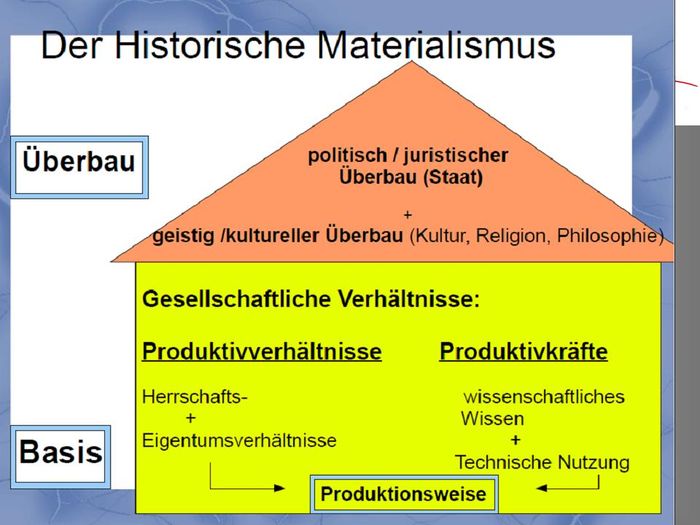
The mode of production (how a society produces and distributes goods) shapes that society's political, legal, and cultural institutions. When the mode of production changes, the social and political structure shifts with it, which in turn influences the development of ideas and culture.
Critique of idealism
Marxist philosophy stands in direct opposition to idealism, the view that ideas and consciousness are the primary determinants of reality. Marx and Engels argued that idealism gets the relationship backwards: ideas don't shape material conditions; material conditions shape ideas.
They specifically targeted Hegelian idealism for treating ideas as autonomous forces that drive history. For Marxists, correcting this inversion is essential. You can't understand social reality or develop strategies for change if you mistake effects (ideas) for causes (material conditions).
Marxist theory of history
The Marxist theory of history provides a materialist framework for understanding how human societies develop and what drives historical change. According to this theory, economic and material conditions are the primary determinants, not ideas, beliefs, or the will of individuals.
Base vs superstructure
This is one of the most important concepts in Marxist thought. Marx distinguishes between two layers of society:
- Base (economic foundation): the mode of production and the relations of production (who owns what, who works for whom)
- Superstructure: the political, legal, and cultural institutions that arise from the economic base (government, law, religion, art, literature)
The base determines the character of the superstructure. When the base changes, the superstructure eventually follows. The transition from feudalism to capitalism, for instance, brought corresponding changes in political systems, legal frameworks, and cultural values. The superstructure can influence the base in return, but Marxists maintain that the base is ultimately the primary driver.
Means of production
The means of production are the physical and technological resources used to produce goods and services: land, factories, machines, raw materials, and so on. Who owns and controls these resources is central to understanding class structure and power.
In capitalist societies, the bourgeoisie (ruling class) privately owns the means of production, while the proletariat (working class) must sell its labor to survive. This concentration of productive resources in the hands of a small class is, for Marx, the root of exploitation and inequality.
Class struggle as driving force
Class struggle is the conflict between social classes over control of the means of production and the distribution of wealth. Marx and Engels famously declared that "the history of all hitherto existing societies is the history of class struggles," from ancient conflicts between slaves and slave-owners to the modern struggle between bourgeoisie and proletariat.
The resolution of class struggle, through the overthrow of the ruling class and the establishment of a classless society, is the ultimate goal of Marxist revolutionary politics. In literary criticism, class struggle often surfaces as a central theme, reflecting the social and political conflicts of the period in which a work was written.
Marxist literary criticism
Marxist literary criticism focuses on the relationship between literary works and the social, economic, and political conditions in which they were produced. It examines how literature reflects, reinforces, or challenges the dominant ideologies and power structures of a society. Marxist critics analyze how the material conditions of a work's production and reception shape its content and form, and how the work contributes to either reproducing or transforming social relations.
Literature as reflection of society
Marxist critics argue that literature is not an autonomous realm of creative expression but a product of specific social and historical conditions. Literary works reflect the values, beliefs, and conflicts of the society that produced them, often in ways that aren't immediately obvious.
By analyzing a work's social and historical context, Marxist critics seek to uncover hidden ideological messages and power relations embedded in its content and form. A Marxist reading of Charles Dickens' Hard Times, for example, would focus on how the novel reflects the social and economic inequalities of Victorian England and critiques the dehumanizing effects of industrial capitalism.
Art and class consciousness
Class consciousness is the awareness of one's position within the class structure and the recognition of shared interests and struggles with others in the same class. Marxist critics are interested in how literature can develop this awareness.
Works that expose the contradictions and injustices of capitalist society, or that give voice to working-class experiences and aspirations, are seen as potentially revolutionary. Marxist critics often celebrate proletarian literature that directly addresses working-class concerns, such as the novels of Maxim Gorky or the poetry of Vladimir Mayakovsky. At the same time, they recognize that literature can also reinforce dominant ideologies by presenting a distorted or incomplete picture of social reality.
Revolutionary potential of literature
For Marxist critics, the goal of literary analysis goes beyond interpretation. Literature is a potential tool for raising class consciousness, inspiring revolutionary action, and imagining alternative social arrangements.
Marxist critics often focus on subversive or oppositional elements within texts: moments of resistance, critique, or utopian vision that point toward the possibility of change. Crucially, the revolutionary potential of literature doesn't reside in the text alone. It depends on how readers and critics interpret, appropriate, and mobilize the work in the context of ongoing social and political struggles.
Ideology and false consciousness
Ideology, in the Marxist sense, is the system of ideas, beliefs, and values that shapes how individuals perceive reality and their place within society. Marxist critics argue that ideology is never neutral. It's a distorted and partial view that serves the interests of the dominant class.
False consciousness, a concept developed by Georg Lukács, describes how ideology leads individuals to accept and internalize the dominant values of their society, even when those values work against their own interests. A factory worker who believes the wealthy deserve their wealth because they "worked harder" would be an example of false consciousness at work.
Dominant vs subordinate ideologies
Any society contains multiple competing ideologies, but one tends to dominate, reflecting the interests and worldview of the ruling class. Subordinate ideologies, such as those of the working class or oppressed groups, may challenge the dominant ideology but are often marginalized or suppressed by institutions of power.
Marxist critics examine how literary works reflect and reinforce the dominant ideology, and how they may give voice to subordinate or oppositional perspectives. A Marxist reading of Jane Austen's novels, for instance, might analyze how they reflect the values and assumptions of the English landed gentry while marginalizing or erasing lower-class perspectives.
Literature's role in promoting ideology
Literature is a powerful tool for shaping ideas, values, and beliefs. Literary works can naturalize the dominant ideology, presenting it as common sense, inevitable, or universally valid. Through narrative structure, characterization, and imagery, texts encode ideological messages that shape how readers perceive reality.
A Marxist analysis of the Western genre, for example, might examine how these novels and films promote individualism, expansionism, and the myth of the frontier while erasing the violence and exploitation of westward expansion.
Strategies for resisting false consciousness
Marxist critics have identified several strategies through which literature can challenge or subvert dominant ideology:
- Defamiliarization (estrangement): making the familiar seem strange or alien, breaking through the naturalized assumptions of ideology so readers see social arrangements as constructed rather than inevitable
- Dialectical irony: juxtaposing conflicting perspectives or ideas to reveal underlying tensions and contradictions in the social order
- Critical reading practices: actively interrogating the ideological assumptions and power relations embedded in literary texts, rather than passively consuming them as entertainment
Marxist aesthetics
Marxist aesthetics examines the relationship between art and politics, and the ways in which artistic form and content reflect and shape social reality. Marxist critics reject the idea of "art for art's sake," arguing that all art is inherently political and ideological, whether explicitly or not. The key debates in Marxist aesthetics center on realism, modernism, the avant-garde, and the role of art in the struggle for emancipation.
Realism vs modernism debate
This debate was a defining issue in Marxist aesthetics during the early 20th century, and it split along these lines:
- Realism (championed by Georg Lukács): Literature should provide a truthful, comprehensive representation of social reality to expose the contradictions and injustices of capitalism. Accessible, narrative-driven forms best serve this purpose.
- Modernism (championed by Bertolt Brecht and Walter Benjamin): Traditional realism can't adequately represent the fragmented, alienated experience of modern life. New artistic forms are needed to shock and provoke audiences into critical reflection.
The debate reflected deeper tensions within Marxist theory between the need for accessible, popular art and the desire for radical experimentation.
Form and content in Marxist criticism
Marxist critics pay close attention to the relationship between form (aesthetic and structural elements like language, style, genre, and narrative technique) and content (thematic and ideological messages).
These aren't treated as separate categories. Form and content are dialectically related: each shapes the other. The choice of literary form is itself political. Choosing realism versus modernist fragmentation, for instance, reflects the author's stance toward social reality and the possibilities for change.

Avant-garde and political art
The avant-garde refers to the radical, experimental edge of artistic production. Avant-garde movements like Surrealism and Constructivism sought to break with traditional forms and conventions, creating new modes of perception that could challenge dominant ideology.
Marxist critics have debated the effectiveness of avant-garde art as a political tool. Some argue it risks becoming elitist or self-referential, accessible only to a small intellectual audience. Others see it as a necessary complement to more popular forms of political art. This tension between artistic autonomy and political engagement remains unresolved in Marxist aesthetics.
Key Marxist literary critics
Several major thinkers have shaped Marxist literary criticism, each bringing distinct emphases while sharing a commitment to the Marxist project of social and cultural transformation.
Georg Lukács
Georg Lukács (1885–1971) was a Hungarian Marxist philosopher and literary critic who played a central role in developing Marxist aesthetics. He's best known for his theory of realism, which he championed against modernist and avant-garde movements.
Lukács argued that literature's task was to provide a truthful, comprehensive representation of social reality, exposing capitalism's contradictions. He valued the 19th-century realist novel (Balzac, Tolstoy) for its ability to capture the totality of social relations. His emphasis on literature's cognitive and educational function has been deeply influential, even though his specific judgments about which works succeed or fail have been widely debated and revised.
Walter Benjamin
Walter Benjamin (1892–1940) was a German Jewish philosopher and cultural critic whose work profoundly influenced Marxist and post-Marxist theories of literature and art. He's known for his concept of the "aura" of the work of art, which he argued was being eroded by technologies of mechanical reproduction like photography and film.
Rather than lamenting this loss, Benjamin saw it as opening new possibilities. Art could become more accessible and reproducible, breaking down traditional distinctions between high and low culture. This erosion of the aura created conditions for the politicization of art, turning it from an object of reverence into a tool for critical engagement.
Theodor Adorno
Theodor Adorno (1903–1969) was a German philosopher and sociologist, and a leading figure in the Frankfurt School of critical theory. His work focused on how aesthetic form and cultural production are shaped by the contradictions of modern capitalism.
Adorno is best known for his critique of the culture industry: the mass media and entertainment apparatus that pacifies audiences by providing standardized, repetitive forms of distraction. Rather than encouraging critical thought, the culture industry integrates people into the dominant ideology. Adorno argued for autonomous, difficult art forms that resist easy consumption, a position that put him at odds with Benjamin's more optimistic view of mass culture.
Fredric Jameson
Fredric Jameson (born 1934) is an American literary critic and political theorist who has been a leading figure in Marxist and post-Marxist cultural studies. He's known for his concept of "cognitive mapping", which he sees as the essential task of art and criticism in the era of late capitalism.
Jameson argues that globalization and postmodernism have made social reality so complex and fragmented that individuals struggle to locate themselves within the totality of social relations. Art and criticism must help people grasp these larger structures. His writings on postmodernism, the dialectic of utopia and ideology, and the need for renewed Marxist cultural critique have been influential in contemporary debates about literature's role in struggles for social justice.
Marxist approaches to specific genres
Marxist literary criticism has developed specific approaches to different literary genres, grounded in their historical and social contexts of production and reception. By examining the social and political functions of specific genres, Marxist critics deepen our understanding of the relationships between literature, culture, and society.
The realist novel
The realist novel, which emerged as a dominant literary form in the 19th century, has been a central focus of Marxist criticism. Critics have analyzed how realist novels by writers like Balzac, Dickens, and Tolstoy provide detailed representations of social reality, exposing the contradictions and conflicts of bourgeois society.
At the same time, Marxist critics have noted the limitations of realism. It can present a naturalized, even idealized view of social relations, failing to capture the more radical and transformative dimensions of human experience. Marxist approaches to the realist novel emphasize situating these works within their historical contexts and examining how they both reflect and shape the dominant ideologies of their time.
Epic theater of Bertolt Brecht
Bertolt Brecht's epic theater is a key reference point for Marxist debates about art's political role. Brecht developed a theory and practice of theater that broke with the conventions of bourgeois realism and naturalism, aiming to create a more critical and engaged form of spectatorship.
His central technique was the Verfremdungseffekt (alienation effect or estrangement effect), which deliberately distances the audience from the action on stage. Instead of becoming emotionally absorbed in the story, viewers are prompted to think critically about what they're watching and to recognize the social forces at work. Techniques included actors breaking the fourth wall, visible stage machinery, and songs that interrupted the narrative. The goal was to prevent passive consumption and encourage audiences to see social conditions as changeable rather than natural or inevitable.
See Fiveable more often in Google
Mark Fiveable as a preferred source and Google is more likely to show you our guides in Top Stories, with a "preferred" badge in AI Mode and AI Overviews.