4.8 Jacques Lacan

🥽Literary Theory and Criticism Unit 4 Review
4.8 Jacques Lacan
🥽 Literary Theory and Criticism
Jacques Lacan's psychoanalytic theory reworked Freud's ideas by placing language at the center of how the unconscious operates. His concepts give literary critics a vocabulary for analyzing how texts produce meaning, stage desire, and reveal the instability of identity. This section covers Lacan's three orders, the mirror stage, his theory of language and desire, the split subject, and how these ideas apply to reading literature.
Lacan's Psychoanalytic Theory
Lacan's project was, in his own words, a "return to Freud." He believed that mainstream psychoanalysis after Freud had drifted toward ego psychology, focusing on helping patients adapt to social norms rather than confronting the radical implications of the unconscious. Lacan wanted to recover what he saw as the most subversive insight in Freud: that the unconscious disrupts any stable sense of self.
Influence of Freud
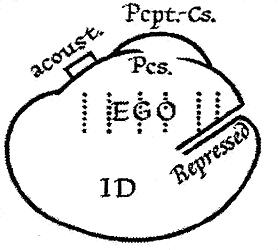
Lacan kept Freud's core framework: the unconscious, repression, the Oedipus complex, and the tripartite psyche (id, ego, superego). He also retained Freud's emphasis on early childhood as formative and on sexuality as central to psychic life. But Lacan didn't just repeat Freud. He filtered these ideas through structural linguistics, anthropology (especially Claude Lévi-Strauss), and philosophy to produce something distinctly his own.
Revisions of Freudian Concepts
The biggest shift Lacan made was reinterpreting the Oedipus complex. Where Freud emphasized sexual rivalry and identification with the father, Lacan reframed it as the child's entry into the Symbolic order, the world of language and cultural rules. The father figure matters not as a biological person but as a representative of cultural law and prohibition.
Lacan also redefined the unconscious. For Freud, the unconscious was a reservoir of repressed wishes. For Lacan, "the unconscious is structured like a language." This single claim reshapes everything: symptoms, dreams, and slips of the tongue all follow the logic of linguistic operations like metaphor and metonymy.
The Three Orders
Lacan organizes human experience around three interrelated registers: the Imaginary, the Symbolic, and the Real. These aren't developmental stages you pass through and leave behind. They operate simultaneously throughout life, and their interplay shapes how you experience yourself and the world.
The Imaginary
The Imaginary is the realm of images, identifications, and the ego. It emerges during the mirror stage (covered below) and is characterized by:
- Identification with images of wholeness and coherence
- Binary oppositions and rivalries (self vs. other, love vs. hate)
- Misrecognition: the ego mistakes an image for the true self
The Imaginary gives you the comforting illusion that you're a unified, autonomous person. But that illusion is built on a fundamental error.
The Symbolic
The Symbolic is the order of language, law, and social structures. When you learn to speak, you enter a pre-existing system of rules and differences that you didn't create and can't fully control. Key features:
- Governed by what Lacan calls the Name-of-the-Father (or Law of the Father), representing cultural prohibitions and the structure of authority
- Introduces lack and desire: once you enter language, you can never fully say what you mean, and something is always lost in translation
- Structures the unconscious, determining the possibilities and limits of identity
The Symbolic order is where meaning happens, but it's also where meaning becomes unstable.
The Real
The Real is the hardest of the three orders to grasp, partly by definition. It's whatever resists being captured in language or images. You can't represent it directly; it shows up only as gaps, disruptions, and moments of trauma that break through the Symbolic and Imaginary.
Think of it this way: the Symbolic gives you words, the Imaginary gives you images, and the Real is everything that escapes both. It's associated with anxiety, the uncanny, and traumatic encounters that can't be processed or made sense of. The Real is a constant reminder that language and identity are never complete.
The Mirror Stage
The mirror stage is one of Lacan's most well-known concepts. It describes a formative moment, occurring roughly between 6 and 18 months of age, when an infant first recognizes its reflection in a mirror (or in the responses of a caregiver).
Formation of the Ego
The infant's actual bodily experience is one of fragmentation and lack of motor coordination. But the mirror image presents a unified, whole figure. The child identifies with this image and takes it as itself. This identification produces the ego, which Lacan sees not as the rational core of the person but as a fictional construct built on misrecognition.
Misrecognition and Alienation
The key point: the ego is founded on a mistake. The child identifies with something external (an image) and treats it as internal (its true self). This creates a permanent split in the subject. You're always caught between the image of wholeness the ego offers and the underlying experience of fragmentation and dependence.
This split doesn't go away. It sets up a lifelong dynamic of seeking wholeness through identification with external images, other people, and ideals, none of which can actually deliver the completeness they promise.
Implications for Subjectivity
The mirror stage establishes several dynamics that persist throughout life:
- Identification: the tendency to form your sense of self through images and others
- Rivalry and aggression: because the other person can seem to possess the wholeness you lack
- The groundwork for entering the Symbolic: the child's sense of lack prepares it for the world of language and desire

The Role of Language
Language isn't just a tool for communication in Lacan's theory. It's the structure that shapes the unconscious and determines how you experience reality.
Language and the Unconscious
Lacan's famous claim that "the unconscious is structured like a language" means the unconscious operates through the same mechanisms as language. Metaphor (substitution of one signifier for another) corresponds to Freud's concept of condensation in dreams. Metonymy (the sliding of meaning along a chain of signifiers) corresponds to displacement.
Slips of the tongue, jokes, dreams, and symptoms all reveal the unconscious at work through these linguistic operations. The unconscious isn't a hidden depth; it's visible on the surface of speech, in the moments where language breaks down or says more than you intended.
The Signifier and the Signified
Lacan borrows from Saussure's distinction between the signifier (the sound-image of a word) and the signified (the concept it refers to). But where Saussure treated these as two sides of the same coin, Lacan insists on the primacy of the signifier. Signifiers don't passively represent pre-existing meanings. They actively produce meaning and shape the subject's experience.
The Sliding of the Signified
Because each signifier gets its meaning only through its difference from other signifiers, meaning is never fixed. It slides along the chain of signifiers, always deferred, never fully pinned down. Lacan represents this with the idea of a bar between signifier and signified that resists easy crossing.
This instability of meaning has direct consequences for desire: the thing you want is always just out of reach, displaced onto the next signifier in the chain. Language can never fully capture what you mean or what you want.
Desire and Lack
For Lacan, desire isn't the same as biological need (like hunger) or demand (like asking for food). Desire is what's left over after need is satisfied and demand is articulated. It's the surplus that language can never capture, and it drives the subject forward endlessly.
The Object a
The objet petit a (object small-a) is Lacan's term for the cause of desire. It's not a specific thing you can obtain. It's the forever-lost object that you believe would make you whole if only you could recover it. It can take various forms: the breast, the gaze, the voice, or any object that seems to promise completeness.
The crucial point is that the objet a is a structural position, not an actual object. No real object can fill the role. That's why desire keeps moving from one object to the next.
The Other vs. the other
Lacan makes a careful distinction between two kinds of "other":
- The Other (capital O): the Symbolic order itself, the entire system of language, law, and culture. The Other is also the site of the unconscious and the place from which the subject seeks recognition. When you speak, you're always addressing the Other, seeking validation that your words mean something.
- The other (lowercase o): the imaginary counterpart you encounter in the mirror stage and in everyday relationships. This is the rival, the double, the person who seems to have what you lack.
Desire as Insatiable
Desire can never be fully satisfied because its object (the objet a) is a fantasy, not something that exists in reality. Every apparent satisfaction reveals a new lack. This isn't a flaw in the system; it's how the system works. The subject's symptoms, repetitive behaviors, and fantasies are all ways of managing this structural insatiability.
Lacan's Theory of the Subject
The Split Subject
The Lacanian subject is not a unified self. It's split between the ego (the imaginary sense of coherence) and the unconscious (the symbolic structure of desire). This division is introduced at the mirror stage and deepened by entry into language. You are never fully identical with yourself.
The Subject of the Unconscious
The "true" subject, for Lacan, isn't the conscious ego that says "I." It's the subject that appears in the gaps of speech: in slips of the tongue, in the punchlines of jokes, in the strange logic of dreams. This subject of the unconscious is always in process, never fixed, shaped by the ongoing circulation of signifiers.
The Barred Subject
Lacan represents the split subject with the symbol (a capital S with a bar through it). The bar signifies the division between conscious and unconscious, the impossibility of complete self-knowledge, and the subject's dependence on the Other. The barred subject is a reminder that no one is fully transparent to themselves.
Lacanian Literary Analysis
Application to Literature
Lacanian theory gives critics a framework for reading texts as sites where the dynamics of desire, lack, and the unconscious play out. A Lacanian reading might examine:
- How a character's pursuit of an object stages the logic of the objet a
- How a narrative's gaps and contradictions reveal something like an unconscious structure
- How a text's language enacts the sliding of the signified, producing meanings that exceed or undermine the surface narrative
These readings work across genres and periods, from Shakespeare to contemporary fiction.
Lacanian Reading Strategies
A Lacanian approach to a text involves several moves:
- Attend to formal and rhetorical features: metaphor, metonymy, repetition, ambiguity, and wordplay are all potential sites where the unconscious of the text surfaces.
- Read the gaps: silences, contradictions, and moments where the text seems to say more (or less) than it intends are where Lacanian analysis does its most productive work.
- Track desire: identify what characters (or the text itself) seem to want, and notice how that desire shifts, is deferred, or is never satisfied.
- Examine subject positions: look at how characters are split, how their identities are constructed through identification and misrecognition, and how the Symbolic order constrains them.
Lacan and Poststructuralism
Lacan's emphasis on the instability of meaning, the decentered subject, and the primacy of language aligns his work closely with poststructuralism. Thinkers like Jacques Derrida, Julia Kristeva, and Slavoj Žižek have all engaged deeply with Lacanian concepts, sometimes extending them, sometimes challenging them.
Lacanian ideas have also been taken up in feminist theory, queer theory, and postcolonial studies, where his account of how subjects are formed through language and cultural law provides tools for analyzing power, identity, and resistance.
Critiques of Lacanian Theory
Obscurity and Complexity
Lacan's writing is notoriously difficult. His seminars are full of puns, neologisms, mathematical diagrams (called "mathemes"), and deliberately elliptical arguments. Critics argue this obscurity makes his ideas hard to verify or apply rigorously. Defenders counter that the difficulty mirrors the complexity of the unconscious itself and that wrestling with the text is part of the point.
Phallocentrism and Gender Bias
Feminist critics have challenged Lacan's use of the phallus as the central signifier in his theory. The concern is that even though Lacan distinguishes the phallus (a symbolic function) from the biological penis, his framework still privileges a masculine position and marginalizes female subjectivity. Thinkers like Luce Irigaray have argued that Lacanian theory reproduces patriarchal structures under the guise of structural analysis.
Other feminists, however, have found Lacan's emphasis on the instability of gender and the constructed nature of identity useful for challenging binary norms. Judith Butler's work on gender performativity, for instance, draws on Lacanian insights even while critiquing aspects of his framework.
Challenges to Lacanian Concepts
Some critics question whether Lacan's claims are empirically testable. The mirror stage, for example, has been challenged by developmental psychologists who argue that self-recognition is more gradual and complex than Lacan's account suggests. Others have questioned whether the "unconscious structured like a language" is a genuine theoretical claim or an unfalsifiable metaphor. These debates are worth keeping in mind: Lacanian theory is powerful as a reading practice, but its status as a scientific account of the psyche remains contested.
See Fiveable more often in Google
Mark Fiveable as a preferred source and Google is more likely to show you our guides in Top Stories, with a "preferred" badge in AI Mode and AI Overviews.