10.6 Pastoral

🥽Literary Theory and Criticism Unit 10 Review
10.6 Pastoral
🥽 Literary Theory and Criticism
Pastoral literature idealizes rural life and the natural world, originating in ancient Greece and Rome. It contrasts the simplicity of the countryside with the complexity of urban life, often featuring shepherds and idyllic landscapes.
The pastoral tradition has evolved over centuries, influencing various literary forms. From classical poetry to Renaissance drama and modern novels, pastoral elements continue to shape literature, offering cultural critique and exploring human relationships with nature.
Pastoral origins and definition
The term pastoral comes from the Latin word pastor, meaning shepherd. It refers to any literary work that idealizes rural life and the natural world. The genre originated in ancient Greece and Rome, where poets depicted the lives of shepherds against idealized rural landscapes.
What makes pastoral distinctive as a literary form is its built-in contrast: the simplicity and innocence of the countryside set against the complexity and corruption of the city or court. That contrast isn't just decorative. It's the engine that drives pastoral's capacity for social commentary, something that persists across every era the genre touches.

Top images from around the web for Theocritus and Greek pastoral poetry
The Enlightenment | Boundless Art History View original
Is this image relevant?
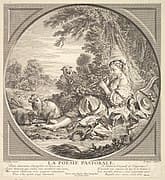
Category:Claude-Augustin Duflos - Wikimedia Commons View original
Is this image relevant?
File:A Pastoral Landscape with Shepherds and their Flocks) by George Lambert.jpg - Wikipedia View original
Is this image relevant?
The Enlightenment | Boundless Art History View original
Is this image relevant?
Category:Claude-Augustin Duflos - Wikimedia Commons View original
Is this image relevant?
Pastoral in classical literature
Theocritus and Greek pastoral poetry
Theocritus, a Greek poet from the 3rd century BCE, is widely considered the originator of pastoral poetry. His Idylls depict the lives and loves of shepherds in an idealized rural setting, establishing many of the conventions later writers would inherit. One of the most influential is the singing contest between shepherds, a motif that became a defining feature of the genre and reappears throughout its history.
Virgil's Eclogues and Georgics
Virgil, writing in Rome during the 1st century BCE, drew directly on Theocritus and expanded the pastoral's range. His Eclogues, a collection of ten pastoral poems, feature dialogues between shepherds but push beyond love poetry into themes of politics and the human relationship with nature. This political dimension is significant: Virgil showed that pastoral could address real-world power structures while maintaining its rural setting.
His Georgics, a didactic poem about agriculture, also contains pastoral elements and celebrates the virtues of rural labor. Together, the Eclogues and Georgics established Virgil as the central figure in the Latin pastoral tradition.
Renaissance pastoral tradition
Pastoral romance in prose and verse
During the Renaissance, pastoral merged with chivalric romance to produce pastoral romance, a hybrid genre that proved enormously popular. Sir Philip Sidney's Arcadia (1590) is a key example in prose, weaving together shepherds and princesses in a mythical rural setting. Edmund Spenser's The Faerie Queene (1590–1596) incorporates pastoral elements into an epic allegorical poem, using the figure of the Shepherd to represent the virtuous life. These works show how pastoral conventions could be transplanted into entirely different literary frameworks.
Pastoral drama and the court masque
Pastoral drama brought shepherds to the stage and became especially popular in Italy and Spain. Torquato Tasso's Aminta (1573) and Battista Guarini's Il Pastor Fido (1590) are the most notable Italian examples. In England, the court masque, a form of entertainment combining poetry, music, and dance, frequently drew on pastoral themes and stock characters like the Shepherd and the Nymph. These performances connected pastoral idealization directly to aristocratic self-presentation, which adds an interesting layer of irony to the genre.
Pastoral elements in Shakespeare's plays
Shakespeare incorporated pastoral elements into several plays, typically as a contrast to the main action or as a vehicle for social commentary. In As You Like It (1599), the Forest of Arden functions as a pastoral retreat where characters escape the corruption of the court. The Winter's Tale (1611) features a pastoral interlude in Act IV, centered on a sheep-shearing feast and the idealization of rural life. In both cases, Shakespeare uses the pastoral setting to test ideas about authenticity, social hierarchy, and human nature.
English pastoral poetry
Spenser's The Shepheardes Calender
Edmund Spenser's The Shepheardes Calender (1579) is a collection of twelve pastoral eclogues, one for each month of the year. The poems feature dialogues between shepherds and allegorical characters, exploring themes of love, religion, and politics. This work helped establish the pastoral genre in English literature and directly influenced later poets including Milton and Keats.
_by_George_Lambert.jpg)
Marlowe's "The Passionate Shepherd to His Love"
Christopher Marlowe's "The Passionate Shepherd to His Love" (1599) is one of the most recognizable English pastoral poems. A shepherd invites his beloved to join him in an idealized rural life, promising the pleasures of nature and love. The poem is worth knowing not just on its own terms but for the literary conversation it sparked: Sir Walter Raleigh's "The Nymph's Reply to the Shepherd" directly counters Marlowe's idealization, pointing out that seasons change, flowers fade, and pastoral promises don't hold up. That exchange captures the tension between pastoral and anti-pastoral in miniature.
Pastoral themes in metaphysical poetry
Metaphysical poets like John Donne and Andrew Marvell used pastoral elements in unconventional ways. Donne's "The Bait" (1633) reworks pastoral imagery by comparing the speaker's beloved to a fish caught by a fisherman, turning the convention inside out. Marvell's "The Garden" (1681) presents retreat into nature as a means of spiritual contemplation and escape from social pressures. Both poets treat pastoral not as a straightforward mode of idealization but as raw material for intellectual play.
Pastoral vs anti-pastoral
Idealization of rural life
Pastoral literature typically presents the countryside as a place of simplicity, innocence, and harmony with nature. This idealization serves as a deliberate contrast to the complexity, corruption, and artificiality of urban or courtly life. The pastoral landscape becomes a space for escape, refuge, and spiritual renewal.
Critiques of pastoral conventions
Anti-pastoral works challenge that idealization head-on. Instead of harmony and innocence, they depict the hardships and realities of rural life: poverty, disease, backbreaking labor, and the exploitation of workers. George Crabbe's "The Village" (1783) is a direct rebuttal to pastoral conventions, insisting on showing rural suffering rather than rural bliss. Oliver Goldsmith's "The Deserted Village" (1770) mourns a community destroyed by enclosure and economic change. These works argue that pastoral idealization can obscure real injustice.
Ambivalence and irony in pastoral works
Not all pastoral works fall neatly into the pastoral or anti-pastoral camp. Some express genuine ambivalence, acknowledging both the attractions and the limitations of the rural ideal. Irony becomes a tool for subverting pastoral conventions from within. Shakespeare's As You Like It is a good example: it celebrates the pastoral ideal through characters who find genuine freedom in the forest, while simultaneously mocking it through Touchstone, the court fool, who punctures romantic illusions about country life.
Pastoral in the 18th and 19th centuries
Pastoral and the cult of sensibility
In the 18th century, pastoral became associated with the cult of sensibility, which emphasized emotion, empathy, and connection to nature. Poets like Thomas Gray and William Collins used pastoral elements to evoke melancholy and nostalgia for a simpler way of life. The pastoral elegy, a poem mourning the death of a friend or public figure, became a popular form during this period. Gray's "Elegy Written in a Country Churchyard" (1751) is the most famous example, using a rural setting to meditate on mortality and the lives of ordinary people.
Romantic poets and the pastoral tradition
Romantic poets drew on the pastoral tradition but reshaped it significantly. Wordsworth's "Michael" (1800) presents a realistic portrayal of rural life and the hardships faced by a shepherd and his family, moving away from idealization toward something closer to anti-pastoral realism while still treating rural life with deep respect. Coleridge's "This Lime-Tree Bower My Prison" (1797) uses pastoral imagery to explore the relationship between nature and the imagination. The Romantics kept pastoral's reverence for nature but grounded it in actual experience rather than literary convention.

Victorian pastoral and the industrial revolution
Victorian writers confronted the impact of industrialization on rural life and the natural world, giving pastoral a new urgency. Elizabeth Gaskell's Cranford (1851–1853) depicts a rural community resisting the encroachment of modernization. Thomas Hardy's novels, such as Far from the Madding Crowd (1874), present a complex and often tragic view of rural life under pressure from social and economic change. For the Victorians, the pastoral ideal wasn't just a literary convention; it was something visibly disappearing.
Modern and postmodern pastoral
Pastoral elements in modernist poetry
Modernist poets incorporated pastoral elements in fragmented or ironic ways. Yeats' "The Lake Isle of Innisfree" (1888) expresses a longing for a simple, pastoral life as refuge from the modern world. Stevens' "Sunday Morning" (1915) uses pastoral imagery to explore themes of religion, nature, and the human condition. In both cases, the pastoral ideal is present but qualified, something desired rather than inhabited.
Ecocriticism and the pastoral tradition
Ecocriticism, a field of literary study that emerged in the late 20th century, examines the relationship between literature and the environment. Ecocritics have re-examined the pastoral tradition through the lens of contemporary environmental concerns like climate change and ecological degradation. This re-examination asks pointed questions: Does pastoral idealization encourage genuine care for nature, or does it substitute a fantasy of nature for engagement with real ecosystems? Works like Robert Frost's "Stopping by Woods on a Snowy Evening" (1923) and Wendell Berry's "The Peace of Wild Things" (1968) have been analyzed from this perspective, with ecocritics exploring how these poems construct and complicate the human relationship to the nonhuman world.
Subversions of pastoral in contemporary literature
Contemporary writers frequently subvert or parody pastoral conventions to comment on modern society. Tom Stoppard's Arcadia (1993) juxtaposes a 19th-century pastoral setting with modern-day academics, using the contrast to explore chaos theory and the nature of knowledge. David Mamet's The Woods (1977) offers a darkly comic take on the pastoral retreat, as a couple's countryside weekend devolves into power struggles and psychological games. These works treat pastoral not as a stable tradition but as a set of expectations that can be productively broken.
Pastoral as a mode vs genre
Pastoral themes across literary forms
While pastoral is often discussed as a genre, it's more accurately understood as a mode: a set of conventions and attitudes that can be adapted to virtually any literary form. Pastoral themes appear in poetry, prose, drama, and even non-fiction. The mode is characterized by a contrast between city and country, an idealization of rural life, and a celebration of nature and simplicity. Recognizing pastoral as a mode rather than a fixed genre helps explain its persistence across such different literary periods and forms.
Pastoral as a lens for cultural critique
The pastoral mode can function as a powerful tool for cultural critique. By depicting an idealized rural world, pastoral works implicitly criticize the corruption, artificiality, or injustice of urban or courtly life. The gap between the pastoral ideal and the realities of rural existence can also expose social and economic inequalities. This is why pastoral has never been purely escapist: even at its most idealized, it's making an argument about what's wrong with the world the writer actually inhabits.
Flexibility and adaptability of pastoral conventions
The pastoral tradition has shown remarkable adaptability. Its conventions have been incorporated into science fiction (Ray Bradbury's Dandelion Wine), children's literature (Kenneth Grahame's The Wind in the Willows), and postcolonial writing (J.M. Coetzee's Disgrace). Each of these works uses pastoral expectations differently, but all draw on the same core tension between an idealized natural world and the complicated realities that surround it. The enduring appeal of the pastoral mode lies in its ability to evoke nostalgia and connection to nature while remaining open to reinvention and subversion.
See Fiveable more often in Google
Mark Fiveable as a preferred source and Google is more likely to show you our guides in Top Stories, with a "preferred" badge in AI Mode and AI Overviews.