10.5 Wilderness

🥽Literary Theory and Criticism Unit 10 Review
10.5 Wilderness
🥽 Literary Theory and Criticism
Wilderness as Literary Theme
Wilderness is one of the most enduring themes in literature, functioning as a space that exists outside human control and social order. In ecocritical analysis, how writers represent wilderness reveals deep assumptions about nature, culture, and power. Wilderness can operate as a setting, a symbol, or even a character in its own right, and its meanings shift depending on the cultural, historical, and ideological context of the work.
Understanding wilderness through an ecocritical lens matters because the concept itself is contested. What counts as "wilderness," who gets to define it, and what values get projected onto it are all questions that carry real political and ecological weight.

Top images from around the web for Wilderness as freedom
Алберт Бийрщат – Уикипедия View original
Is this image relevant?
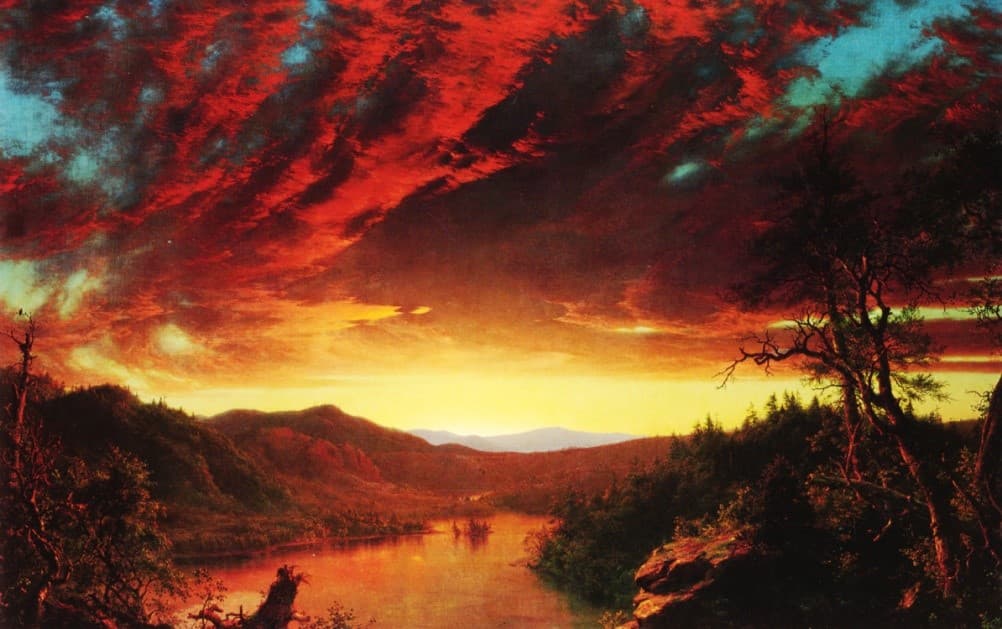
Night: Another Frontier in American Wilderness Studies? ⋆ U.S. Studies Online View original
Is this image relevant?
File:Looking Down Yosemite-Valley.jpg - Wikimedia Commons View original
Is this image relevant?
Алберт Бийрщат – Уикипедия View original
Is this image relevant?
Night: Another Frontier in American Wilderness Studies? ⋆ U.S. Studies Online View original
Is this image relevant?
Wilderness vs. Civilization
The wilderness/civilization binary is one of the oldest structuring oppositions in Western literature. Wilderness represents what lies beyond human settlement, development, and social norms, while civilization represents order, reason, and cultural achievement.
This dichotomy does a lot of ideological work in literary texts:
- It frames nature and culture as opposites, reinforcing the idea that humans are separate from the natural world
- It sets up tensions between instinct and reason, freedom and constraint, chaos and order
- It often drives plot: characters move between these spaces, and the consequences of that movement (loss of natural landscapes, psychological breakdown, spiritual renewal) become the story's central concern
Ecocriticism is particularly interested in how this binary gets constructed and maintained, since it tends to privilege civilization and treat wilderness as something to be conquered, feared, or romanticized rather than understood on its own terms.
Wilderness as Symbol
Wilderness rarely functions as a neutral backdrop. In most literary works, it carries symbolic weight, and that symbolism shifts depending on context.
Wilderness as Freedom
Wilderness frequently symbolizes liberation from social constraints. Characters seek out wild spaces to escape oppressive norms or discover something authentic about themselves. The vastness and ungoverned quality of wilderness represents a space for self-discovery and individual autonomy.
This association is especially strong in the Transcendentalist tradition, where writers like Emerson and Thoreau treated nature as a space where individuals could access truths unavailable in society.
Wilderness as Danger
Wilderness can just as easily symbolize chaos, threat, and the unknown. Wild animals, harsh weather, treacherous terrain: these become obstacles or outright antagonists in a narrative. Survival narratives depend on this symbolic register, using the dangers of wilderness to test a character's physical and psychological resilience.
The danger symbolism often works alongside the freedom symbolism, creating an ambivalence that makes wilderness such a rich literary subject.
Wilderness as Spiritual Realm
Some literary traditions treat wilderness as sacred space, a place where characters encounter the divine or experience transcendence. The beauty and scale of wild landscapes can evoke what aesthetic theory calls the sublime: a feeling of awe mixed with terror in the face of something far greater than yourself.
Nature writing frequently draws on this tradition, portraying encounters with wilderness as moments of reverence and humility that reconnect humans with something beyond the everyday.
Wilderness in Romanticism
The Romantic movement (late 18th to early 19th century) made wilderness central to its literary project. Romantic writers celebrated wild nature as a source of inspiration, emotional intensity, and spiritual renewal, positioning it as a counterpoint to what they saw as the artificiality and corruption of industrializing urban life.
Wilderness and the Sublime
The sublime was a key aesthetic category for the Romantics. It describes the experience of encountering something in nature (mountains, oceans, storms) that is simultaneously terrifying and beautiful, overwhelming human reason and connecting the observer to something primal.
Wordsworth's poetry is a touchstone here. His depictions of the Lake District don't just describe scenery; they use wilderness landscapes to explore how encounters with nature's grandeur can transform consciousness and deepen emotional life.
Wilderness as Escape
Romantic literature frequently portrays wilderness as a refuge from modern society's pressures. Characters retreat to wild settings for emotional and spiritual healing. The solitude and simplicity of wilderness are treated as conditions that foster introspection and creativity.
Thoreau's Walden (1854) is the classic example, though it's worth noting that Thoreau's "wilderness" was only about a mile from town. Even the Romantic ideal of escape involves a degree of construction and selectivity about what wilderness means.
Wilderness in American Literature
Wilderness occupies a unique place in American literary history because it's bound up with national identity: westward expansion, frontier life, and eventually, the conservation movement. American writers have grappled with wilderness as simultaneously a space of opportunity, a symbol of national character, and the site of ecological crisis.

Wilderness and the Frontier Myth
The frontier, the boundary between settled and unsettled land, has been a defining concept in American culture. Frederick Jackson Turner's 1893 "frontier thesis" argued that the frontier experience shaped American democracy and character.
In literature, wilderness beyond the frontier was portrayed as a space of possibility where individuals could test themselves and build new lives free from Eastern social constraints. Cooper's Leatherstocking Tales are early examples, celebrating the figure who moves between civilization and wilderness.
Wilderness and Rugged Individualism
American literature has long celebrated the self-reliant individual who thrives in wild settings. These characters embody independence and resourcefulness, and wilderness provides the proving ground for their qualities.
Hemingway's The Old Man and the Sea (1952) is a later iteration of this archetype: Santiago's struggle with the marlin in the open ocean is a contest between individual will and natural force. The ideal of rugged individualism ties wilderness to the broader American mythology of personal freedom and self-determination.
Wilderness and Environmental Conservation
As industrialization and westward expansion consumed American wilderness, writers increasingly turned to advocacy for conservation and preservation. This shift marks a crucial development for ecocriticism.
- John Muir championed wilderness preservation for its spiritual and aesthetic value
- Aldo Leopold articulated a land ethic that extended moral consideration to ecosystems themselves
- Edward Abbey's Desert Solitaire (1968) combined nature writing with fierce critique of the forces destroying wild landscapes
These writers helped establish the literary tradition that ecocriticism most directly inherits, one that treats wilderness not just as a theme but as something with real stakes.
Wilderness in Post-Colonial Literature
Post-colonial literature complicates Western conceptions of wilderness by exposing how those conceptions served colonial power. Wilderness in post-colonial texts becomes a site of resistance, reclamation, and contested meaning.
Wilderness and Indigenous Perspectives
Indigenous writers challenge the Western idea that wilderness is "empty" or "untouched." For many Indigenous communities, the landscapes that Europeans called wilderness were (and are) inhabited, managed, and deeply meaningful cultural spaces.
- Wilderness in Indigenous literature is often a source of traditional knowledge and ecological stewardship
- These perspectives emphasize the interconnectedness of human and non-human life, rejecting the nature/culture binary
- Leslie Marmon Silko's Ceremony (1977) portrays the land as inseparable from Laguna Pueblo identity and healing
This reframing is one of the most important contributions post-colonial literature makes to ecocritical thinking about wilderness.
Wilderness and Colonial Conquest
Colonial writers frequently depicted wilderness as savage and dangerous, which served to justify European intervention and control. Portraying colonized lands as wild and chaotic made the imposition of "civilization" seem necessary and even benevolent.
Post-colonial literature critiques this dynamic, showing how the appropriation and transformation of wilderness landscapes by colonial powers constituted both cultural and ecological violence. Achebe's Things Fall Apart (1958) reveals how colonial narratives about "civilizing" the land erased existing Igbo relationships with the natural world.
Representations of Wilderness
How wilderness gets represented in a text (as setting, character, or structural principle) shapes what meanings it can carry.
Wilderness as Setting
At its most basic, wilderness provides the physical backdrop for a narrative. But setting is never just backdrop. The specific geography, climate, and ecology of a wilderness setting shape what characters experience and what themes the work can explore.
Jack London's The Call of the Wild (1903) uses the Yukon during the Klondike Gold Rush as a setting that strips away domestication and forces both human and animal characters toward primal states.
Wilderness as Character
Some works go further and treat wilderness as an active agent in the narrative, with its own force and influence. This can take the form of anthropomorphism (giving nature human qualities) or simply depicting natural forces as having their own will and power.
Melville's Moby-Dick (1851) is the classic case. The white whale and the ocean it inhabits are not just setting or symbol; they function as antagonists with a kind of agency that resists human understanding and control.

Wilderness and Narrative Structure
Wilderness can shape a story's structure and pacing. Journeys through wild spaces, whether physical or metaphorical, often serve as organizing principles for narratives built around growth, discovery, and transformation.
- Wilderness provides obstacles and turning points that drive plot
- The journey-through-wilderness structure mirrors internal character development
- Willa Cather's O Pioneers! (1913) uses the Nebraska prairie as both the literal ground of the narrative and the force that shapes its characters' lives
Gender and Wilderness
Representations of wilderness are frequently gendered, and ecocriticism pays close attention to how these gendered associations work.
Wilderness and Masculinity
Wilderness has traditionally been associated with masculine qualities: strength, courage, independence, dominance. Male characters seek out wilderness to prove their manhood or assert control over nature. The conquest of wilderness mirrors and reinforces patriarchal power structures.
Faulkner's "The Bear" (1942) explores this dynamic through a ritualized hunt in the Mississippi wilderness, where the act of confronting wild nature is explicitly tied to masculine identity and its costs.
Wilderness and Femininity
Wilderness has also been coded as feminine, portrayed as nurturing, life-giving, or seductive. The longstanding metaphor of "Mother Nature" reflects this association. Female characters may be linked to wilderness through connections to intuition, emotion, and the body.
Ecofeminism critiques the parallel between the domination of nature and the domination of women, arguing that both stem from the same patriarchal logic. Chopin's The Awakening (1899) connects its protagonist's desire for freedom with the pull of the natural world, particularly the sea, in ways that reveal how femininity and wilderness get entangled in the cultural imagination.
Race, Ethnicity, and Wilderness
Wilderness in literature is also racialized. Access to wilderness, the freedom to move through it, and the meanings attached to it differ dramatically depending on a character's racial and ethnic position.
For marginalized groups, wilderness can be a site of both danger and reclamation. Morrison's Beloved (1987) uses the natural world in complex ways: the woods are a space of terror (slave catchers, violence) but also of refuge and spiritual power. The novel resists any single symbolic reading of wilderness, insisting on the layered, historically specific experiences of Black Americans in relation to the land.
Ecocriticism increasingly recognizes that any analysis of wilderness must account for how race shapes who gets to experience wild spaces as liberating and who experiences them as threatening.
Ecocritical Approaches to Wilderness
Ecocriticism brings specific theoretical frameworks to the analysis of wilderness in literature, challenging assumptions that other critical traditions might leave unexamined.
Wilderness and Anthropocentrism
Anthropocentrism is the belief that humans are the central or most significant beings in the world, and that nature exists primarily for human use. Most traditional literary representations of wilderness are anthropocentric: wilderness matters because of what it means to humans.
Ecocriticism pushes back against this. Literature that challenges anthropocentrism portrays wilderness as having intrinsic value and agency independent of human needs. Leopold's A Sand County Almanac (1949) is foundational here, arguing that land has value beyond its economic utility to people.
Wilderness and Biocentrism
Biocentrism holds that all living beings, not just humans, have inherent moral worth. Ecocritical readings informed by biocentrism emphasize the interconnectedness and mutual dependence of all life within ecosystems.
Literature reflecting a biocentric worldview portrays wilderness as a complex, dynamic system in which humans are one part of a larger web. Annie Dillard's Pilgrim at Tinker Creek (1974) exemplifies this approach, observing the natural world with an attention that treats non-human life as worthy of sustained, serious engagement on its own terms.
Psychological Dimensions of Wilderness
Wilderness also functions as a powerful psychological symbol in literature, reflecting inner landscapes of the mind.
Wilderness and the Unconscious
Wilderness is often mapped onto the unconscious: a space where repressed desires, fears, and impulses surface. Journeys into wilderness become metaphors for exploring uncharted psychological territory. The wildness and unpredictability of nature mirrors the chaotic, irrational dimensions of the psyche.
Conrad's Heart of Darkness (1899) is the most frequently cited example. Marlow's journey up the Congo River is simultaneously a physical journey into wilderness and a psychological descent into the darkest aspects of human nature. (Post-colonial critics rightly note that this text also reproduces deeply problematic representations of Africa and African people.)
Wilderness and Identity Formation
Wilderness can serve as a crucible for identity. The challenges of wild environments strip away social masks and force characters to confront who they really are. This experience can be transformative, leading to a renewed or fundamentally altered sense of self.
Krakauer's Into the Wild (1996) traces Chris McCandless's fatal journey into the Alaskan wilderness as an attempt to shed his social identity and discover something more authentic. The book raises difficult questions about whether the desire to find yourself in wilderness is genuine self-discovery or a romanticized fantasy with real consequences.
See Fiveable more often in Google
Mark Fiveable as a preferred source and Google is more likely to show you our guides in Top Stories, with a "preferred" badge in AI Mode and AI Overviews.