12.1 Introduction to film semiotics and structuralism

🎥Intro to Film Theory Unit 12 Review
12.1 Introduction to film semiotics and structuralism
🎥 Intro to Film Theory
Key Concepts and Theorists in Film Semiotics and Structuralism
Film semiotics treats movies the way linguistics treats language: as a system of signs that produce meaning. Instead of just watching a film and reacting to it, semiotics gives you a framework for asking how the film communicates what it does. Structuralism, the broader intellectual movement behind it, argues that meaning doesn't come from individual elements in isolation but from the structures and relationships between them.
Understanding these tools matters because they move you beyond "I liked it" or "it felt sad" toward being able to explain why a scene feels sad, how a director builds tension, and what cultural assumptions a film relies on to make sense.
Key Concepts of Film Semiotics
Signs are the basic unit of semiotic analysis. Every sign has two parts: the signifier (the form you actually perceive, like an image or a sound) and the signified (the concept or meaning it represents). A close-up of a ticking clock is the signifier; urgency or running out of time is the signified.
Denotation and connotation describe two layers of meaning. Denotation is the literal, surface-level meaning of a sign. A red traffic light denotes "stop." Connotation is the associated or implied meaning layered on top. That same red might connote danger, passion, or violence depending on context. Roland Barthes made this distinction central to his work.
Codes are the organized systems that govern how signs function together. Film relies on two broad types:
- Cultural codes draw on shared societal knowledge (a character in a white lab coat signals "scientist" because of cultural convention)
- Cinematic codes are specific to film technique (a dissolve transition typically signals the passage of time; a jump cut can signal disorientation)
Two types of analysis help you examine how signs relate to each other:
- Syntagmatic analysis looks at the relationship between elements in sequence. Why does this shot follow that one? How does the order of shots in a montage build meaning?
- Paradigmatic analysis asks what could have been chosen instead. If a director uses a low angle instead of a high angle, what meaning shifts? Thinking about the alternatives that were rejected helps reveal why a particular choice matters.
Relevance of Semiotics in Film
Semiotics isn't just abstract theory. It gives you concrete ways to analyze what's happening on screen:
- Visual and auditory decoding: You can explain why low-key lighting in a noir film creates unease, or how a minor-key score signals melancholy, rather than just feeling the effect.
- Film language: Shot types, editing patterns, and mise-en-scène all function as signs within a code. Semiotics helps you read them systematically.
- Cultural meaning: Films are packed with symbols, metaphors, and allegories that rely on shared cultural knowledge. A white dove released in slow motion connotes peace not because of anything inherent to doves, but because of cultural convention.
- Narrative structure: Semiotic and structuralist tools let you examine how plot development, character arcs, and themes are organized according to underlying patterns.
- Genre conventions: Genres are essentially bundles of codes and expectations. Semiotics helps you see how films follow or deliberately subvert those expectations (think of a Western set in space, like Firefly).
- Intertextuality: Films constantly reference other films through homages, parodies, and quotations. Semiotic analysis traces how meaning travels between texts.
- Ideology: Every film carries assumptions about how the world works. Semiotics helps uncover the social and political ideas embedded in seemingly neutral storytelling choices.
Theorists in Film Semiotics
Several thinkers built the theoretical foundation you'll encounter in this unit:
Ferdinand de Saussure is the starting point. His work in linguistics established the signifier/signified model and the idea that meaning comes from differences within a system rather than from any natural connection between a word and what it refers to. He called this broader study semiology.
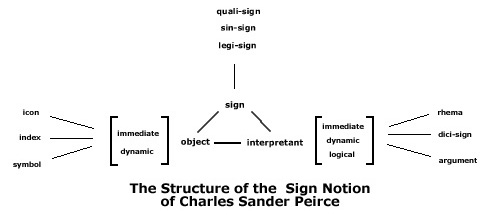
Charles Sanders Peirce developed a different, three-part model of signs. His categories are especially useful for film:
- Icon: resembles what it represents (a photograph of a person)
- Index: has a direct, causal connection to what it represents (smoke as an index of fire)
- Symbol: connected to its meaning only by convention (a nation's flag)
Roland Barthes applied semiotic thinking to popular culture broadly. His concepts of denotation, connotation, and myth (the way connotations get naturalized so they seem like common sense) are essential tools for analyzing how films reinforce cultural ideologies.
Christian Metz is the figure who most directly built a semiotics of cinema. His Grande Syntagmatique classified the different ways film sequences can be organized, treating cinema as a kind of language system with its own grammar. He argued that film is "like" a language but not a language in the strict Saussurean sense, since it lacks the double articulation of spoken language.
Umberto Eco expanded semiotic theory across media, including film and television, and questioned some of the stricter structuralist assumptions about how codes work.
Peter Wollen brought Peirce's icon/index/symbol framework into film theory and used it to analyze the styles of auteur directors.
Yuri Lotman contributed a cultural semiotics perspective, examining cinema as a cultural text shaped by the broader "semiosphere" of signs surrounding it.
Film Semiotics and Other Theoretical Approaches
Semiotics doesn't exist in a vacuum. It overlaps with and informs many other film theories:
- Auteur theory: Semiotic analysis can identify the recurring signs, motifs, and stylistic codes that define a director's personal signature.
- Psychoanalytic film theory: Interprets cinematic signs in relation to unconscious desires and anxieties (Freudian or Lacanian imagery, dream symbolism).
- Feminist film theory: Uses semiotic tools to deconstruct how gender is represented and coded on screen, examining what signs construct "femininity" or "masculinity."
- Marxist film theory: Analyzes how films encode ideological messages about class, labor, and power through their sign systems.
- Postcolonial film theory: Examines how cultural signs construct dynamics of othering, exoticism, and power in cinema.
- Cognitive film theory: Studies how viewers actually process and interpret filmic signs at a perceptual and cognitive level.
- Reception theory: Investigates how different audiences derive different meanings from the same film signs, depending on cultural context.
- Digital cinema theory: Explores how digital tools like CGI and virtual environments create new kinds of signs and new semiotic possibilities that didn't exist in analog filmmaking.
See Fiveable more often in Google
Mark Fiveable as a preferred source and Google is more likely to show you our guides in Top Stories, with a "preferred" badge in AI Mode and AI Overviews.