4.2 Theoretical Perspectives on Society

👩👩👦Intro to Sociology Unit 4 Review
4.2 Theoretical Perspectives on Society
👩👩👦 Intro to Sociology
Theoretical Perspectives on Society
Sociology doesn't have one single way of explaining how society works. Instead, it offers several theoretical perspectives, each acting as a different lens that brings certain features of society into focus while leaving others blurry. The lens you choose shapes the questions you ask and the answers you find.

Top images from around the web for Functionalism vs conflict theory
Types and Stages of Social Movements | Introduction to Sociology View original
Is this image relevant?
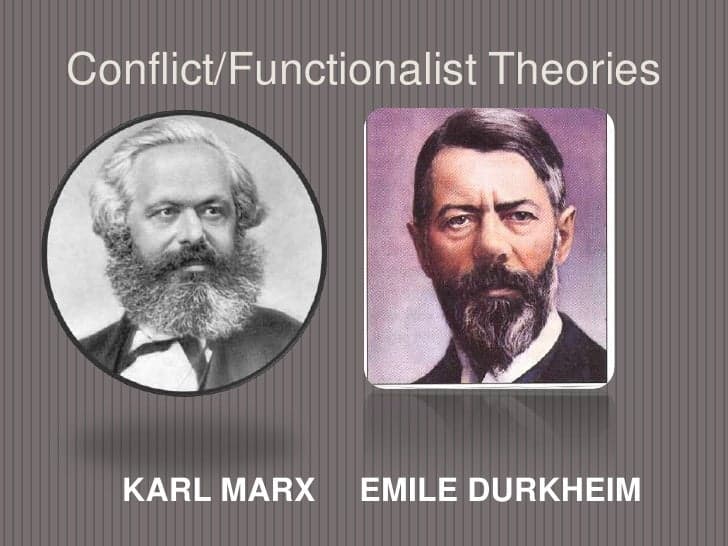
Conflict and functionalist theory View original
Is this image relevant?
Conflict Theory and Society | Introduction to Sociology View original
Is this image relevant?
Types and Stages of Social Movements | Introduction to Sociology View original
Is this image relevant?
Conflict and functionalist theory View original
Is this image relevant?
Functionalism vs. Conflict Theory
Functionalism views society as a complex system of interconnected parts that work together to maintain stability and order. Think of it like the human body: the heart, lungs, and brain each perform a specific function, and the body stays healthy when they all do their jobs. In the same way, functionalists argue that social institutions like family, education, and religion each serve important functions that keep society running smoothly. Shared values and social consensus are what hold everything together.
Conflict theory takes the opposite view. Instead of a smoothly functioning system, conflict theorists see society as an arena of inequality where different groups compete for power and resources. Social institutions don't exist to serve everyone's needs; they exist to serve the interests of whichever group holds the most power and wealth. Inequality and struggle, not harmony, are what drive social change.
Key contrasts to remember:
- Functionalists ask: How does this institution contribute to social stability? Conflict theorists ask: Who benefits from this arrangement, and who is harmed?
- Functionalists see social structures as meeting collective needs. Conflict theorists see them as protecting the advantages of dominant groups.
- Functionalism explains why things stay the same. Conflict theory explains why things change.

Marx's Class and Alienation Concepts
Karl Marx's ideas form the foundation of conflict theory. His analysis centers on two concepts: class and alienation.
Class, for Marx, isn't about income level or lifestyle. It's defined by your relationship to the means of production, the tools, factories, land, and resources used to produce goods.
- The bourgeoisie owns the means of production. They hire workers and profit from their labor.
- The proletariat owns no means of production. They survive by selling their labor to the bourgeoisie.
- Class conflict is the ongoing tension between these two groups over who controls production and who gets the wealth it generates.
Alienation describes the ways capitalism disconnects workers from what should be meaningful activity. Marx identified several dimensions of this:
- Alienation from labor: Workers don't control how they work. They perform repetitive tasks dictated by someone else rather than engaging in creative, self-directed activity.
- Alienation from the product: Workers don't own what they make. The goods they produce belong to the bourgeoisie and are sold for profit the workers never see.
- Alienation from other people: The competitive nature of capitalism isolates workers from one another, making genuine solidarity difficult.
For Marx, these aren't just personal frustrations. They're built into the structure of capitalism itself. Economic and political institutions, he argued, are shaped by the ruling class to maintain their dominance, and class inequality and alienation are the predictable results.

Symbolic Interactionism in Social Interactions
While functionalism and conflict theory zoom out to look at large-scale social structures (the macro level), symbolic interactionism zooms in on face-to-face encounters (the micro level). This perspective asks: how do people create and interpret meaning through everyday interactions?
The core idea is that social reality isn't just "out there" waiting to be discovered. People actively construct it through the exchange of symbols, which include language, gestures, facial expressions, and even objects like wedding rings or uniforms. A raised fist means something different at a protest than at a concert, and symbolic interactionists are interested in exactly that kind of interpretation.
A few key concepts within this perspective:
- Role-taking: The ability to imagine yourself in someone else's position and anticipate how they'll respond. This is how you adjust your behavior depending on whether you're talking to a professor, a friend, or a stranger.
- Negotiated order: Social order isn't imposed from above; it's constantly created and maintained through ongoing interactions. People negotiate expectations, rules, and norms in real time.
- Definition of the situation: How people define a social situation shapes how they behave in it. If you interpret a comment as a joke, you laugh. If you interpret the same comment as an insult, you react very differently.
Symbolic interactionists argue that these micro-level interactions aren't trivial. Social norms, identities, and even power relations are constructed, reinforced, and sometimes challenged through the everyday exchange of symbols and meanings.
Social Constructionism and Its Impact on Society
Social constructionism is closely related to symbolic interactionism but broader in scope. It's the idea that much of what we treat as "just the way things are" is actually created and maintained through human interaction and shared understanding.
This doesn't mean that nothing is real. It means that many categories, beliefs, and practices we take for granted are products of specific cultural and historical contexts rather than objective, universal truths. For example, what counts as a "disability," what behaviors are considered "criminal," or what roles are deemed appropriate for different genders have all varied dramatically across time and place. These aren't fixed facts of nature; they're socially constructed.
Two important applications:
- Social norms are products of collective agreement, reinforced through interaction. They feel natural, but they're created and can be changed.
- Social identity is shaped by societal expectations, cultural context, and personal experience. You aren't born with a fully formed identity; it's constructed through your interactions with the world around you.
A major piece of social constructionism is agency: people aren't passive recipients of social reality. They actively participate in constructing and reconstructing it. This means social change is always possible when people collectively redefine meanings, challenge norms, and build new shared understandings.
Strengths and Limitations of Each Perspective
No single perspective captures the full picture. Each has trade-offs, and knowing these will help you think critically about which lens fits a given situation.
Functionalism
| Strengths | Limitations |
|---|---|
| Offers a big-picture view of how society's parts fit together | Tends to overlook inequality, conflict, and power |
| Explains why social institutions persist and how they meet collective needs | Can make oppressive arrangements seem natural or inevitable |
| Highlights the role of shared values in maintaining social cohesion | Doesn't account well for individual agency or social change |
Conflict Theory
| Strengths | Limitations |
|---|---|
| Draws attention to power, inequality, and exploitation | May overemphasize conflict and underestimate cooperation |
| Critically examines who benefits from existing social arrangements | Can reduce complex social life to economic or material factors alone |
| Explains how and why social change happens | May overlook the ways individuals actively resist oppression from within |
Symbolic Interactionism
| Strengths | Limitations |
|---|---|
| Centers individual agency and subjective meaning-making | Can miss the broader structures that shape interactions |
| Provides rich, detailed analysis of everyday social life | Focuses on micro-level encounters and may neglect macro-level forces |
| Shows how norms, identities, and power are constructed in real time | May underestimate how deeply inequality constrains people's choices |
The most useful approach is often to combine perspectives. Functionalism helps you see the big picture, conflict theory reveals who holds power, and symbolic interactionism shows how people experience and create social reality on the ground.
See Fiveable more often in Google
Mark Fiveable as a preferred source and Google is more likely to show you our guides in Top Stories, with a "preferred" badge in AI Mode and AI Overviews.