11.4 Intergroup Relationships

👩👩👦Intro to Sociology Unit 11 Review
11.4 Intergroup Relationships
👩👩👦 Intro to Sociology
Types and Examples of Intergroup Relations
Intergroup relations describe the patterns of interaction between dominant and minority groups in a society. These patterns range widely, from peaceful coexistence to systematic extermination. Sociologists study these relationships to understand how power, culture, and identity shape social inequality.

Top images from around the web for Types of intergroup relations
Propaganda, media effects and conflict: Evidence from the Rwandan genocide - The Journalist's ... View original
Is this image relevant?
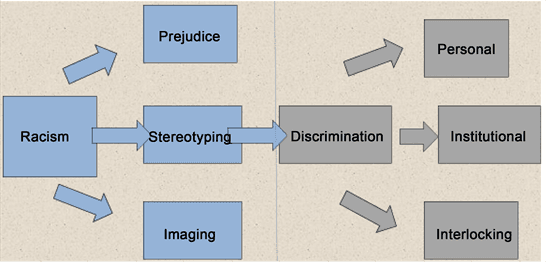
The Contemporary United States Workplace: An Analysis of Racial Segregation Perceptions View original
Is this image relevant?
Jim Crow Laws/Segregation Introduction | OER Commons View original
Is this image relevant?
Propaganda, media effects and conflict: Evidence from the Rwandan genocide - The Journalist's ... View original
Is this image relevant?
The Contemporary United States Workplace: An Analysis of Racial Segregation Perceptions View original
Is this image relevant?
Types of Intergroup Relations
Sociologists generally organize intergroup relations along a spectrum, from most inclusive to most destructive.
- Pluralism is when diverse groups coexist while maintaining their distinct identities and cultures. Modern-day Canada is often cited as an example, where multiculturalism is an official government policy encouraging ethnic groups to preserve their heritage.
- Assimilation occurs when a minority group adopts the culture, norms, and values of the dominant group. This can be voluntary or forced. The "Americanization" of immigrants in the early 20th century is a classic example: public schools, settlement houses, and social pressure pushed newcomers to abandon their native languages and customs.
- Amalgamation is the blending of cultures and racial or ethnic groups into a new, combined group. Think of the "melting pot" metaphor sometimes applied to the United States. This differs from assimilation because, in theory, all groups contribute to the resulting culture rather than one group absorbing another.
- Segregation is the physical and social separation of groups, often based on race, ethnicity, or religion. It comes in two forms:
- De jure segregation is separation enforced by law (Jim Crow laws in the U.S., apartheid in South Africa)
- De facto segregation is separation maintained through social norms, housing patterns, and institutional practices rather than explicit laws (racially segregated neighborhoods that persist today)
- Expulsion involves a dominant group forcing a minority group to leave a region or country. The forced removal of Native Americans along the Trail of Tears (1830s) is one example.
- Genocide is the deliberate, systematic destruction of a racial, ethnic, or religious group. The Holocaust during World War II (approximately 6 million Jews killed) and the Rwandan genocide in 1994 (roughly 800,000 Tutsis killed in about 100 days) are two of the most well-documented cases.

Examples of Intergroup Dynamics
Historical examples:
- Slavery in the United States involved Africans being forcibly brought to the Americas and subjected to forced labor and brutal oppression. This system lasted from the early 17th century until the end of the Civil War in 1865 and created racial hierarchies whose effects persist today.
- Colonialism saw European powers establishing control over territories in Africa, Asia, and the Americas, exploiting resources and labor while suppressing local cultures. British rule in India (roughly 1757 to 1947) is one example, where colonial policies reshaped the economy, legal system, and social structure of an entire subcontinent.
Contemporary examples:
- Racial profiling and police brutality involve the disproportionate targeting and use of force against racial and ethnic minorities by law enforcement. The Black Lives Matter movement, which gained national prominence after 2013, emerged in direct response to police violence against African Americans.
- Islamophobia refers to prejudice, discrimination, and hostility directed at Muslims or those perceived to be Muslim. This intensified in many Western countries after the September 11, 2001 terrorist attacks, manifesting in policies like travel bans and surveillance programs targeting Muslim communities.

Impact of Segregation on Society
Segregation does more than physically separate groups. It creates and reinforces systemic inequality across multiple dimensions of social life.
-
Unequal access to resources: Segregated communities typically have unequal access to quality education, healthcare, and employment. This perpetuates cycles of poverty and disadvantage. For example, predominantly Black neighborhoods in the U.S. have historically received less school funding due to property-tax-based funding models.
-
Reduced intergroup contact: When groups are separated, there are fewer opportunities to build empathy or shared understanding. This fuels stereotyping, prejudice, and mistrust.
The contact hypothesis (developed by Gordon Allport) suggests that meaningful, equal-status contact between groups can reduce prejudice. Segregation does the opposite by eliminating those opportunities.
-
Psychological harm: Members of segregated groups may internalize feelings of inferiority and self-doubt. The stress and trauma of ongoing discrimination take a measurable toll on mental and physical health.
-
Resistance and social movements: Segregation also generates organized opposition. The Civil Rights Movement of the 1950s and 1960s directly challenged racial segregation through boycotts, sit-ins, marches, and legal challenges, leading to landmark legislation like the Civil Rights Act of 1964.
Intergroup Attitudes and Behaviors
Several sociological concepts help explain why intergroup relations take the forms they do.
- Ethnocentrism is the tendency to view your own group's culture as superior and to judge other groups by your own standards. This is one of the most basic drivers of intergroup tension.
- Social identity theory (developed by Henri Tajfel) explains how people derive part of their self-concept from the groups they belong to. Because your group membership is tied to your self-esteem, you're motivated to see your group positively, sometimes at the expense of other groups.
- Ingroup favoritism is the tendency to prefer and prioritize members of your own group. This doesn't always involve hostility toward outsiders, but it creates advantages for insiders that accumulate over time.
- Outgroup derogation goes a step further: it involves expressing negative attitudes or behaviors toward members of other groups. Combined with ingroup favoritism, this can entrench social divisions.
- Intergroup conflict refers to tensions or hostilities between social groups, often rooted in competition for resources, power, or status. Realistic conflict theory argues that when groups compete for scarce resources (jobs, land, political power), prejudice and discrimination increase as a result.
See Fiveable more often in Google
Mark Fiveable as a preferred source and Google is more likely to show you our guides in Top Stories, with a "preferred" badge in AI Mode and AI Overviews.