1.3 Theoretical Perspectives in Sociology

👩👩👦Intro to Sociology Unit 1 Review
1.3 Theoretical Perspectives in Sociology
👩👩👦 Intro to Sociology
Sociological theories give you frameworks for understanding why society works the way it does. Rather than just describing what happens in the social world, these theories explain why it happens and help researchers figure out what questions to ask. The three major perspectives you need to know each zoom in on different forces shaping social life.
Sociological Theories
Top images from around the web for Use of theories in sociology
Classical Sociological Theory and Foundations of American Sociology – Open Textbook View original
Is this image relevant?
1.3: Theoretical Perspectives in Sociology - Social Sci LibreTexts View original
Is this image relevant?
Classical Sociological Theory and Foundations of American Sociology – Open Textbook View original
Is this image relevant?
1.3: Theoretical Perspectives in Sociology - Social Sci LibreTexts View original
Is this image relevant?
Use of theories in sociology
Theories aren't just abstract ideas. They're practical tools that tell sociologists what to look for and how to interpret what they find. A theory about power, for example, will push a researcher to study wealth distribution, while a theory about meaning-making will push them toward how people talk about and experience their daily lives.
- Theories guide research by suggesting what to study and how to interpret findings
- They focus attention on specific aspects of social reality: inequality, social change, individual interactions
- Theories help sociologists develop hypotheses and research questions
- Researchers test these through empirical methods like surveys, experiments, and ethnography
- Findings can then refine or challenge the original theory
The key takeaway: no single theory captures everything about society. That's why sociologists often draw on multiple perspectives.
Comparison of major sociological perspectives
Functionalism (also called structural functionalism) views society as a system of interconnected parts, each serving a purpose to keep the whole thing running. Think of it like the organs in a body: the heart, lungs, and brain all do different jobs, but they depend on each other. Social institutions like family, education, and religion each meet specific societal needs. Shared norms and values hold everything together through socialization.
Critique of functionalism: It tends to assume that the way things are is the way they should be. By emphasizing stability and consensus, it can overlook deep inequalities and power imbalances built into the system.
Conflict theory flips that script. Instead of asking "how does society hold together?" it asks "who benefits from the way society is organized?" Rooted in the work of Karl Marx, this perspective focuses on competition over scarce resources like money, status, and power. It highlights how social institutions can perpetuate the dominance of powerful groups. For example, conflict theorists might examine how wealthy elites influence media and politics to protect their interests.
Critique of conflict theory: It can overemphasize struggle and competition while downplaying the genuine cooperation and shared values that also exist in society.
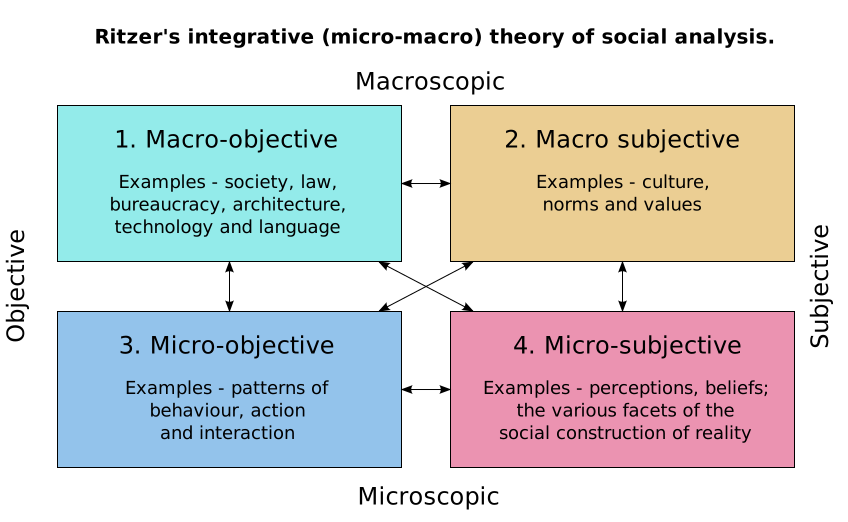
Symbolic interactionism zooms in from the big picture to the small scale. Instead of looking at large social structures, it examines how individuals create meaning through everyday interactions. The words you use, the gestures you make, the labels society assigns to people: all of these shape how you understand the world and your place in it. Concepts like stereotypes, stigma, and impression management all fall under this perspective.
Critique of symbolic interactionism: Because it focuses on micro-level interactions, it can neglect the larger structural forces (economic systems, political institutions) that constrain individual behavior.

Additional theoretical perspectives
Beyond the big three, a couple of other perspectives show up in introductory sociology:
- Social constructionism explores how things we treat as "natural" or "obvious" are actually created and maintained by people through shared meanings. Gender roles, for instance, aren't simply biological facts; they're shaped by cultural expectations that vary across time and place. This perspective asks: how did this come to be seen as "normal"?
- Ethnomethodology studies the unspoken rules and routines people use to navigate everyday life. It focuses on the taken-for-granted assumptions that keep social interactions running smoothly. A classic example: think about what happens when someone breaks an unwritten rule, like standing too close to a stranger in an elevator. The discomfort reveals just how much of social order depends on shared, unstated expectations.
Application of theories to social issues
Each perspective generates different questions when applied to the same social issue. Take education as an example:
- Functionalist perspective
- Analyze how education contributes to societal stability by socializing young people and sorting them into roles
- Examine latent functions: unintended consequences like schools serving as childcare or creating peer networks
- Conflict theory perspective
- Investigate how educational inequality reproduces class divisions (e.g., underfunded schools in low-income neighborhoods vs. well-resourced suburban schools)
- Analyze how dominant groups shape curricula and policies to maintain their advantages
- Symbolic interactionist perspective
- Explore how teacher expectations and labels (like "gifted" or "at-risk") shape students' self-concepts and outcomes
- Examine how students interpret and negotiate their identities within school settings
The real power comes from combining perspectives. A functionalist might explain what education does for society, a conflict theorist reveals who benefits and who doesn't, and a symbolic interactionist shows how those dynamics play out in actual classrooms. Using multiple lenses gives you a more complete picture than any single theory can offer. Recognizing what each perspective does well, and where it falls short, is a core skill in sociology.
See Fiveable more often in Google
Mark Fiveable as a preferred source and Google is more likely to show you our guides in Top Stories, with a "preferred" badge in AI Mode and AI Overviews.