18.3 Work in the United States

👩👩👦Intro to Sociology Unit 18 Review
18.3 Work in the United States
👩👩👦 Intro to Sociology
Trends and Demographics in the U.S. Workforce

Top images from around the web for Trends in U.S. workforce
Facing our economic, workforce, and educational challenges for the next generation - EducationNC View original
Is this image relevant?
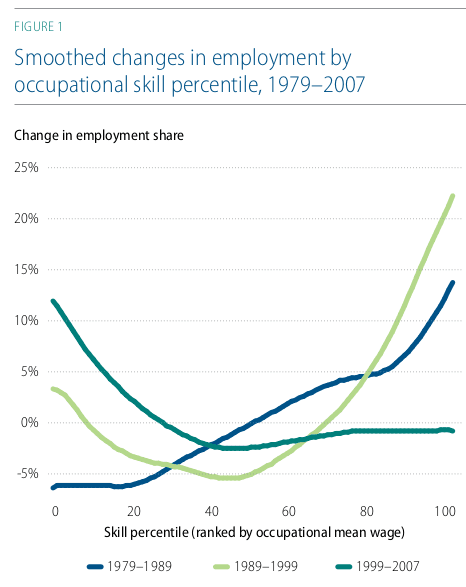
Job Polarization in the 2000s? | CEPR Blog | CEPR View original
Is this image relevant?
Job polarization and workers’ response to the decline in middle-skill jobs - Journalist's Resource View original
Is this image relevant?
Facing our economic, workforce, and educational challenges for the next generation - EducationNC View original
Is this image relevant?
Job Polarization in the 2000s? | CEPR Blog | CEPR View original
Is this image relevant?
Trends in the U.S. Workforce
Job polarization refers to the hollowing out of middle-skill jobs while both ends of the skill spectrum grow. Factory and office jobs that once formed the backbone of the middle class are disappearing as automation replaces routine tasks and globalization sends work overseas through outsourcing.
What's left is a split labor market:
- High-skill, high-wage jobs in fields like tech and healthcare are expanding, requiring specialized education or training.
- Low-skill, low-wage jobs in retail and food service are also growing, but these positions offer fewer benefits and less stability.
The result is widening income inequality. An engineer and a cashier live in increasingly different economic worlds, and the middle rungs of the ladder between them are thinning out.
Changing demographics are reshaping who makes up the workforce:
- The workforce is aging as Baby Boomers (born 1946–1964) reach retirement, creating labor shortages in some industries.
- Racial and ethnic diversity is increasing. The share of Latino and Asian workers is growing, while the share of white, non-Hispanic workers is projected to decline.
- Educational attainment is rising overall, with a higher proportion of workers holding bachelor's degrees. However, persistent gaps by race and ethnicity mean Black and Hispanic workers are still underrepresented among degree holders.
Women and Immigrants in the Labor Market
Women's labor force participation has risen dramatically since the 1950s. Yet a gender wage gap persists: on average, women earn about 80 cents for every dollar men earn. Several factors drive this gap:
- Occupational segregation channels women into lower-paying fields (like teaching) and away from higher-paying ones (like engineering).
- Discrimination in hiring, promotion, and pay continues to play a role.
- Caregiving responsibilities, especially childcare, disproportionately fall on women and can interrupt careers.
Women have made real gains in professional and managerial roles, including law and executive positions. Still, they remain underrepresented in STEM fields like computer science.
Immigrants now make up roughly 15% of the U.S. labor force and are concentrated at both ends of the skill spectrum:
- High-skill roles: STEM fields, healthcare, and entrepreneurship. Many tech startups in places like Silicon Valley were founded by immigrants.
- Low-skill roles: agriculture, construction, and service industries like housekeeping.
Immigration sparks ongoing debate. Critics worry about wage suppression and competition for low-skill jobs. Research, however, points to significant positive contributions through innovation, entrepreneurship, and overall economic growth.

Evolving Labor Market Dynamics
The gig economy has grown rapidly, with more workers taking on short-term contracts and freelance work through platforms like Uber or TaskRabbit. This flexibility comes at a cost: gig workers typically lack job security, health insurance, retirement plans, and other benefits that traditional employees receive.
Labor unions historically played a major role in securing better wages, shorter hours, and safer working conditions. Their influence has declined significantly in recent decades, though. Union membership has dropped, which some sociologists link to stagnating wages and weakening worker bargaining power.
Workplace diversity initiatives aim to promote inclusion and equal opportunity for underrepresented groups. These efforts range from targeted recruitment to anti-bias training. Progress has been uneven, and addressing deep-rooted systemic inequalities remains a significant challenge.
Poverty in Contemporary U.S. Society

Causes of Poverty
Poverty in the U.S. doesn't have a single cause. It results from overlapping structural and personal factors:
- Low wages and underemployment: The federal minimum wage of $7.25 per hour is not enough to support a family. Many workers are stuck in part-time or temporary positions that offer limited benefits like health insurance.
- Family structure: Single-parent households, especially those headed by women, face poverty rates around 35%. One income and the cost of childcare make financial stability much harder.
- Limited access to education: Without affordable education or skills training, many workers have few paths to higher-paying jobs. Vocational programs exist but aren't always accessible.
- Discrimination: Racial discrimination (such as historical redlining in housing), ethnic bias in hiring, and gender-based pay gaps all funnel certain groups toward economic disadvantage.
- Economic downturns: Recessions cause widespread job losses, and low-income workers are often hit first and hardest.
Consequences of Poverty
The effects of poverty reach into nearly every part of a person's life:
- Health disparities: Low-income populations experience higher rates of chronic diseases like diabetes, mental health issues like depression, and higher mortality overall. Limited access to preventive healthcare and nutritious food (many poor neighborhoods are "food deserts" with no nearby grocery stores) compounds these problems.
- Educational disparities: Students from low-income families have lower graduation rates and academic achievement. Underfunded school districts often lack basic resources like up-to-date computers, and dropout rates are higher.
- Social and economic exclusion: Poverty tends to concentrate in specific neighborhoods, particularly inner cities. Residents of these areas often lack access to job referrals, reliable transportation, and other public services that connect people to opportunity.
- Intergenerational transmission: Children born into poverty are significantly more likely to remain poor as adults. This "cycle of poverty" is reinforced by cumulative disadvantages, including a lack of inherited wealth, limited social networks, and fewer educational opportunities passed from one generation to the next.
See Fiveable more often in Google
Mark Fiveable as a preferred source and Google is more likely to show you our guides in Top Stories, with a "preferred" badge in AI Mode and AI Overviews.