5.4 Relationship between ICESCR and Development Goals

🧍🏼♂️International Human Rights Unit 5 Review
5.4 Relationship between ICESCR and Development Goals
🧍🏼♂️ International Human Rights
ICESCR and Sustainable Development Goals

Top images from around the web for Shared Objectives and Legal Framework
Sustainable Development Goal #1: End Poverty - FAMVIN NewsEN View original
Is this image relevant?
A more sustainable future should be a more open future | Opensource.com View original
Is this image relevant?
A GUIDE for Popular Education on the Sustainable Development Goals (SDGs) - FAMVIN NewsEN View original
Is this image relevant?
Sustainable Development Goal #1: End Poverty - FAMVIN NewsEN View original
Is this image relevant?
A more sustainable future should be a more open future | Opensource.com View original
Is this image relevant?
Shared Objectives and Legal Framework
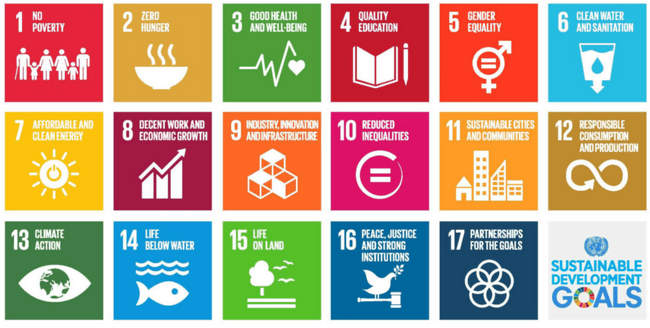
The ICESCR and the SDGs are pursuing many of the same goals, but from different angles. The ICESCR (adopted in 1966, entered into force in 1976) creates legally binding obligations for states to progressively realize economic, social, and cultural rights. The SDGs, adopted by the UN General Assembly in 2015, are a set of 17 interlinked global goals meant to address social, economic, and environmental challenges by 2030. The SDGs are political commitments, not legal obligations, which is a key distinction.
Despite that difference, the two frameworks overlap significantly:
- Right to work (ICESCR Art. 6–7) maps onto SDG 8 (Decent Work and Economic Growth)
- Right to education (ICESCR Art. 13–14) maps onto SDG 4 (Quality Education)
- Right to health (ICESCR Art. 12) maps onto SDG 3 (Good Health and Well-Being)
- Right to an adequate standard of living (ICESCR Art. 11) maps onto SDG 1 (No Poverty) and SDG 2 (Zero Hunger)
The ICESCR gives these development aspirations a legal backbone. When a state has ratified the ICESCR, its commitments to goals like universal education or accessible healthcare aren't just policy preferences; they're treaty obligations that can be monitored and enforced through international mechanisms.
Alignment and Implementation
The ICESCR's core principle of non-discrimination aligns directly with the SDGs' pledge to "leave no one behind." Both frameworks single out marginalized populations, including indigenous peoples, persons with disabilities, and women, as requiring targeted attention.
There's also a structural parallel. The ICESCR requires states to pursue progressive realization, meaning they must take deliberate, concrete steps toward full realization of rights over time, using the maximum of their available resources. The SDGs similarly set long-term targets (2030) with incremental benchmarks. The ICESCR's reporting mechanism, where states submit periodic reports to the Committee on Economic, Social and Cultural Rights (CESCR), can serve as a tool for tracking SDG-related progress as well. The Committee's concluding observations often address the same issues the SDGs target.
ICESCR's Contribution to Development

Economic and Social Progress
The ICESCR contributes to development in concrete ways, not just as an abstract ideal. Its provisions on the right to work and just working conditions (Articles 6–7) support objectives like fair wages, safe workplaces, and equal opportunity, all of which feed into broader economic growth.
The right to education (Articles 13–14) is particularly significant for development because education drives human capital formation. States that invest in universal primary and secondary education tend to see downstream gains in productivity, health outcomes, and civic participation.
The right to health (Article 12) pushes states to invest in healthcare systems and address the social determinants of health, things like clean water, nutrition, and sanitation, that are prerequisites for a productive population.
The covenant's non-discrimination provisions also matter here. Development strategies that exclude marginalized groups tend to be less effective and less sustainable. The ICESCR's insistence on inclusion helps ensure that economic and social progress reaches the people who need it most.
Cultural and International Dimensions
ICESCR provisions on cultural rights (Article 15) support development in ways that are sometimes overlooked. Preserving cultural heritage and promoting cultural diversity aren't just about identity; they contribute to social cohesion and can drive economic activity through tourism, creative industries, and traditional knowledge systems.
The covenant also emphasizes international assistance and cooperation (Article 2(1)), providing a framework for global partnerships. This matters because many states lack the domestic resources to fully realize economic, social, and cultural rights on their own. The ICESCR frames international cooperation not as charity but as a structural component of the treaty's implementation.
By addressing root causes of poverty and inequality rather than just their symptoms, the ICESCR promotes development that is genuinely sustainable over time.
Rights-Based Approach to Development

Conceptual Framework
A rights-based approach to development reframes poverty and inequality as human rights violations rather than purely economic problems. This shift matters because it changes who is responsible and what tools are available.
Under a rights-based approach:
- Individuals and communities are treated as rights-holders with legitimate claims, not passive recipients of aid
- States are duty-bearers with legal obligations to respect, protect, and fulfill those rights
- Development policies must prioritize participation, non-discrimination, transparency, and accountability
Compare this to a traditional needs-based approach, which might ask "What do people lack?" A rights-based approach asks "What are people entitled to, and who is failing to deliver?" That reframing tends to mobilize political will and resources more effectively because it creates legal accountability, not just moral appeals.
Implementation and Outcomes
In practice, a rights-based approach shapes development work in several ways:
- It directs resources toward the most marginalized populations first, rather than toward wherever the greatest aggregate impact can be achieved
- It strengthens legal and institutional frameworks by tying development goals to enforceable human rights obligations
- It encourages active participation of affected communities in planning and implementation, which tends to produce more locally appropriate and sustainable results
- It uses human rights indicators alongside traditional development metrics (like GDP growth) to measure progress, capturing dimensions that purely economic measures miss
The result is often more durable outcomes. Addressing root causes of poverty, such as discrimination, lack of legal protections, and exclusion from political processes, tends to produce longer-lasting change than addressing symptoms alone.
International Cooperation for ICESCR Rights
Forms and Principles of Cooperation
Article 2(1) of the ICESCR explicitly recognizes the importance of "international assistance and cooperation" in realizing economic, social, and cultural rights. This isn't a vague aspiration; it's built into the treaty's core obligation clause.
International cooperation takes several forms:
- Financial aid (bilateral and multilateral development assistance)
- Technical assistance (sharing expertise in areas like public health systems or educational infrastructure)
- Capacity building (helping states develop the institutional frameworks needed to implement rights)
- Knowledge sharing (exchanging best practices across different national contexts)
The principle of "maximum available resources" in Article 2(1) has an international dimension: it implies that wealthier states bear some responsibility to assist poorer states in realizing these rights. The CESCR has reinforced this interpretation in its General Comments, though the precise scope of this obligation remains debated.
Actors and Implementation
Multiple actors are involved in international cooperation for ICESCR rights:
- International financial institutions (like the World Bank and regional development banks) fund programs targeting health, education, and social protection
- UN agencies play specialized roles: the UNDP coordinates development programming, the WHO provides health-related technical expertise, and UNESCO supports education and cultural rights
- Civil society organizations and NGOs contribute through advocacy, independent monitoring, and grassroots capacity building
A persistent tension in this area is balancing international cooperation with state sovereignty. The ICESCR places primary responsibility on each state to fulfill its own treaty obligations. International cooperation supplements but does not replace that responsibility. States cannot use a lack of international aid as an excuse for inaction, nor can international actors impose conditions that undermine a state's ability to set its own development priorities.
See Fiveable more often in Google
Mark Fiveable as a preferred source and Google is more likely to show you our guides in Top Stories, with a "preferred" badge in AI Mode and AI Overviews.