11.2 Evidence for Evolution

🐇Honors Biology Unit 11 Review
11.2 Evidence for Evolution
🐇 Honors Biology
continue practicing 11.2
Multiple choice
Anatomical Evidence
Comparative Anatomy and Homologous Structures
Comparative anatomy looks at the similarities and differences in body structures across species. These structural comparisons are one of the strongest lines of evidence for common ancestry.
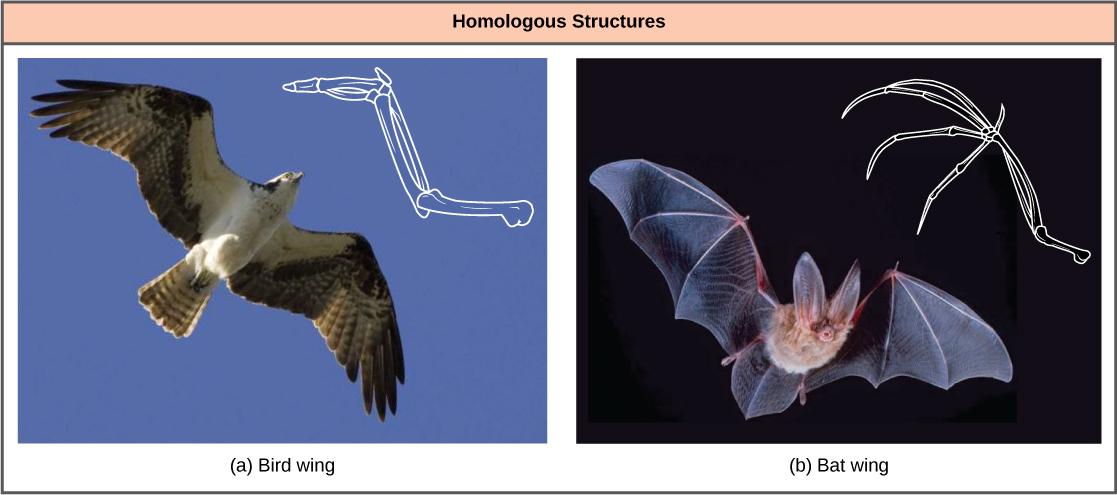
Homologous structures are body parts in different species that share the same underlying anatomy and embryonic origin, even if they serve different functions. A penguin's flipper, a bat's wing, and your arm all contain the same set of bones (humerus, radius, ulna, carpals) arranged in the same pattern. The functions differ wildly (swimming, flying, manipulating objects), but the shared blueprint points back to a common ancestor.
Analogous structures are the opposite situation: body parts that perform similar functions but evolved independently in unrelated lineages. A bird's wing and an insect's wing both enable flight, but they developed from completely different tissues and have no shared structural plan. Analogous structures result from convergent evolution, where similar environmental pressures produce similar adaptations in unrelated organisms.
The key distinction: homologous structures = same structure, different function (evidence of common ancestry). Analogous structures = different structure, same function (evidence of similar selective pressures, not shared ancestry).
Vestigial Structures and Embryology
Vestigial structures are anatomical features that have lost most or all of their original function over evolutionary time. They persist as remnants of structures that were fully functional in ancestral species. The human appendix, the pelvis bones embedded in whale tissue, and tiny hind limb bones in some snake species all point to ancestors where those structures served a clear purpose. Whales, for instance, retain a reduced pelvis because their ancestors were four-legged land mammals.
Embryology provides another window into evolutionary history. When you compare embryos of different vertebrate species at early developmental stages, the similarities are striking. Human, chicken, and fish embryos all develop pharyngeal pouches, a tail, and a notochord. In fish, those pharyngeal pouches become gills. In humans, they develop into structures in the ear and throat. These shared embryonic features reflect a shared genetic program inherited from a common ancestor, even though the adult organisms look nothing alike.

Fossil and Biogeographical Evidence
Fossil Record
Fossils are preserved remains or traces of organisms that lived in the past, and they provide the most direct evidence of how life has changed over time.
The fossil record reveals a clear pattern: older rock layers (deeper in the earth) contain fossils of more ancient, often simpler organisms, while younger rock layers (closer to the surface) contain more recent species. This layering, governed by the principle of superposition, gives scientists a timeline of when different groups appeared and went extinct.
Transitional fossils are especially powerful evidence because they show intermediate forms between an ancestral group and its descendants. Two classic examples:
- Archaeopteryx has features of both dinosaurs (teeth, bony tail, clawed fingers) and modern birds (feathers, wishbone), linking the two groups.
- Tiktaalik has features of both fish (scales, fins) and tetrapods (a flat head, a neck, wrist-like bones in its fins), documenting the transition from water to land.
The fossil record is incomplete because fossilization requires specific conditions, so not every species or transition is preserved. But the fossils we do have consistently match the evolutionary relationships predicted by other evidence.
Biogeography
Biogeography examines where species live and why they live there. The geographic distribution of organisms provides strong evidence for evolution.
Similar environments on different continents often contain different species that fill similar ecological roles. Australia's marsupials (kangaroos, koalas, wombats) and Europe's placental mammals (deer, bears, rodents) occupy comparable niches, yet they belong to very different lineages. This pattern makes sense if each group evolved independently from different ancestors on separate landmasses, rather than being specially created for each environment.
Island species tell an even clearer story. The Galápagos finches and Hawaiian honeycreepers each diversified from a single ancestral species that colonized the islands. Over time, populations adapted to different food sources and habitats, producing clusters of closely related but distinct species. This pattern of adaptive radiation on isolated islands is exactly what evolution predicts.
Molecular Evidence
Molecular Biology and DNA Sequencing
Molecular biology gives us the ability to compare organisms at the most fundamental level: their DNA. By sequencing genomes and comparing nucleotide sequences, scientists can measure how closely related two species are.
The principle is straightforward: species that share a recent common ancestor have more similar DNA sequences, while species that diverged long ago have accumulated more mutations and show greater differences. Humans and chimpanzees share roughly 98-99% of their DNA, while humans and mice share about 85%. These percentages align with the evolutionary relationships established by anatomy and the fossil record, providing independent confirmation.
Molecular clocks take this a step further. Because mutations accumulate at a roughly steady rate in certain genes, scientists can estimate when two species diverged by counting the number of genetic differences between them. This technique has helped date evolutionary splits that left little fossil evidence.
Molecular comparisons aren't limited to DNA. Similarities in protein sequences (like cytochrome c, a protein used in cellular respiration across nearly all aerobic organisms) and the universality of the genetic code itself both point to all life sharing a common ancestor.
Antibiotic Resistance
Antibiotic resistance is one of the clearest real-time demonstrations of evolution by natural selection. Here's how it works:
- A bacterial population naturally contains genetic variation. Some individuals carry mutations that happen to provide partial or full resistance to a particular antibiotic.
- When the antibiotic is applied, most bacteria die. But resistant individuals survive.
- Those survivors reproduce, passing the resistance genes to their offspring.
- Over successive generations, the resistant bacteria dominate the population.
This is natural selection in action: variation exists, a selective pressure is applied, and the individuals best suited to survive reproduce at higher rates.
Overuse and misuse of antibiotics accelerate this process by creating constant selective pressure for resistance. MRSA (methicillin-resistant Staphylococcus aureus) and multidrug-resistant tuberculosis are two well-known results. Both pose serious public health threats precisely because the antibiotics that once killed them no longer work.
Antibiotic resistance matters for your understanding of evolution because it's not a hypothetical or historical example. It's evolution happening right now, on a timescale you can observe in a lab within days or weeks.
See Fiveable more often in Google
Mark Fiveable as a preferred source and Google is more likely to show you our guides in Top Stories, with a "preferred" badge in AI Mode and AI Overviews.