5.2 Cellular Respiration: Glycolysis, Krebs Cycle, and Electron Transport Chain

🐇Honors Biology Unit 5 Review
5.2 Cellular Respiration: Glycolysis, Krebs Cycle, and Electron Transport Chain
🐇 Honors Biology
continue practicing 5.2
Multiple choice
Cellular respiration is the process cells use to break down glucose and produce ATP, the molecule that powers nearly every cellular activity. It involves three main stages: glycolysis, the Krebs cycle, and the electron transport chain. Together, these stages extract as much usable energy from a single glucose molecule as possible.
Glycolysis takes place in the cytoplasm, while the Krebs cycle and electron transport chain both occur inside the mitochondria. Understanding how these stages connect is essential for seeing how cells convert food into fuel.
Glycolysis and Fermentation

Top images from around the web for Glycolysis Overview
Glycolysis | Boundless Biology View original
Is this image relevant?
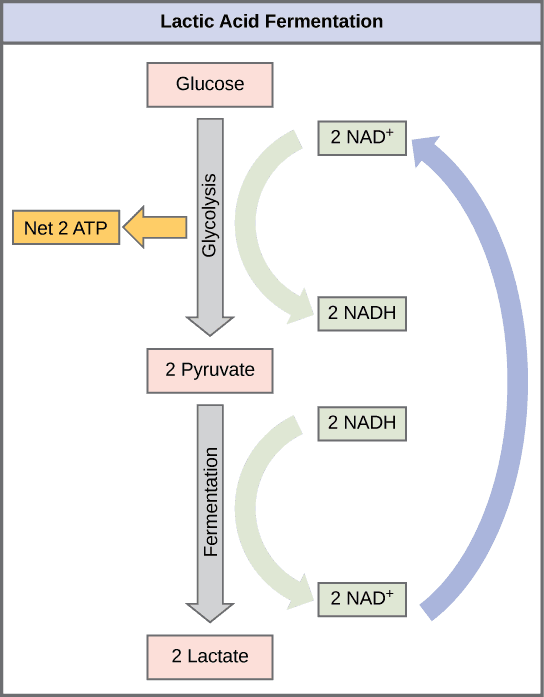
Metabolism without Oxygen · Biology View original
Is this image relevant?
Glycolysis | Boundless Microbiology View original
Is this image relevant?
Glycolysis | Boundless Biology View original
Is this image relevant?
Metabolism without Oxygen · Biology View original
Is this image relevant?
Glycolysis Overview
Glycolysis is the first step of cellular respiration. It splits one 6-carbon glucose molecule into two 3-carbon pyruvate molecules. This happens in the cytoplasm and does not require oxygen, making it an anaerobic process.
The pathway has two phases:
- Energy investment phase: The cell spends 2 ATP to phosphorylate (add phosphate groups to) glucose, making it unstable enough to split apart.
- Energy payoff phase: The split fragments are oxidized, producing 4 ATP and 2 NADH.
Since 2 ATP were invested up front, the net gain is 2 ATP and 2 NADH per glucose molecule. The NADH carries high-energy electrons that will be used later in the electron transport chain.
Pyruvate and Fermentation
What happens to pyruvate depends on whether oxygen is available:
- With oxygen: Pyruvate enters the mitochondria and is converted to acetyl-CoA, which feeds into the Krebs cycle.
- Without oxygen: Pyruvate is rerouted into fermentation.
Fermentation doesn't produce more ATP. Its real job is to regenerate NAD+ from NADH so that glycolysis can keep running. Without NAD+, the energy payoff phase of glycolysis stalls, and ATP production stops entirely.
There are two main types:
- Lactic acid fermentation: Pyruvate is reduced directly to lactate. This occurs in your muscle cells during intense exercise when oxygen delivery can't keep up with demand. That burning sensation in your muscles? That's lactate accumulating.
- Alcoholic fermentation: Pyruvate is first decarboxylated (loses a ) to form acetaldehyde, which is then reduced to ethanol. Yeast and some bacteria use this pathway, which is why yeast produces alcohol and carbon dioxide bubbles during brewing and bread-making.

Krebs Cycle and Electron Transport Chain
Krebs Cycle (Citric Acid Cycle)
The Krebs cycle is the second stage of cellular respiration and takes place in the matrix (the inner compartment) of the mitochondria.
Before the cycle begins, each pyruvate is converted to acetyl-CoA. This is a key transition step: the 3-carbon pyruvate loses one carbon as , and the remaining 2-carbon fragment is attached to coenzyme A. One NADH is also produced per pyruvate during this conversion.
Here's what happens during one turn of the cycle:
- Acetyl-CoA (2 carbons) combines with oxaloacetate (4 carbons) to form citrate (6 carbons). This is why it's also called the citric acid cycle.
- Through a series of redox reactions, citrate is gradually oxidized. Two carbons are released as .
- Each turn produces 3 NADH, 1 FADH2, and 1 GTP (which is equivalent to 1 ATP).
- Oxaloacetate is regenerated at the end, allowing the cycle to repeat.
Since each glucose produces two pyruvates (and therefore two acetyl-CoA), the Krebs cycle turns twice per glucose. That means the total yield per glucose is 6 NADH, 2 FADH2, and 2 ATP from this stage.

Electron Transport Chain and Oxidative Phosphorylation
The electron transport chain (ETC) is the final and most productive stage. It takes place along the inner mitochondrial membrane.
Here's how it works, step by step:
- NADH and FADH2 donate their high-energy electrons to a series of protein complexes embedded in the inner membrane.
- As electrons pass from one complex to the next, they release energy. That energy is used to pump protons () from the matrix into the intermembrane space.
- This builds up a proton gradient, a high concentration of on one side of the membrane. This gradient stores potential energy, much like water behind a dam.
- Protons flow back into the matrix through ATP synthase, a protein that acts like a turbine. The flow of protons drives ATP synthase to produce ATP. This process is called chemiosmosis.
- At the end of the chain, the electrons (now low-energy) combine with oxygen and to form water. This is why you need to breathe oxygen: it serves as the final electron acceptor in the ETC. Without it, the chain backs up and ATP production via oxidative phosphorylation stops.
The ETC and oxidative phosphorylation together produce approximately 34 ATP per glucose molecule, making this stage by far the biggest contributor to the cell's energy yield.
Cellular Respiration Overview
Aerobic Respiration
Aerobic respiration is the complete pathway: glycolysis, the Krebs cycle, and the electron transport chain. It requires oxygen and produces a theoretical maximum of about 36–38 ATP per glucose molecule.
Here's the breakdown:
| Stage | Location | ATP Produced | Key Outputs |
|---|---|---|---|
| Glycolysis | Cytoplasm | 2 ATP (net) | 2 NADH, 2 pyruvate |
| Pyruvate oxidation | Mitochondrial matrix | 0 ATP | 2 NADH, 2 |
| Krebs cycle (×2 turns) | Mitochondrial matrix | 2 ATP | 6 NADH, 2 FADH2, 4 |
| Electron transport chain | Inner mitochondrial membrane | ~34 ATP |
Most of the ATP comes not from direct production but from the NADH and FADH2 molecules that feed into the ETC. The mitochondria's inner membrane is folded into structures called cristae, which increase the surface area available for the electron transport chain and ATP synthase.
The overall equation for aerobic respiration:
Anaerobic Respiration and Efficiency
When oxygen is absent, cells fall back on anaerobic respiration: glycolysis followed by fermentation. This produces only 2 ATP per glucose, which is roughly 18–19 times less efficient than aerobic respiration.
Key comparisons:
- Efficiency: Aerobic yields ~36–38 ATP; anaerobic yields only 2 ATP per glucose.
- Speed: Anaerobic respiration is actually faster, which is why your muscles use it during short bursts of intense activity.
- Byproducts: Aerobic respiration produces and . Anaerobic respiration produces lactate (in animals) or ethanol and (in yeast).
- Oxygen requirement: Aerobic requires as the final electron acceptor. Anaerobic does not.
The tradeoff is straightforward: anaerobic respiration sacrifices efficiency for speed and the ability to function without oxygen. Aerobic respiration extracts far more energy but depends on a steady oxygen supply.
See Fiveable more often in Google
Mark Fiveable as a preferred source and Google is more likely to show you our guides in Top Stories, with a "preferred" badge in AI Mode and AI Overviews.