17.3 Biotic and Abiotic Interactions

🐇Honors Biology Unit 17 Review
17.3 Biotic and Abiotic Interactions
🐇 Honors Biology
continue practicing 17.3
Multiple choice
Biotic and Abiotic Factors
Components of an Ecosystem
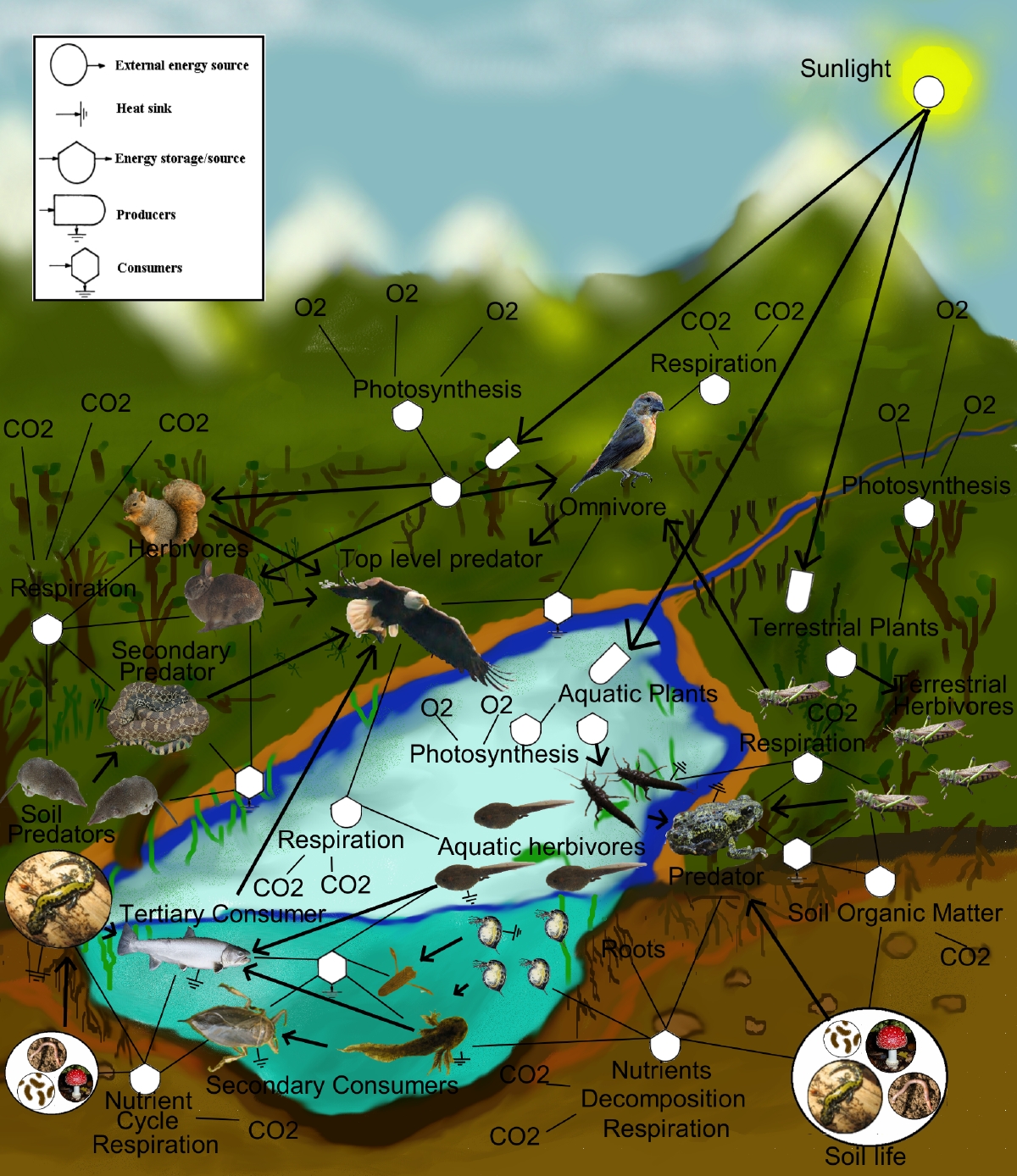
Every ecosystem is built from two categories of factors working together. Biotic factors are all the living organisms: plants, animals, fungi, and bacteria. Abiotic factors are the non-living components that influence those organisms.
Abiotic factors break down into two groups:
- Physical factors: temperature, light intensity, rainfall, wind, soil type
- Chemical factors: atmospheric gases (like and ), water pH, mineral nutrients in the soil
These two categories don't exist in isolation. Abiotic conditions determine which organisms can survive in a given area, and those organisms in turn modify the abiotic environment. A forest canopy, for example, reduces light reaching the forest floor and increases soil moisture, creating conditions that favor shade-tolerant species.
Limiting Factors and Carrying Capacity
A limiting factor is any resource or condition that restricts the growth or abundance of a population. These can be biotic (food availability, predation, disease) or abiotic (temperature, water, sunlight). The factor in shortest supply relative to demand is the one that actually caps population size. In a desert, that's almost always water. In the deep ocean, it's often light or nutrients.
Carrying capacity (represented as in population models) is the maximum population size an environment can sustain indefinitely given its available resources. A few things to keep in mind:
- Carrying capacity isn't fixed. It shifts when resource availability changes, such as after a drought or a particularly productive growing season.
- When a population exceeds , resources get depleted faster than they're replenished. This triggers a population decline through starvation, increased disease, or emigration.
- A classic example: overgrazing by livestock degrades grassland habitat, which lowers the carrying capacity even further, creating a downward spiral.
Symbiotic Relationships
Symbiosis refers to a close, prolonged interaction between two different species living in direct contact. There are three main types, categorized by who benefits and who's harmed.
Mutualism and Commensalism
Mutualism benefits both species:
- Oxpeckers feed on ticks living on rhinos. The bird gets a meal; the rhino gets pest removal.
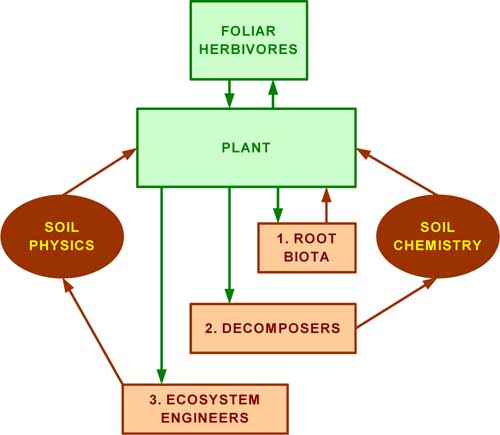
- Mycorrhizal fungi form associations with plant roots. The fungi extend the root system's effective reach, improving water and mineral uptake for the plant. In return, the plant supplies the fungi with carbohydrates produced through photosynthesis. This relationship is extremely widespread; roughly 80–90% of land plants have mycorrhizal partners.
Commensalism benefits one species while the other is neither helped nor harmed:
- Barnacles attach to whale skin, gaining transportation to nutrient-rich waters without measurably affecting the whale.
- Epiphytes like orchids and bromeliads grow on tree branches to access sunlight higher in the canopy. They anchor to the tree for physical support but don't draw nutrients from it, so the tree is unaffected.
The line between mutualism and commensalism can be blurry. Some relationships that look commensal might involve subtle costs or benefits that are hard to measure.
Parasitism
In parasitism, one species (the parasite) benefits at the expense of another (the host). The parasite feeds on the host's tissues or nutrients, reducing the host's fitness but typically not killing it outright, since a dead host means a lost food source.
Parasites are classified by where they live:
- Endoparasites live inside the host's body. Examples include tapeworms in the intestines and Plasmodium protozoans (the cause of malaria) inside red blood cells.
- Ectoparasites live on the host's exterior. Ticks, lice, and fleas all fall into this category.
Parasites have evolved remarkable adaptations for their lifestyle:
- Specialized structures for attachment and feeding, like the hooks of a hookworm or the piercing mouthparts of a mosquito
- Complex life cycles that involve multiple host species. The liver fluke, for instance, passes through snails and fish before reaching its definitive mammalian host. Plasmodium cycles between mosquitoes and humans.
Species Interactions
Competition and Predation
Competition occurs when two or more organisms vie for the same limited resource, whether that's food, territory, mates, or sunlight.
- Intraspecific competition happens within a single species. Male deer competing for mates during rutting season is a common example. This type of competition is often the most intense because individuals of the same species have identical resource needs.
- Interspecific competition occurs between different species. Lions and hyenas competing for the same prey on the African savanna is a well-studied case.
The competitive exclusion principle (sometimes called Gause's principle) states that two species competing for the exact same resources in the same niche cannot coexist indefinitely. One will eventually outcompete the other. In practice, species often avoid this outcome through resource partitioning, where they divide up the resource in some way (feeding at different times, in different locations, or on slightly different food items).
Predation is the interaction where a predator hunts, kills, and consumes prey. Both sides are under strong selective pressure:
- Predators evolve adaptations for capturing prey: sharp claws, acute senses, ambush camouflage, pack hunting strategies.
- Prey evolve defenses: warning coloration (bright colors signaling toxicity), mimicry (harmless species resembling toxic ones), speed, armor, or group vigilance.
Predator and prey populations are tightly linked. The lynx-hare cycle is a textbook example: as hare populations rise, lynx populations follow with a slight time lag. When lynx become abundant enough to suppress hare numbers, the lynx population then crashes from lack of food, and the cycle repeats roughly every 10 years.
Keystone Species
A keystone species has a disproportionately large effect on its ecosystem relative to its abundance. Remove a keystone species, and the entire community structure can shift dramatically.
Three well-known examples:
- Sea otters prey on sea urchins, keeping urchin populations in check. Without otters, urchin populations explode and overgraze kelp forests, turning diverse kelp ecosystems into barren "urchin barrens."
- Gray wolves in Yellowstone regulate elk and deer populations. When wolves were reintroduced in 1995, elk stopped overbrowsing riverbank vegetation. Trees and shrubs recovered, stabilizing stream banks and even altering river channel patterns. This cascade of effects from a single predator is called a trophic cascade.
- Beavers build dams that create wetland habitats. These wetlands support fish, amphibians, waterfowl, and a wide range of plant species that wouldn't otherwise exist in that landscape.
The keystone concept highlights that not all species contribute equally to ecosystem stability. Losing a common grass species might have minimal impact, but losing a keystone predator or ecosystem engineer can reshape the entire community.
See Fiveable more often in Google
Mark Fiveable as a preferred source and Google is more likely to show you our guides in Top Stories, with a "preferred" badge in AI Mode and AI Overviews.