8.2 Volcanoes and Volcanic Eruptions

🏝️Earth Science Unit 8 Review
8.2 Volcanoes and Volcanic Eruptions
🏝️ Earth Science
continue practicing 8.2
Multiple choice
Volcano Formation and Structure
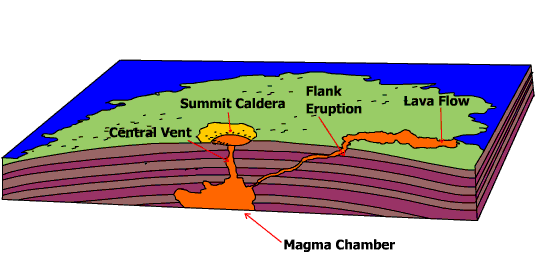
Volcanoes are vents or fissures in Earth's crust where molten rock (magma), volcanic gases, and ash escape onto the surface. Magma forms when rock in the upper mantle or lower crust melts, typically due to increased heat, decreased pressure, or the addition of water. Once magma reaches the surface, it's called lava.
Volcanic activity is closely tied to plate tectonics, with most volcanoes forming at plate boundaries or over hotspots. The type of eruption and the shape of the volcano depend largely on the magma's composition, particularly its silica content and gas content.
Types of Volcanoes
Shield volcanoes are broad, gently sloping structures built from repeated flows of fluid basaltic lava. Their low profile and wide base resemble a warrior's shield laid on the ground. Mauna Loa and Mauna Kea in Hawaii are classic examples. Because the lava is runny and low in silica, eruptions tend to be relatively calm.
Cinder cones are small, steep-sided volcanoes built from ejected lava fragments called cinders or scoria. They typically have a bowl-shaped crater at the summit and rarely rise more than about 300 meters (1,000 feet). Parícutin in Mexico famously grew from a cornfield starting in 1943, reaching about 336 meters in its first year.
Composite volcanoes (also called stratovolcanoes) are tall, conical volcanoes made of alternating layers of hardened lava, tephra, and volcanic ash. Their magma is viscous and silica-rich, which traps gas and leads to periodic explosive eruptions. Mount Fuji in Japan and Mount Rainier in Washington State are well-known examples.
Volcanic Landforms
Beyond the three main volcano types, volcanic activity produces several other landforms:
- Lava domes form when viscous lava is too thick to flow far and instead piles up around the vent.
- Calderas are large, roughly circular depressions that form when a volcano's summit collapses after a massive eruption empties the magma chamber beneath it. Yellowstone's caldera spans about 72 km across.
- Volcanic plugs are the solidified remains of magma that hardened inside a volcano's conduit. After the surrounding rock erodes away, the plug stands alone. Shiprock in New Mexico is a striking example.
Volcanic Eruption Classification
Effusive and Explosive Eruptions
The two broad categories of eruptions are effusive and explosive, and the difference comes down to magma viscosity and gas content.
Effusive eruptions involve the gentle outpouring of fluid, low-viscosity basaltic magma. Lava flows spread across the landscape, building shield volcanoes, lava plains, and lava tubes. Kilauea in Hawaii and Nyiragongo in the Democratic Republic of the Congo are known for this type of eruption.
Explosive eruptions happen when viscous, gas-rich magma can't release its dissolved gases gradually. Instead, pressure builds until the magma fragments violently into ash, pumice, and volcanic bombs. These eruptions produce towering ash clouds, pyroclastic flows, and lahars (volcanic mudflows). Mount St. Helens in 1980 and Krakatoa in 1883 are famous examples.
Pyroclastic flows deserve special attention because they're the deadliest volcanic hazard. These are ground-hugging avalanches of hot ash, pumice, rock fragments, and volcanic gas that race down a volcano's slopes at speeds up to 200 m/s (roughly 450 mph) and temperatures around 1,000°C. There is essentially no surviving one if you're in its path.
Volcanic Ejecta and Explosivity
Volcanic ejecta refers to all material thrown from a volcano during an eruption. This includes:
- Volcanic bombs (large, partially molten rock fragments)
- Lapilli (pebble-sized fragments, 2–64 mm)
- Ash (fine particles less than 2 mm)
- Volcanic gases (water vapor, , , and others)
The size and composition of ejecta depend on the eruption type and the magma's characteristics.
Scientists classify eruption strength using the Volcanic Explosivity Index (VEI), a scale from 0 to 8. A VEI 0 eruption is non-explosive (think gentle Hawaiian lava flows), while a VEI 8 is a mega-colossal eruption. The 1980 Mount St. Helens eruption was a VEI 5; the Yellowstone supervolcano eruption about 640,000 years ago was a VEI 8. Each step up on the scale represents roughly a tenfold increase in the volume of ejected material.
Plate Tectonics and Volcanoes
Volcanic Activity at Plate Boundaries
Most volcanoes form at plate boundaries, and the type of boundary determines the style of volcanism.
Divergent boundaries are where plates pull apart. Basaltic magma rises to fill the gap, creating new oceanic crust through mostly effusive eruptions. The Mid-Atlantic Ridge (which surfaces in Iceland) and the East African Rift are examples. These eruptions tend to be relatively gentle because the magma is low in silica and gas escapes easily.
Convergent boundaries are where plates collide. When an oceanic plate subducts beneath a continental or another oceanic plate, it carries water down into the mantle. That water lowers the melting point of the overlying mantle rock, generating magma that rises through the crust. This magma is typically silica-rich and gas-laden, producing explosive eruptions and forming volcanic arcs. The Andes Mountains and the Aleutian Islands in Alaska are both volcanic arcs formed by subduction.
Hotspot and Intraplate Volcanism
Not all volcanoes sit on plate boundaries. Hotspot volcanism occurs when a mantle plume brings extremely hot material from deep in the mantle up toward the surface, melting rock along the way. As a tectonic plate drifts over a stationary hotspot, a chain of volcanoes forms. The Hawaiian Islands are the textbook example: the oldest islands are to the northwest, and the youngest (the Big Island, with active Kilauea) sits directly over the hotspot today. Yellowstone is another hotspot, this one beneath a continental plate.
Intraplate volcanism can also occur away from hotspots, often linked to the reactivation of ancient rifts or localized heat sources. These eruptions are less common and typically effusive. The Eifel volcanic field in Germany and the Tibesti Mountains in Chad are examples.

Volcanic Hazards vs. Benefits
Hazards Associated with Volcanic Eruptions
Volcanic eruptions produce several distinct hazards, each dangerous in different ways:
- Lava flows destroy buildings, roads, and vegetation in their path. Damage depends on the lava's viscosity and the terrain's slope. Basaltic flows can travel quickly but are usually slow enough for people to evacuate.
- Pyroclastic flows are the deadliest hazard. They travel too fast to outrun and incinerate everything in their path. The 79 CE eruption of Vesuvius buried Pompeii largely through pyroclastic flows.
- Ash falls cause respiratory problems, damage crops, disrupt air and ground transportation, and can collapse roofs under accumulated weight. Fine volcanic ash is especially dangerous to aircraft engines and can ground flights across entire regions.
- Volcanic gases like , , and hydrogen fluoride cause respiratory irritation and acid rain. Large eruptions that inject into the stratosphere can cause temporary global cooling. The 1991 eruption of Mount Pinatubo lowered global temperatures by about 0.5°C for over a year.
- Lahars are volcanic mudflows triggered by heavy rainfall, rapid snowmelt, or the collapse of volcanic material. They can travel long distances down river valleys at high speed and bury entire communities.
Benefits of Volcanic Activity
Volcanoes aren't only destructive. They provide significant benefits:
- Fertile soils: Volcanic ash and weathered lava break down into nutrient-rich soils called andisols. This is why many volcanic regions support thriving agriculture, such as the coffee-growing highlands of Central America.
- Geothermal energy: Hot springs, geysers, and steam vents near volcanoes can be tapped for clean, renewable energy. Iceland generates about 25% of its electricity from geothermal sources.
- Mineral deposits: Hydrothermal circulation near volcanoes concentrates valuable minerals like copper, gold, and silver into economically important ore deposits.
- Tourism and research: Volcanic landscapes like calderas, lava fields, and geothermal features attract visitors and provide opportunities for scientific study, generating income for local communities.
Monitoring and Mitigation Strategies
Predicting exactly when a volcano will erupt remains difficult, but volcanologists use several techniques to assess risk:
- Seismic monitoring detects the small earthquakes caused by magma moving underground. An increase in earthquake frequency or intensity often signals that an eruption may be approaching.
- Ground deformation measurements use GPS and satellite radar to track swelling or tilting of the volcano's surface, which indicates magma accumulating beneath.
- Gas emissions analysis measures changes in the types and amounts of gases escaping from vents. A spike in emissions, for instance, can indicate fresh magma rising toward the surface.
These data feed into hazard maps that show which areas face the greatest risk from lava flows, pyroclastic flows, lahars, and ash fall. Combined with evacuation plans and public education, monitoring systems have saved thousands of lives. The 1991 evacuation around Mount Pinatubo, guided by monitoring data, is one of the most successful examples.
See Fiveable more often in Google
Mark Fiveable as a preferred source and Google is more likely to show you our guides in Top Stories, with a "preferred" badge in AI Mode and AI Overviews.