3.1 Poetic Forms and Structures

🔤English 9 Unit 3 Review
3.1 Poetic Forms and Structures
🔤 English 9
Poetry comes in many shapes and sizes, each with its own rules and rhythms. From the structured sonnets of Shakespeare to the free-flowing verses of Whitman, poetic forms offer diverse ways to express ideas and emotions.
Understanding these forms helps you appreciate the craft behind the words. Whether it's the concise beauty of a haiku or the intricate patterns of a villanelle, each form shapes a poem's impact and meaning in specific ways.
Poetic Forms

Top images from around the web for Types of poetic forms
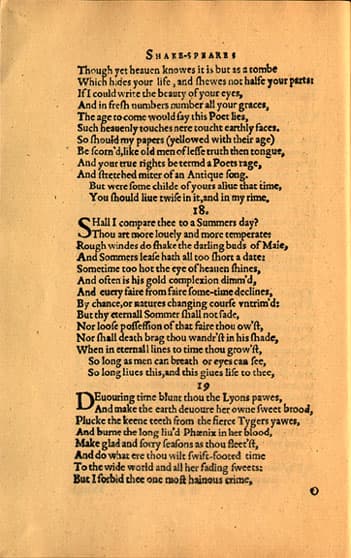
Shakespeare's sonnets - Wikipedia View original
Is this image relevant?
Poetic devices - Wikipedia View original
Is this image relevant?
Haiku - Wikipedia View original
Is this image relevant?
Shakespeare's sonnets - Wikipedia View original
Is this image relevant?
Poetic devices - Wikipedia View original
Is this image relevant?
Types of Poetic Forms
Sonnets consist of 14 lines written in iambic pentameter, which means each line has 10 syllables that alternate between unstressed and stressed syllables (da-DUM da-DUM da-DUM da-DUM da-DUM). There are two main types:
- English (Shakespearean) sonnets follow the rhyme scheme ABAB CDCD EFEF GG. That final rhyming couplet (GG) often delivers a twist or conclusion.
- Italian (Petrarchan) sonnets follow the rhyme scheme ABBAABBA in the first eight lines (the octave), then shift to CDECDE or CDCDCD in the last six lines (the sestet). That shift between octave and sestet, called the volta or "turn," usually marks a change in the poem's argument or perspective.
Haikus are a Japanese poetic form consisting of just three lines with a syllable pattern of 5-7-5 (17 syllables total). They traditionally focus on nature or seasonal imagery, like cherry blossoms in spring or autumn leaves. Because they're so short, every word has to earn its place.
Free verse does not follow strict meter or rhyme schemes. Instead, it relies on natural speech patterns and rhythms, giving the poet greater flexibility in expression and form. Walt Whitman's Leaves of Grass is one of the most famous examples. Don't confuse "free" with "random," though. Free verse poets still make deliberate choices about line length, rhythm, and sound.

Structure and Organization in Poetry
Stanzas are groups of lines in a poem, similar to paragraphs in prose. They organize ideas and themes and can follow specific patterns:
- A couplet has 2 lines
- A tercet has 3 lines
- A quatrain has 4 lines
Stanzas may follow a set rhyme scheme or meter, or they can vary in length throughout the poem.
Line breaks indicate where a line of poetry ends and a new one begins. Poets use them for emphasis, pacing, and visual effect. Two key concepts here:
- Enjambment occurs when a sentence or phrase continues from one line to the next without punctuation, pulling the reader forward. For example: "I wandered lonely as a cloud / That floats on high o'er vales and hills". Your eye keeps moving because the thought isn't finished.
- End-stopped lines end with punctuation, creating a pause or a sense of completion. For example: "Shall I compare thee to a summer's day? / Thou art more lovely and more temperate:". Each line feels like its own unit.
Recognizing these techniques helps you understand why a poem feels fast or slow, urgent or calm.

Purpose of Poetic Forms
Form isn't just decoration. It actively shapes how a poem communicates.
- Form can reinforce or contrast with a poem's content. A strict form like a sonnet can suggest order or tradition, while free verse might signal freedom or rebellion against convention.
- Structure creates emotional and tonal effects. Short, choppy lines can build urgency or tension. Long, flowing lines tend to feel calmer or more expansive.
- Repetition of forms or patterns can hammer home key ideas. The villanelle, for instance, repeats entire lines throughout the poem, which can create an obsessive or haunting quality. Dylan Thomas's "Do Not Go Gentle into That Good Night" is a famous example.
Comparison of Poetic Forms
| Feature | Sonnet | Haiku | Free Verse |
|---|---|---|---|
| Length | 14 lines | 3 lines | Varies |
| Meter | Iambic pentameter | Syllable count (5-7-5) | No fixed meter |
| Rhyme | Set rhyme scheme | Typically no rhyme | No required rhyme |
| Typical Subject | Complex emotions, arguments, love | Nature, seasons, single moments | Any subject |
| Tone/Feel | Musical, structured | Brief, contemplative | Conversational, flexible |
Structured forms like sonnets, ballads, and odes carry a long history and cultural weight. Their rules create a sense of musicality and order. Free verse, by contrast, allows for more experimentation and personal expression, and can feel more modern or conversational. T.S. Eliot's The Waste Land is a good example of how free verse can still be deeply complex even without traditional structure.
The key takeaway: a poet's choice of form is never accidental. It's one of the first interpretive clues you have when reading a poem.
See Fiveable more often in Google
Mark Fiveable as a preferred source and Google is more likely to show you our guides in Top Stories, with a "preferred" badge in AI Mode and AI Overviews.