7.3 Roman numerals

🏛️Elementary Latin Unit 7 Review
7.3 Roman numerals
🏛️ Elementary Latin
Origins of Roman numerals
Roman numerals served as the counting system of ancient Rome, used for everything from trade receipts to monumental inscriptions. Understanding how they work is essential for reading Latin texts, interpreting dates on buildings and documents, and grasping how Romans thought about numbers.

Top images from around the web for Historical context
Latin inscription on the Roman milestone... © Karl and Ali cc-by-sa/2.0 :: Geograph Britain and ... View original
Is this image relevant?
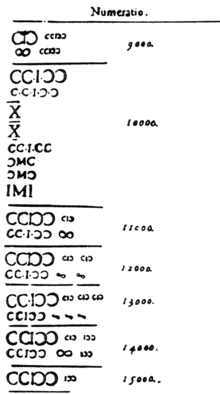
Roman numerals - Wikipedia View original
Is this image relevant?
Category:Ancient Roman inscriptions in the Museo Arqueológico y Etnológico de Córdoba ... View original
Is this image relevant?
Latin inscription on the Roman milestone... © Karl and Ali cc-by-sa/2.0 :: Geograph Britain and ... View original
Is this image relevant?
Roman numerals - Wikipedia View original
Is this image relevant?
Historical context
The system has roots in the Etruscan civilization, which predated the Roman Empire by several centuries. Early versions evolved from simple tally marks used for counting livestock, goods, and debts. As Rome expanded, the Romans adopted and refined these marks into a standardized system suited to governing a vast empire. You'll find Roman numerals carved into temples, stamped on coins, and written across official records throughout the Roman world.
Development over time
The system started out representing numbers only up to about 1,000. As Roman society grew more complex, so did its numerical needs. One major development was subtractive notation, which shortened awkward strings of repeated symbols. For example, 49 could be written as XLIX instead of the cumbersome XXXXVIIII.
The system continued to evolve through the Middle Ages, when many of the conventions we recognize today became standardized, though regional variations persisted for centuries.
Basic Roman numeral symbols
Seven primary symbols form the backbone of the entire system. Every Roman numeral you'll ever encounter is built from combinations of these characters.
Primary numerals
| Symbol | Value | Origin |
|---|---|---|
| I | 1 | A single tally mark or finger |
| V | 5 | Possibly the shape of an open hand |
| X | 10 | Two Vs placed point-to-point |
| L | 50 | Thought to derive from a halved form of C |
| C | 100 | From the Latin word centum (hundred) |
| D | 500 | Possibly from half of the symbol for 1,000 |
| M | 1,000 | From the Latin word mille (thousand) |
A helpful mnemonic for remembering these in ascending order: I Value Xylophones Like Cows Dig Milk.
Secondary numerals
For numbers above a few thousand, less common symbols appear in some ancient texts:
- ↁ represents 5,000
- ↂ represents 10,000
- ↇ represents 50,000
- ↈ represents 100,000
You won't encounter these often in elementary Latin, but they're worth knowing exist.
Roman numeral system structure
The Roman numeral system works very differently from the Arabic place-value system you use every day. In Arabic numerals, the digit 3 means something different in 30 vs. 300 vs. 3,000 because its position determines its value. Roman numerals don't work that way. Each symbol always represents the same fixed value, and you combine symbols to build up a number.
Additive vs. subtractive notation
Additive notation is the default: you read left to right and add up the values.
VII = 5 + 1 + 1 = 7
Subtractive notation kicks in when a smaller-value symbol is placed before a larger one. That tells you to subtract the smaller from the larger.
IV = 5 − 1 = 4
Both notations can appear in the same number:
MCMXCIX = 1,000 + (1,000 − 100) + (100 − 10) + (10 − 1) = 1,999
Place value concept
Since Roman numerals lack true place value, the system relies entirely on which symbols appear and their order relative to each other. Larger values are generally written to the left of smaller values. There's no symbol for zero, and there's no way for a symbol's position alone to change its meaning.

Writing Roman numerals
Follow these rules when converting a number into Roman numerals:
- Break the number into thousands, hundreds, tens, and ones. For example, 2,954 breaks into 2,000 + 900 + 50 + 4.
- Write each group using the appropriate symbols. 2,000 = MM, 900 = CM, 50 = L, 4 = IV.
- Combine them left to right, largest to smallest. 2,954 = MMCMLIV.
Rules for combining symbols
- You can repeat I, X, C, and M up to three times in a row (III = 3, XXX = 30, CCC = 300).
- Never repeat V, L, or D. There's no VV for 10; you just write X.
- Use subtractive notation for 4s and 9s in each decimal place: IV (4), IX (9), XL (40), XC (90), CD (400), CM (900).
- Only subtract one symbol at a time. Writing IL for 49 is incorrect; the correct form is XLIX (40 + 9).
- Only subtract a symbol that is one "level" below: I subtracts from V or X; X subtracts from L or C; C subtracts from D or M.
Representing large numbers
For numbers above a few thousand, a bar (vinculum) placed over a symbol multiplies its value by 1,000:
= 5,000 · = 10,000 · = 200,000
You can also combine bars with standard symbols. For instance, 5,999 can be written as CMXCIX rather than stringing together five Ms.
Reading Roman numerals
Reading Roman numerals is the reverse of writing them. Here's a step-by-step process:
- Start at the leftmost symbol.
- Compare each symbol to the one immediately to its right.
- If the current symbol's value is greater than or equal to the next one, add it to your running total.
- If the current symbol's value is less than the next one, subtract it from the next symbol's value, add that result to your total, and skip ahead past both symbols.
- Continue until you've processed every symbol.
Worked example: MCMXLIV
- M (1,000) → next is C, which is smaller, so add 1,000. Running total: 1,000.
- C (100) → next is M (1,000), which is larger, so subtract: 1,000 − 100 = 900. Running total: 1,900.
- X (10) → next is L (50), which is larger, so subtract: 50 − 10 = 40. Running total: 1,940.
- I (1) → next is V (5), which is larger, so subtract: 5 − 1 = 4. Running total: 1,944.
MCMXLIV = 1,944
Common patterns worth memorizing
- IV = 4, IX = 9, XL = 40, XC = 90, CD = 400, CM = 900
- Repeated symbols: III = 3, XXX = 30, CCC = 300
- Familiar dates: MCMLXIX = 1969, MMXXIV = 2024
Roman numerals vs. Arabic numerals
Advantages and disadvantages
Roman numerals work well for small numbers and are visually distinctive, which is why they persist in formal and decorative contexts. But they become unwieldy for large numbers and are poorly suited to complex arithmetic. There's no symbol for zero, no way to represent negative numbers, and no efficient method for multiplication or division.
Arabic numerals, with their place-value system and zero, allow for compact notation and rapid calculation. That efficiency is why they eventually replaced Roman numerals for most practical purposes.

Historical transition
Arabic numerals reached Europe around the 10th century CE, transmitted through contact with the Islamic world. Merchants and mathematicians adopted them gradually because they made commerce and calculation far easier. Roman numerals held on in official documents and formal contexts for several more centuries, but by the 15th and 16th centuries, Arabic numerals dominated in most fields. Roman numerals survived in specific niches: clock faces, chapter headings, formal documents, and inscriptions.
Roman numerals in modern usage
You still encounter Roman numerals regularly, even if you don't always notice them.
Clock faces and documents
- Many analog clocks use Roman numerals for the hours (though some use IIII instead of IV for visual balance).
- Legal documents and outlines often number sections with Roman numerals.
- Academic books frequently use lowercase Roman numerals (i, ii, iii...) for front matter page numbers.
Film, sports, and book conventions
- Movie end credits traditionally display the copyright year in Roman numerals (e.g., MMXXIII for 2023).
- The Super Bowl uses Roman numerals to identify each year's game (Super Bowl LVIII = 58).
- Book chapters and volumes are often numbered with Roman numerals.
- Film and game sequels sometimes use them in titles (Rocky II, Final Fantasy VII).
Mathematical operations with Roman numerals
Doing math with Roman numerals gives you a sense of why the Romans eventually needed something better for complex calculations.
Addition and subtraction
Addition is relatively straightforward: combine all the symbols from both numbers, then regroup and simplify.
VIII + VII: Combine to get VVIIIIII → regroup as XIIIII → simplify to XV (15)
For subtraction, cancel matching symbols and convert as needed.
XVI − VII: Cancel the shared V and one I → remaining is X and minus one I from the leftover II → IX (9)
In practice, Romans often used counting boards (abaci) rather than doing symbol manipulation on paper.
Multiplication and division challenges
Multiplication essentially requires repeated addition (III × IV means adding III four times to get XII). Division involves repeated subtraction or grouping. These processes get extremely tedious with large numbers, and there's no clean way to handle remainders or fractions within the system.
These limitations are a major reason Arabic numerals, with their support for zero and efficient algorithms for multiplication and long division, eventually won out for mathematical work.
Common errors and misconceptions
Incorrect symbol combinations
These mistakes come up frequently:
- Writing IIII for 4. The standard form is IV. (You will see IIII on some clock faces, but that's a deliberate design tradition, not correct standard notation.)
- Skipping levels in subtractive notation. IC for 99 is wrong. The correct form is XCIX (90 + 9). You can only subtract I from V or X, X from L or C, and C from D or M.
- Repeating a symbol more than three times. XXXX for 40 is wrong; use XL.
- Subtracting more than one symbol at once. IIX for 8 is wrong; the correct form is VIII.
Misinterpretation of values
- Confusing L (50) with I (1) in handwritten or weathered inscriptions.
- Assuming that any smaller-before-larger pair is subtractive. In practice, only specific pairs (IV, IX, XL, XC, CD, CM) use subtractive notation.
- Misreading the bar notation: means 5,000, not just "V with a line."
- Applying modern math concepts (like negative numbers or decimal fractions) to a system that simply didn't have them.
See Fiveable more often in Google
Mark Fiveable as a preferred source and Google is more likely to show you our guides in Top Stories, with a "preferred" badge in AI Mode and AI Overviews.