
Types of Latin Prefixes
Latin prefixes are word parts attached to the front of root words that change or refine their meaning. Most come from prepositions or adverbs, and they show up constantly in Latin texts. Learning them gives you a reliable way to break down unfamiliar vocabulary, both in Latin and in the many English words that descend from it.
Prefixes generally fall into a few functional categories: direction, quantity, negation, and time/order.
Prefixes Indicating Direction
These prefixes tell you where the action is headed:
- Ad- (towards): movement or action toward something. advenio = to arrive (to come towards)
- Ab- (away from): separation or departure. abeo = to go away
- In- (into, in): entering or being placed within. ingredior = to enter
- Ex- (out of, from): movement outward. exeo = to go out
- Trans- (across, through): movement across or beyond. transeo = to cross over
Prefixes Denoting Quantity
These tell you "how many" or "how much":
- Uni- (one): singularity. unicus = only, singular
- Bi- (two): duality or pairs. bilinguis = bilingual
- Multi- (many): plurality or abundance. multiplex = manifold
- Semi- (half): partial or incomplete. semideus = demigod
- Omni- (all): totality. omnipotens = all-powerful
Prefixes Expressing Negation
Watch out here: in- can mean "not" or "into," depending on context (more on this below).
- In- (not, un-): negates the root word. infelix = unhappy
- Non- (not): straightforward negation. nonnullus = some (literally "not none")
- Dis- (apart, away): often implies reversal. discedo = to depart
- A-/Ab- (away from, without): can indicate absence. amens = out of one's mind
- Ne- (not): negation or prohibition in certain words. nefas = wrong, sin
Prefixes Showing Time or Order
These orient you in time or sequence:
- Prae- (before): precedence in time or rank. praevenio = to come before
- Post- (after): something that follows. postpono = to put after, postpone
- Inter- (between, among): intervals or relationships. interpono = to place between
- Re- (again, back): repetition or return. redeo = to go back, return
- Pro- (forward, forth): advancement. procedo = to go forward, advance
Note the spelling: in Latin the prefix is prae-, not "pre-." The simplified "pre-" form is what survived into English.
Common Latin Prefixes
This section pairs up prefixes that are easy to confuse, so you can see how they contrast.
Ad- vs Ab-
Ad- (to, towards) and ab- (from, away) are near-opposites.
- addo = to add to; abduco = to lead away
Both undergo spelling changes depending on what letter follows:
- Ad- often assimilates: ad- + fero → affero (to bring to), ad- + cedo → accedo (to approach)
- Ab- can appear as a- or abs-: amitto (to send away), abstraho (to drag away)
Con- vs Dis-
Con- (with, together) and dis- (apart, away) are another opposing pair.
- coniungo = to join together; discedo = to depart
Con- assimilates frequently: it becomes col- before l, cor- before r, and com- before b, m, or p. So colligo (to gather), corrigo (to correct), compono (to put together).
Dis- can shorten to di- before certain consonants: digredior (to depart).
Con- also sometimes acts as an intensifier rather than meaning "together." Conficio doesn't just mean "to do together" but "to finish completely."
In- and Its Variations
This is one of the trickiest prefixes because in- has two completely different meanings:
- Locative in- = "in, into, onto" (ingredior = to enter)
- Negative in- = "not, un-" (infelix = unhappy)
You have to use context to tell them apart. If the root is a verb of motion, in- probably means "into." If it's attached to an adjective, it's likely the negative.
Both versions undergo the same assimilation:
- il- before l (illudo)
- im- before b, m, p (immitto, impius)
- ir- before r (irrumpo)
Prae- and Post-
Prae- (before) and post- (after) mark position in time or space.
- praepono = to place before; postpono = to place after
Prae- can also imply superiority or intensity: praeclarus means not just "previously bright" but "very bright, illustrious."
Post- is used to form comparatives: posterior = later, following.
Sub- and Super-
Sub- (under, below) and super- (above, over) describe vertical position or rank.
- subeo = to go under; superpono = to place over
Sub- has a secondary meaning of "slightly" or "secretly": subrideo = to smile slightly.
Sub- assimilates heavily: suc- before c, suf- before f, sug- before g, sum- before m, sup- before p. So succedo, suffero, suggero.
Prefix Modifications
Latin prefixes don't always keep their original spelling. They change to make pronunciation smoother. Recognizing these changes is essential for identifying prefixes in the wild.

Assimilation of Consonants
Assimilation happens when the last consonant of a prefix changes to match the first consonant of the root. This makes the word easier to say.
The main patterns:
| Prefix | Before | Becomes | Example |
|---|---|---|---|
| Ad- | c, f, g, l, n, p, r, s, t | ac-, af-, ag-, al-, an-, ap-, ar-, as-, at- | accedo, affero, aggredior |
| Con- | l, r, b/m/p | col-, cor-, com- | colligo, corrigo, compono |
| In- | l, b/m/p, r | il-, im-, ir- | illudo, immitto, irrumpo |
| Sub- | c, f, g, m, p | suc-, suf-, sug-, sum-, sup- | succedo, suffero, suggero |
When you see a doubled consonant in a Latin word (like affero or colligo), that's often a clue that a prefix has assimilated.
Vowel Changes in Prefixes
Some prefixes drop or change vowels depending on what follows:
- Ab- can become a- before most consonants other than h: amitto (to send away)
- Ex- may shorten to e- before consonants: educo (to lead out)
- Pro- can become prod- before vowels: prodeo (to go forth)
- Re- adds a d before vowels to prevent two vowels from colliding: redeo (to go back)
Prefix Truncation
Sometimes part of the prefix simply drops off:
- Dis- → di- before certain consonants: digredior (to depart)
- Ex- → e- before b, d, g, l, m, n, r, v: ebibo (to drink up)
- Trans- → tra- before d or n: trado (to hand over)
- Circum- → circu- before vowels: circueo (to go around)
- Per- can lose its r before l: pellucidus (transparent)
Semantic Impact of Prefixes
Prefixes don't just tweak meaning slightly. They can intensify, reverse, or fundamentally transform what a root word means.
Intensifying Meaning
Several prefixes can mean "thoroughly" or "completely" rather than their literal directional sense:
- Per- often adds "thoroughly": perficio = to complete, accomplish (not just "to do through")
- Con- can intensify: conficio = to finish completely
- Re- sometimes means "thoroughly" rather than "again": reseco = to cut back drastically
- Ex- can emphasize completeness: exuro = to burn completely
- Prae- sometimes adds a sense of exceptional degree: praeclarus = very bright, illustrious
This intensifying function is easy to miss if you only memorize the basic prefix meaning. Context matters.
Reversing or Negating Meaning
- Dis- reverses the root action: dissolvo = to loosen, break up (opposite of solvo in a stronger sense)
- In- (negative) flips adjectives: infelix = unhappy
- De- can indicate removal or decrease: decresco = to decrease, diminish
- Ex- sometimes implies deprivation: exanimo = to deprive of life
- Ab- can negate: abnego = to refuse, deny
Changing Word Class
Prefixes can shift a word's grammatical category:
- Ad- + adjective → verb: ad + levis → allevo (to lighten, relieve)
- Con- + noun → verb: con + silium → consulo (to consult)
- In- + adjective → new adjective: in + felix → infelix (unhappy)
- Ex- + noun → verb: ex + anima → exanimo (to deprive of life)
Prefixes in English Derivatives
A huge number of English words preserve Latin prefixes with their original meanings mostly intact. Recognizing them gives you a shortcut for building English vocabulary too.
Recognizing Latin Prefixes
When prefixes crossed into English, they kept their assimilated forms:
- Ad- shows up as ac-, af-, ag-, al-, an-, ap-, ar-, as-, at-: accede, affect, aggression, allocate, announce, approve
- Con- appears as con-, com-, col-, cor-: convene, compress, collaborate, correspond
- In- (both meanings) persists with its variations: insert, illegal, immobile, irregular
- Prae-/Pre- and post- keep their forms: precede, postpone
- Sub- and super- remain recognizable: submarine, superimpose
Prefix Influence on Meaning
The meanings transfer fairly directly into English:
- Ex- = "out of" or "former": extract, ex-president
- Re- = "again" or "back": return, revise
- Dis- = negation or reversal: disagree, dismantle
- Trans- = "across" or "beyond": transport, transcend
- Inter- = "between" or "among": interact, international
Prefixes in Scientific Terminology
Scientific and medical English relies heavily on Latin (and Greek) prefixes:
- Uni-, bi-, tri- for number: unicellular, bilateral, tripartite
- Multi- for "many": multifaceted, multilateral
- Sub- and super- in anatomy and chemistry: subcutaneous (under the skin), superoxide
- Extra- and intra- in medicine: extracellular (outside the cell), intramuscular (within the muscle)
- Semi- for "half" or "partial": semiconductor, semipermeable
Usage in Latin Texts
Different genres of Latin writing use prefixes in characteristic ways. Knowing this helps you anticipate vocabulary when reading.
Prefixes in Classical Literature
- Cicero uses prefixes for rhetorical contrast, pairing opposites like dedecus (disgrace) vs. decus (honor)
- Vergil packs his poetry with prefixed verbs for vivid action: ingemit (groans deeply), procumbit (falls forward)
- Caesar relies on prefixed words for precise military language: circumvenio (to surround), praemitto (to send ahead)
- Ovid plays with unusual prefix combinations for poetic effect: irremeabilis (from which there is no return)
Prefixes in Ecclesiastical Latin
Church Latin developed its own characteristic prefix usage:
- Prae- and ante- mark events before Christ: praedestinatio (predestination)
- Con- expresses unity and community: confiteor (I confess), congregatio (congregation)
- Re- signals spiritual renewal: redemptor (redeemer), resurrectio (resurrection)
- Trans- appears in sacramental language: transubstantiatio (transubstantiation)
Prefixes in Legal Latin
Legal terminology has its own patterns:
- Ab- and de- for removal or cessation: abrogatio (repeal), desuetudo (disuse)
- Inter- for agreements and exchanges: interdictum (injunction), interpellatio (interruption of proceedings)
- Pro- in procedural terms: prorogatio (extension), promulgatio (public announcement)
- Re- for restoration: restitutio (restoration), rescissio (annulment)
Prefixes vs. Prepositions
Many Latin prefixes started life as prepositions, and the two forms often coexist. Understanding how they relate helps with both vocabulary and syntax.
Similarities and Differences
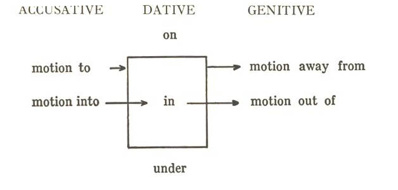
The core distinction: prefixes attach directly to words and change their meaning, while prepositions stand alone and govern the case of a following noun.
Many forms serve both roles. Sub, for instance, works as a preposition (sub monte = under the mountain) and as a prefix (subeo = to go under). The basic meaning stays similar, but the grammatical function is completely different.
Contextual Usage
Prefixed verbs and prepositions sometimes work together in the same phrase, reinforcing each other:
- incedo in urbem = to walk into the city (prefix in- + preposition in)
- pervenio ad finem = to arrive at the end (prefix per- intensifies the arrival)
Some prefixed verbs take their objects in cases that match the prefix's prepositional meaning. For example, exeo urbe (to go out of the city) uses the ablative without a separate preposition, because the ex- prefix already implies "out of."
Certain prefixed verbs can shift meaning depending on which preposition follows: accedo ad (to approach toward) vs. accedo in (to enter into).
Grammatical Functions
A few key differences to keep in mind:
- Prefixes affect the lexical meaning of a word and sometimes change its grammatical behavior (what case its object takes, for instance)
- Prepositions govern noun cases and show syntactic relationships
- Prefixed verbs may take different constructions than their unprefixed forms: transeo takes a direct accusative (transeo flumen = I cross the river), while plain eo needs a preposition
- Prepositions can sometimes function as adverbs, but prefixes always remain bound to their words
Exercises and Practice
Identifying Prefixes in Words
- Take Latin words apart to separate prefix from root: de-scribo, in-ter-ficio, re-con-cili-o
- Practice matching prefixes to their meanings in a mixed list of terms
- Look for assimilated forms: can you spot the prefix in affluo? (It's ad- + fluo, with assimilation)
- Sort prefixed words into groups by prefix type (direction, negation, time, quantity)
Creating Words with Prefixes
- Combine given prefixes with root verbs to form compound verbs, then predict the meaning
- Make antonyms by adding negative prefixes: felix → infelix, solvo → dissolvo
- Try intensifying verbs with per-, con-, or re- and see how the meaning shifts
- Experiment with adding multiple prefixes to a single root
Translating Prefixed Words
- Translate prefixed Latin words into English, paying attention to how the prefix changes the root meaning
- Compare simple and prefixed forms side by side: venio (to come) vs. advenio (to arrive) vs. praevenio (to come before)
- Find English derivatives of Latin prefixed words and trace the semantic connection
- Practice with short Latin sentences that contain several prefixed words, focusing on how each prefix contributes to the overall meaning