5.6 Integrals Involving Exponential and Logarithmic Functions

∫Calculus I Unit 5 Review
5.6 Integrals Involving Exponential and Logarithmic Functions
Exponential and logarithmic functions show up constantly in integration problems. Their integrals follow clean, predictable patterns, and once you know the core formulas and when to apply substitution, these problems become very manageable.
Integration Techniques for Exponential and Logarithmic Functions
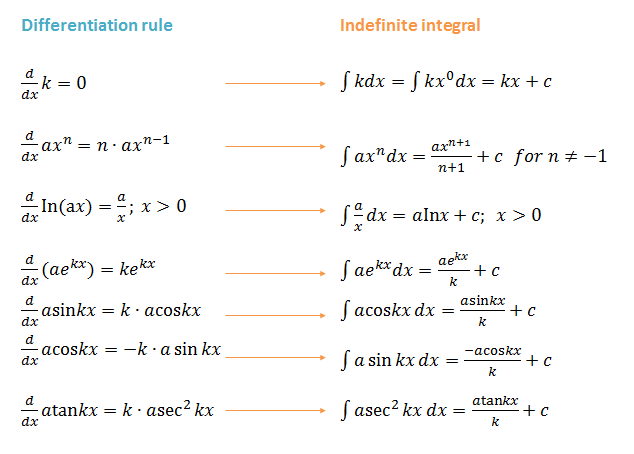
Integrals of exponential functions
The natural exponential function is its own antiderivative, which makes it one of the simplest functions to integrate:
For exponential functions with a base other than , you divide by the natural log of the base:
For example, and .
Constants pull out front as usual:
When an exponential is multiplied by , you need integration by parts (which you may or may not have covered yet depending on your course). The results are:

Integration of logarithmic expressions
You can't integrate by a simple formula the way you can with . Instead, the result comes from integration by parts, but the formula itself is worth memorizing:
Constants factor out as expected:
For logarithms with a base other than , use the change of base identity to convert, then integrate:
When a logarithm is multiplied by , integration by parts gives:
Substitution for exponential and logarithmic integrals
Many exponential and logarithmic integrals aren't in their basic form. That's where -substitution comes in. The key idea: let equal whatever is "inside" the function (the exponent, or the argument of the logarithm), then rewrite everything in terms of .
Example 1: Exponential substitution
Evaluate .
- Let , so , which means .
- Rewrite: .
- Integrate and substitute back: .
Example 2: Logarithmic substitution
Evaluate .
- Let , so , which means .
- Rewrite: .
- Integrate and substitute back: .
This simplifies to .
Compositions that simplify directly: Watch for cases where exponential and logarithmic functions cancel each other out. Since , you get:
Fundamental Concepts of Integration
A few background ideas tie everything together:
- An indefinite integral represents a family of antiderivatives, all differing by a constant .
- A definite integral calculates the net area under a curve between two bounds.
- The Fundamental Theorem of Calculus connects differentiation and integration: if is an antiderivative of , then .
- The exponential function and the natural logarithm are inverses of each other. This relationship is why compositions like and simplify so cleanly, and it's the reason these two function types keep appearing together in integration problems.
See Fiveable more often in Google
Mark Fiveable as a preferred source and Google is more likely to show you our guides in Top Stories, with a "preferred" badge in AI Mode and AI Overviews.