3.2 The Derivative as a Function

∫Calculus I Unit 3 Review
3.2 The Derivative as a Function
∫ Calculus I
The Derivative Function
The derivative function takes a single-point calculation and extends it across an entire domain. Instead of finding the slope of a tangent line at just one point, you get a new function that outputs that slope for every point where the limit exists. This is what makes derivatives so useful for analyzing how a function behaves overall.
Definition of the Derivative Function
The derivative of is itself a function, written , defined by:
This limit gives you the slope of the tangent line to the graph of at each point where the limit exists. Notice this is the same limit definition you've seen before, but now is a variable rather than a fixed number .
What the derivative's sign tells you about the original function:
- Positive : is increasing on that interval
- Negative : is decreasing on that interval
- Zero : has a horizontal tangent line at that point, which may be a local max, local min, or neither
Graphing Derivative Functions
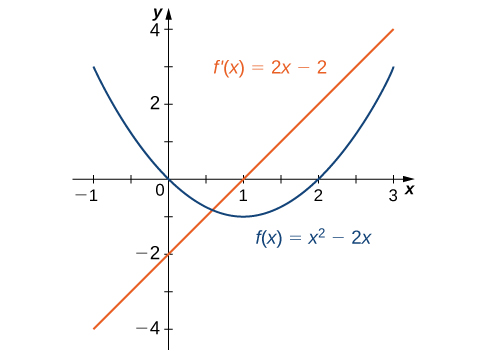
You can sketch the graph of directly from the graph of without ever writing a formula. Here's the process:
- Identify intervals where is increasing. On those intervals, plot as positive (above the x-axis).
- Identify intervals where is decreasing. On those intervals, plot as negative (below the x-axis).
- Mark where has local maxima or minima. At those x-values, , so the derivative graph crosses or touches the x-axis.
- Look at how steeply is rising or falling. Steeper slopes mean has a larger magnitude; flatter slopes mean is closer to zero.
The derivative graph also reveals concavity of the original function:
- If is increasing, then is concave up (curves upward like a bowl)
- If is decreasing, then is concave down (curves downward like an arch)
- Where changes from increasing to decreasing (or vice versa), has an inflection point
Continuity and Higher-Order Derivatives
Derivatives and Continuity
A function is differentiable at a point if exists, meaning the limit produces a finite value.
The key relationship to remember:
Differentiable implies continuous, but continuous does not imply differentiable.
If a function is differentiable at a point, it must be continuous there. But a function can be perfectly continuous at a point and still fail to be differentiable. There are three common ways this happens:
- Sharp corner or cusp: The left-hand and right-hand slopes don't match. For example, at has slope from the left and slope from the right.
- Vertical tangent line: The slope approaches . For example, at .
- Discontinuity: If the function isn't continuous at a point (jump, removable, or infinite discontinuity), it can't be differentiable there.

Higher-Order Derivatives
You can differentiate a derivative to get a second derivative, then differentiate again for a third, and so on. The notation builds naturally:
- First derivative : rate of change of
- Second derivative : rate of change of . In physics, if is position, then is acceleration.
- Third derivative : rate of change of . In physics, this is called jerk.
The second derivative is especially useful in Calculus I:
- It determines concavity: means concave up, means concave down.
- The second derivative test classifies critical points: if and , then is a local minimum; if , it's a local maximum. If , the test is inconclusive.
- Higher-order derivatives appear later in Taylor series, where they're used to build polynomial approximations of functions.
Applications of Derivatives
Derivatives show up across many fields because rates of change are everywhere:
- Physics: Position, velocity, and acceleration. If is position, then is velocity and is acceleration.
- Economics: Marginal cost, marginal revenue, and marginal profit are all derivatives. They tell you the cost or revenue added by producing one more unit.
- Optimization: Finding maximum profit, minimum cost, or the dimensions that maximize volume subject to a constraint. These problems rely on setting and analyzing critical points.
- Biology: Modeling how fast a population grows at a given time, such as in logistic growth where the growth rate itself changes.
In all of these, the process is the same: translate the real-world quantity into a function, differentiate, and interpret the result in context.
Differentiation Rules
These are the core rules you'll use to compute derivatives efficiently, without going back to the limit definition every time:
- Power rule: If , then . Works for integer and rational exponents.
- Product rule: If , then .
- Quotient rule: If , then .
- Chain rule: If , then . Used whenever you have a function inside another function.
- Implicit differentiation: When is defined implicitly by an equation (like ), differentiate both sides with respect to , treating as a function of , and solve for .
See Fiveable more often in Google
Mark Fiveable as a preferred source and Google is more likely to show you our guides in Top Stories, with a "preferred" badge in AI Mode and AI Overviews.