6.5 Physical Applications

∫Calculus I Unit 6 Review
6.5 Physical Applications
∫ Calculus I
6.1
Areas between Curves
6.2
Determining Volumes by Slicing
6.3
Volumes of Revolution: Cylindrical Shells
6.4
Arc Length of a Curve and Surface Area
6.5
Physical Applications
6.6
Moments and Centers of Mass
6.7
Integrals, Exponential Functions, and Logarithms
6.8
Exponential Growth and Decay
6.9
Calculus of the Hyperbolic Functions
Mass and Density
Mass Calculation with Density Functions
The core idea here: if density varies across an object, you can't just multiply density by length (or area). You need to integrate the density function to account for how it changes at every point.
Linear density describes mass per unit length, written as , where is position along a one-dimensional object like a rod or wire. To find the total mass from position to :
Think of it as slicing the rod into infinitely thin pieces, each with mass , then adding them all up.
Radial density describes mass per unit area for circular objects (disks, plates), written as , where is the distance from the center. To find the total mass of a circular object with radius :
Why the extra ? You're integrating over thin concentric rings. Each ring at radius has circumference and thickness , so its area is . Multiplying by the density at that radius gives the ring's mass.
Work and Variable Forces
Work Done by a Variable Force
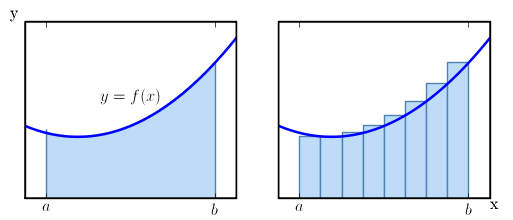
When a constant force acts over a displacement , work is simply . But when force changes as an object moves, you need integration.
For a variable force acting along a straight path from to :
Example: A spring with force (Hooke's law). The work to stretch it from to m with N/m is:
The same logic applies to pumping problems, where you compute the work needed to lift each thin layer of fluid a different distance.
Hydrostatic Force on Submerged Surfaces
Fluid pressure increases with depth. At depth below the surface, pressure is:
where is the fluid's density (for water, about ) and is gravitational acceleration ().
To find the total hydrostatic force on a submerged vertical surface, you integrate pressure over the surface area. The general approach:
- Set up a coordinate system with measuring depth below the fluid surface.
- At depth , determine the horizontal width of the surface, .
- A thin horizontal strip at depth has area and experiences pressure .
- Integrate to get total force:
where and are the depths of the top and bottom edges.
Special case: For a rectangular surface of constant width and height , with its top edge at depth :
The term is the depth of the rectangle's centroid (its geometric center). This works because pressure varies linearly, so the average pressure acts at the midpoint.
Setting Up Physical Application Integrals
The trickiest part of these problems isn't the calculus itself; it's translating the physical situation into the right integral. Here's a general strategy:
- Identify what varies. Is it density, force, pressure, or distance? That varying quantity goes inside your integral.
- Slice the object or region into thin pieces where the varying quantity is approximately constant.
- Write an expression for the contribution of one thin slice (mass of a slice, work on a slice, force on a strip).
- Integrate over the full range to sum all contributions.
- Check units. Mass integrals should yield kg, work integrals should yield joules (J), and force integrals should yield newtons (N).
Once the integral is set up, apply whatever technique fits: substitution, integration by parts, or sometimes just a power rule. The integration technique matters less than getting the setup right.
Connecting to Mechanics
These applications tie directly to foundational physics. Newton's second law, , connects force, mass, and acceleration. Work is how energy gets transferred by a force acting over a distance, and it links to both kinetic energy (energy of motion, ) and potential energy (stored energy due to position).
The calculus connection: velocity is the derivative of displacement, and acceleration is the derivative of velocity. Going the other direction, integrating acceleration gives velocity, and integrating velocity gives displacement. Work done by a variable force is the integral of that force over displacement. These aren't separate ideas; they're all part of the same framework where integration recovers totals from rates of change.
See Fiveable more often in Google
Mark Fiveable as a preferred source and Google is more likely to show you our guides in Top Stories, with a "preferred" badge in AI Mode and AI Overviews.