3.7 Derivatives of Inverse Functions

∫Calculus I Unit 3 Review
3.7 Derivatives of Inverse Functions
∫ Calculus I
Derivatives of Inverse Functions
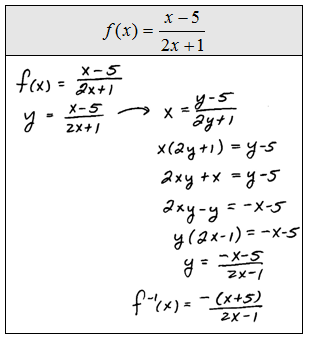
Inverse function theorem application
If is differentiable and one-to-one on an interval, then its inverse is also differentiable. The derivative of the inverse is:
This formula says: to find the derivative of the inverse at some input , first figure out what the inverse gives you (that's ), then plug that into the derivative of the original function, and take the reciprocal. The original function must be continuous and strictly monotonic (always increasing or always decreasing) on its domain for this to work.
Steps to apply the theorem:
- Identify the original function and confirm it's one-to-one on the relevant interval.
- Find if possible, or at least identify the point where you need the derivative.
- Compute .
- Plug into and take the reciprocal: .
Example: Suppose and you want the derivative of at . You can't easily solve for algebraically, but you can check that , so . Since , you get:
This is exactly the situation where the theorem shines: you don't need an explicit formula for the inverse.
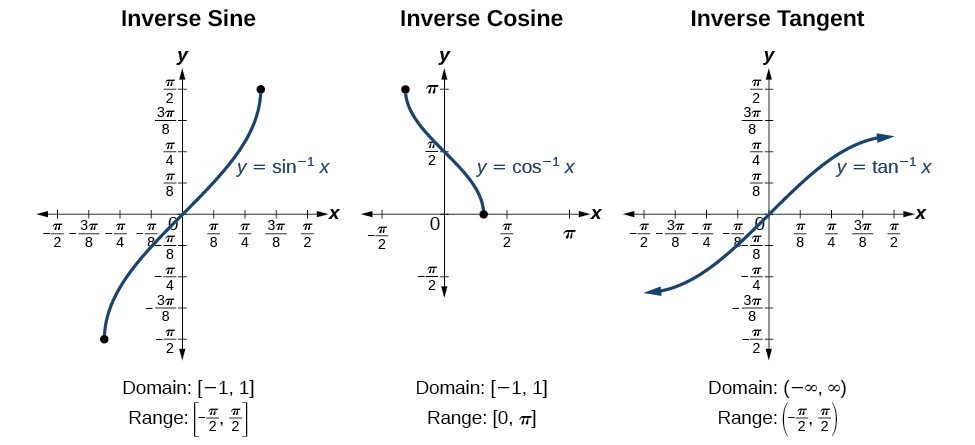
Inverse trigonometric function derivatives
These six derivatives come directly from applying the inverse function theorem to the standard trig functions (restricted to domains where they're one-to-one). You should memorize them:
Notice the pattern: arcsin/arccos are negatives of each other, arctan/arccot are negatives of each other, and arcsec/arccsc are negatives of each other. This happens because each pair sums to a constant (e.g., ), so their derivatives must be negatives.
Application examples:
- The slope of the tangent line to at :
- Suppose an angle is given by . By the chain rule, the rate of change with respect to is:
At :
Don't forget the chain rule factor of here. The original guide listed for this problem, but that omits the chain rule.
Slope relationships for inverse functions
Since and are reflections of each other across the line , their tangent line slopes at corresponding points are reciprocals.
Concretely: if the tangent to at has slope , then the tangent to at the reflected point has slope .
This follows directly from the inverse function theorem. Evaluating at :
The left side is the slope of at the point . The right side is the reciprocal of the slope of at . That's the whole relationship.
One thing to watch: if , the inverse isn't differentiable at that corresponding point (you'd be dividing by zero). Graphically, a horizontal tangent on becomes a vertical tangent on .
Domain, range, and derivative rules
The domain of is the range of , and the range of is the domain of . This swap matters when you're checking where an inverse trig derivative is valid. For instance, only applies for because that's the domain of arcsin (and the denominator is zero at the endpoints).
When differentiating compositions involving inverse functions, you'll almost always need the chain rule alongside the formulas above. For example:
The inverse function derivative gives you the "outer" piece, and the chain rule supplies the derivative of the inner function. Forgetting that inner derivative is one of the most common mistakes on exams.
See Fiveable more often in Google
Mark Fiveable as a preferred source and Google is more likely to show you our guides in Top Stories, with a "preferred" badge in AI Mode and AI Overviews.