9.4 Defining and Differentiating Vector-Valued Functions

♾️AP Calculus AB/BC Unit 9 Review
9.4 Defining and Differentiating Vector-Valued Functions
♾️ AP Calculus AB/BC
9.1
Defining and Differentiating Parametric Equations
9.2
Second Derivatives of Parametric Equations
9.3
Finding Arc Lengths of Curves Given by Parametric Equations
9.4
Defining and Differentiating Vector-Valued Functions
9.5
Integrating Vector-Valued Functions
9.6
Solving Motion Problems Using Parametric and Vector-Valued Functions
9.7
Defining Polar Coordinates and Differentiating in Polar Form
9.8
Find the Area of a Polar Region or the Area Bounded by a Single Polar Curve
9.9
Finding the Area of the Region Bounded by Two Polar Curves
A vector-valued function pairs parametric functions into one vector, usually written . To differentiate it, take the derivative of each component separately, so . For AP Calculus BC, component-wise differentiation connects position, velocity, acceleration, and speed.
Vector-valued functions show up in both multiple-choice and free-response questions about planar motion. Unit 9 is a BC-only unit that makes up 10-15% of the AP Calculus BC multiple-choice section.
Differentiating Vector-Valued Functions Component by Component
- A vector has both direction and magnitude; magnitude is its length.
- Write a vector-valued function as , where each component is a function of .
- Differentiate component by component: .
- The same derivative rules apply, so watch for the chain rule inside trig and composite components.
- When is position, is the velocity vector and is the acceleration vector.
- The magnitude of a vector is , found with the Pythagorean theorem.
↖️ Vector Review
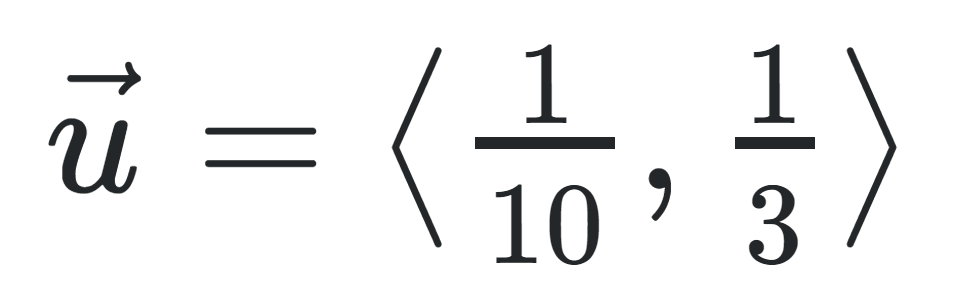
A vector is a quantity that has both direction and magnitude. Magnitude refers to the length of a vector. All vectors have horizontal and vertical components, and they are written based on those two components. For example, a vector with a horizontal component of 5 and a vertical component of 4 is written as . This bracket notation is the one used most often on the AP Calculus BC exam.
Every vector has a head and a tail. The tail is where the vector starts. If no other information is given, you can assume the tail sits at the origin . The head is the final point of the vector, drawn with an arrowhead in diagrams.
You can find the magnitude from the horizontal and vertical components. Take the vector . Using the Pythagorean theorem with and , you get . So the magnitude is , written as .
You can also find the direction from the components. Since , this vector gives . Taking the inverse tangent gives radians.
The reverse works too: given a magnitude and direction, you can recover the horizontal and vertical components.
📐 Vector-Valued Functions
Think of as a vector built from two parametric functions, and . You write it as . To differentiate, take the derivative of each component on its own:
The normal derivative rules still apply, including the power rule, trig derivatives, and the chain rule. Nothing about being a vector changes how you differentiate each piece.
✏️ Vector-Valued Functions Walkthrough
Try a quick example.
Find .
Start by finding , taking the derivative of each component. For the horizontal component, the derivative of with respect to is .
For the vertical component, the derivative of with respect to is .
Put it together:
Substitute :
Simplify:
🤔 Practice Problems with Vector-Valued Functions
💭 Vector Practice Problem 1
Find given that
Find the derivative of each component. For the horizontal component, the derivative of with respect to is (chain rule brings out the factor of 5).
For the vertical component, the derivative of with respect to is (chain rule brings out , and ).
Put it together:
Substitute :
Simplify (in radians):
💭 Vector Practice Problem 2
A particle moves along a path so that its position at any time is given by . Find the particle's velocity vector at .
A particle's velocity vector is the first derivative of its position vector, so . Start by differentiating each component of the position vector.
For the horizontal component, the derivative of with respect to is .
For the vertical component, the derivative of with respect to is .
Put it together:
Substitute :
Simplify:
Differentiating Position Vectors and Writing Clean Answers
Problem Solving:
- Differentiate one component at a time. Treat the horizontal and vertical pieces as separate single-variable derivatives.
- Watch for the chain rule inside trig, exponential, or composite components. A missing inner derivative is the most common point loss here.
- Keep your calculator in radians for trig problems. Position and velocity components are almost always in radians on BC.
Common Trap:
- Notation matters for clear exam work. Write your answer as a vector with brackets, like , not as two loose numbers.
- When a question asks for velocity, find . When it asks for acceleration, find . When it asks for speed, find the magnitude , which is a single number, not a vector.
Common Misconceptions
- Misconception: Differentiating a vector is one big operation, so you combine the components first.Actually: Differentiating a vector is not one big operation. You do not combine the components first. Differentiate each component separately, then write the results back as a vector.
- Misconception: Velocity and speed are the same thing.Actually: Velocity and speed are different. The velocity vector has direction and magnitude. Speed is just the magnitude , a single nonnegative number.
- Misconception: The chain rule does not apply to components inside a vector.Actually: The chain rule does not disappear inside a vector. Components like or still need the chain rule. Bracket notation does not let you skip it.
- Misconception: A vector-valued function and a parametric pair are different, unrelated ideas.Actually: A vector-valued function and a parametric pair are the same idea in different clothes. carries the same information as the parametric equations , , so the differentiation logic carries straight over.
- Misconception: Magnitude is just adding the components.Actually: Magnitude is not just adding the components. Use , not , to get the length of a vector.
Related AP Calculus Guides
- 9.1 Defining and Differentiating Parametric Equations
- Unit 9 Review: Parametric Equations, Polar Coordinates, and Vector-Valued Functions
- 9.2 Second Derivatives of Parametric Equations
- 9.3 Finding Arc Lengths of Curves Given by Parametric Equations
- 9.7 Defining Polar Coordinates and Differentiating in Polar Form
- 9.8 Find the Area of a Polar Region or the Area Bounded by a Single Polar Curve
Practice Questions for 9.4
1 of 10
A drone's position is modeled by . The derivative vector maintains a constant direction or its exact opposite for all . Which of the following vector-valued functions shares this structural property of moving along a single line?
A.
, representing accelerating linear motion
B.
, representing accelerating curved motion
C.
, representing accelerating spiral motion
D.
, representing accelerating circular motion
Vocabulary
The following words are mentioned explicitly in the AP® course framework for this topic.Term | Definition |
|---|---|
derivative | The instantaneous rate of change of a function at a specific point, representing the slope of the tangent line to the function at that point. |
vector-valued function | Functions that output vectors rather than scalar values, where each component is a function of the same independent variable. |
See Fiveable more often in Google
Mark Fiveable as a preferred source and Google is more likely to show you our guides in Top Stories, with a "preferred" badge in AI Mode and AI Overviews.