6.1 Gastrointestinal Tract Anatomy

🫀Anatomy and Physiology II Unit 6 Review
6.1 Gastrointestinal Tract Anatomy
🫀 Anatomy and Physiology II
The gastrointestinal tract is a continuous muscular tube that processes food from ingestion to elimination. Each region has distinct structural features matched to its specific digestive or absorptive role, and understanding this anatomy is the foundation for the physiology you'll study later in the course.
Gastrointestinal Tract Anatomy

Top images from around the web for Structure and Organization
Human digestive system - Wikipedia View original
Is this image relevant?
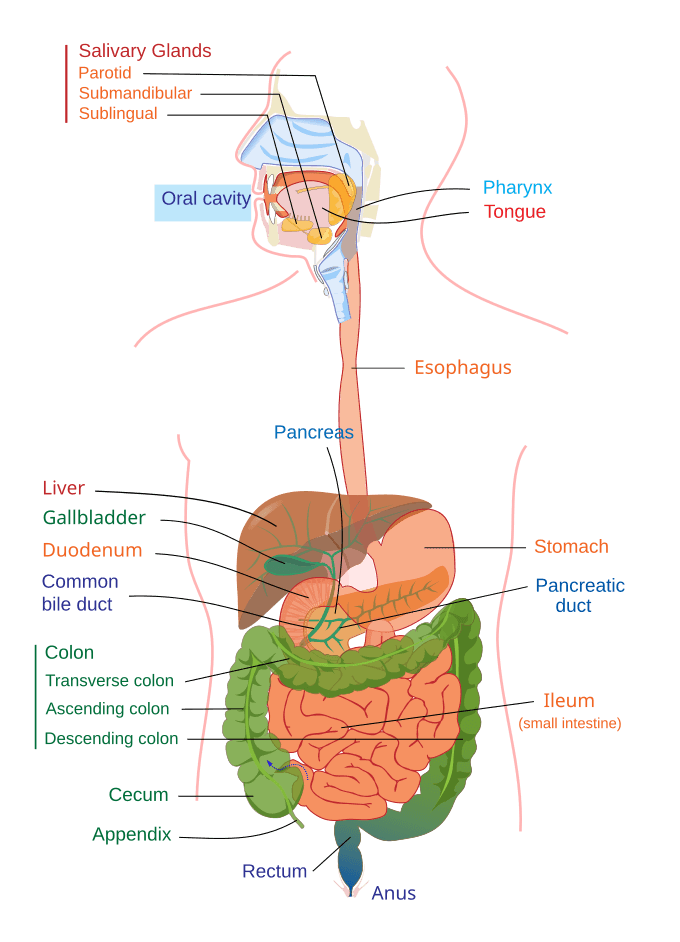
Gastrointestinal tract - Wikipedia View original
Is this image relevant?
Digestive System ‹ OpenCurriculum View original
Is this image relevant?
Human digestive system - Wikipedia View original
Is this image relevant?
Gastrointestinal tract - Wikipedia View original
Is this image relevant?
Structure and Organization
The GI tract (also called the alimentary canal) runs from the mouth to the anus as one continuous tube, approximately 9 meters long in a cadaver. It's divided into two broad regions:
- Upper GI tract: oral cavity, pharynx, esophagus, and stomach
- Lower GI tract: small intestine and large intestine
Each segment has a different diameter, epithelial lining, and set of specializations that reflect its function. The oral cavity handles mechanical breakdown and initial enzymatic digestion, the stomach handles chemical digestion in an acidic environment, the small intestine is the primary site of digestion and absorption, and the large intestine reclaims water and electrolytes before waste is eliminated.
Accessory Organs and Mucosa
The accessory organs don't form part of the tube itself but deliver secretions into it. These include the salivary glands, liver, gallbladder, and pancreas. Each contributes enzymes, bile, or other substances essential for digestion.
The entire GI tract is lined by a mucous membrane called the mucosa, which has three sublayers:
- Epithelium: the innermost layer, in direct contact with the lumen contents. The type of epithelium varies by region (stratified squamous in the esophagus, simple columnar in the intestines).
- Lamina propria: a layer of loose connective tissue that supports the epithelium and contains blood vessels, lymphatics, and immune cells.
- Muscularis mucosae: a thin smooth muscle layer that creates small folds in the mucosa, increasing surface area and allowing local movement of the mucosal surface.
Esophagus, Stomach, Small Intestine, Large Intestine
Esophagus
The esophagus is a muscular tube about 25 cm long that connects the pharynx to the stomach. It's lined with stratified squamous epithelium, which resists the abrasion of swallowed food. Mucus-secreting glands in the submucosa provide additional lubrication and protection. The esophagus doesn't perform significant digestion or absorption; its job is transport via peristalsis.
Stomach
The stomach is a J-shaped muscular organ in the upper left quadrant of the abdomen. It has four anatomical regions, each with a slightly different role:
- Cardia: the narrow zone surrounding the opening where the esophagus enters the stomach
- Fundus: the dome-shaped upper portion that often collects swallowed gas
- Body: the largest region, where most gastric glands are located
- Pylorus: the funnel-shaped inferior region that connects to the duodenum
The stomach stores food, mechanically churns it, and chemically digests it by secreting gastric juice containing hydrochloric acid () and pepsinogen. The highly acidic environment (pH ~1.5–3.5) activates pepsinogen into pepsin for protein digestion and kills most ingested microorganisms. The stomach's mucosa is lined with simple columnar epithelium that secretes a thick alkaline mucus layer to protect itself from its own acid.

Small Intestine
The small intestine is the longest segment of the GI tract at about 6 meters. It's divided into three regions: the duodenum, jejunum, and ileum (covered in detail below).
This is where the bulk of chemical digestion and nutrient absorption occurs. Three structural features dramatically increase the absorptive surface area:
- Plicae circulares (circular folds): permanent, large folds of the mucosa and submucosa that slow chyme movement and increase contact time
- Villi: finger-like projections of the mucosa, each containing a capillary network and a central lymphatic vessel called a lacteal
- Microvilli: microscopic projections on the apical surface of each epithelial cell, forming the "brush border"
Together, these features increase the surface area to roughly 200 square meters, about the size of a tennis court.
Large Intestine
The large intestine is about 1.5 meters long and has a larger diameter than the small intestine. Its segments, in order, are:
- Cecum (with the attached appendix)
- Ascending colon
- Transverse colon
- Descending colon
- Sigmoid colon
- Rectum
- Anal canal
The primary functions here are absorbing water and electrolytes and compacting the remaining material into feces. The mucosa of the large intestine lacks villi since bulk nutrient absorption is already complete. Instead, it contains abundant goblet cells that secrete mucus to lubricate fecal material as it moves toward elimination.
A distinguishing external feature is the haustra, pouch-like segments that give the colon its characteristic segmented appearance. These form because the longitudinal muscle layer is concentrated into three bands called teniae coli rather than forming a complete sheet.
Sphincters in the Gastrointestinal Tract
Function and Structure
Sphincters are rings of smooth muscle (and in some cases skeletal muscle) that act as valves between GI compartments. By contracting and relaxing, they control the direction and rate of flow, keeping digestive contents moving in one direction and preventing backflow.
Major Sphincters
Five sphincters are particularly important to know:
| Sphincter | Location | Function |
|---|---|---|
| Upper esophageal sphincter (UES) | Pharynx–esophagus junction | Prevents air from entering the esophagus during breathing; opens during swallowing |
| Lower esophageal sphincter (LES) | Esophagus–stomach junction | Prevents gastric acid reflux into the esophagus; opens to admit food into the stomach |
| Pyloric sphincter | Stomach–duodenum junction | Regulates the release of chyme into the duodenum in small, controlled amounts |
| Ileocecal valve | Ileum–cecum junction | Prevents backflow from the large intestine into the small intestine |
| Anal sphincters (internal and external) | Distal anal canal | Control fecal elimination; the internal sphincter is involuntary smooth muscle, the external is voluntary skeletal muscle |
The distinction between the two anal sphincters matters clinically: the internal anal sphincter contracts reflexively, while the external anal sphincter is under conscious control, which is what allows you to maintain continence voluntarily.

Small Intestine Regions and Functions
Duodenum
The duodenum is the shortest segment (~25 cm) and the most proximal. Despite its short length, it's where the majority of chemical digestion takes place. Acidic chyme from the stomach enters here and is mixed with two critical secretions:
- Bile (from the liver and gallbladder): emulsifies fats, breaking large lipid droplets into smaller ones so lipase enzymes can access them
- Pancreatic juice (from the pancreas): contains enzymes that digest proteins (trypsin, chymotrypsin), carbohydrates (pancreatic amylase), and lipids (pancreatic lipase), along with bicarbonate to neutralize the acidic chyme
Both secretions enter the duodenum through the hepatopancreatic ampulla (ampulla of Vater), typically at the major duodenal papilla.
Jejunum
The jejunum is the middle segment (~2.5 meters) and the primary site of nutrient absorption. It has the most prominent plicae circulares and the tallest, most densely packed villi of any region. This is where most carbohydrates, proteins, lipids, vitamins, and minerals are absorbed into the blood and lymph.
The jejunum's walls are thicker and more vascular than the ileum's, which makes sense given the heavy absorptive workload.
Ileum
The ileum is the longest segment (~3.5 meters) and the most distal. It absorbs whatever the jejunum didn't finish, plus two substances that are specifically absorbed here:
- Vitamin : absorbed in the terminal ileum via intrinsic factor
- Bile salts: reclaimed and recycled back to the liver (enterohepatic circulation)
The ileum also contains large clusters of lymphoid follicles called Peyer's patches, which are part of the gut-associated lymphoid tissue (GALT). Because the ileum is close to the bacteria-rich large intestine, these immune structures serve as a surveillance system, sampling luminal contents and mounting immune responses when needed.
pH Gradient
The pH changes progressively along the small intestine:
- Duodenum: slightly acidic (~pH 6) because acidic chyme from the stomach enters here. Bicarbonate from the pancreas gradually neutralizes it.
- Jejunum: approximately neutral (~pH 7)
- Ileum: slightly alkaline (~pH 7.5)
This gradient matters because different digestive enzymes have different optimal pH ranges. Pancreatic lipase, for example, works best near neutral pH, while the brush border enzymes of the jejunum and ileum function optimally in a neutral to slightly alkaline environment.
See Fiveable more often in Google
Mark Fiveable as a preferred source and Google is more likely to show you our guides in Top Stories, with a "preferred" badge in AI Mode and AI Overviews.