4.3 Mechanics of Breathing

🫀Anatomy and Physiology II Unit 4 Review
4.3 Mechanics of Breathing
🫀 Anatomy and Physiology II
Pressure Gradients in Breathing

Top images from around the web for Pressure differences drive airflow
The Process of Breathing | Anatomy and Physiology II View original
Is this image relevant?
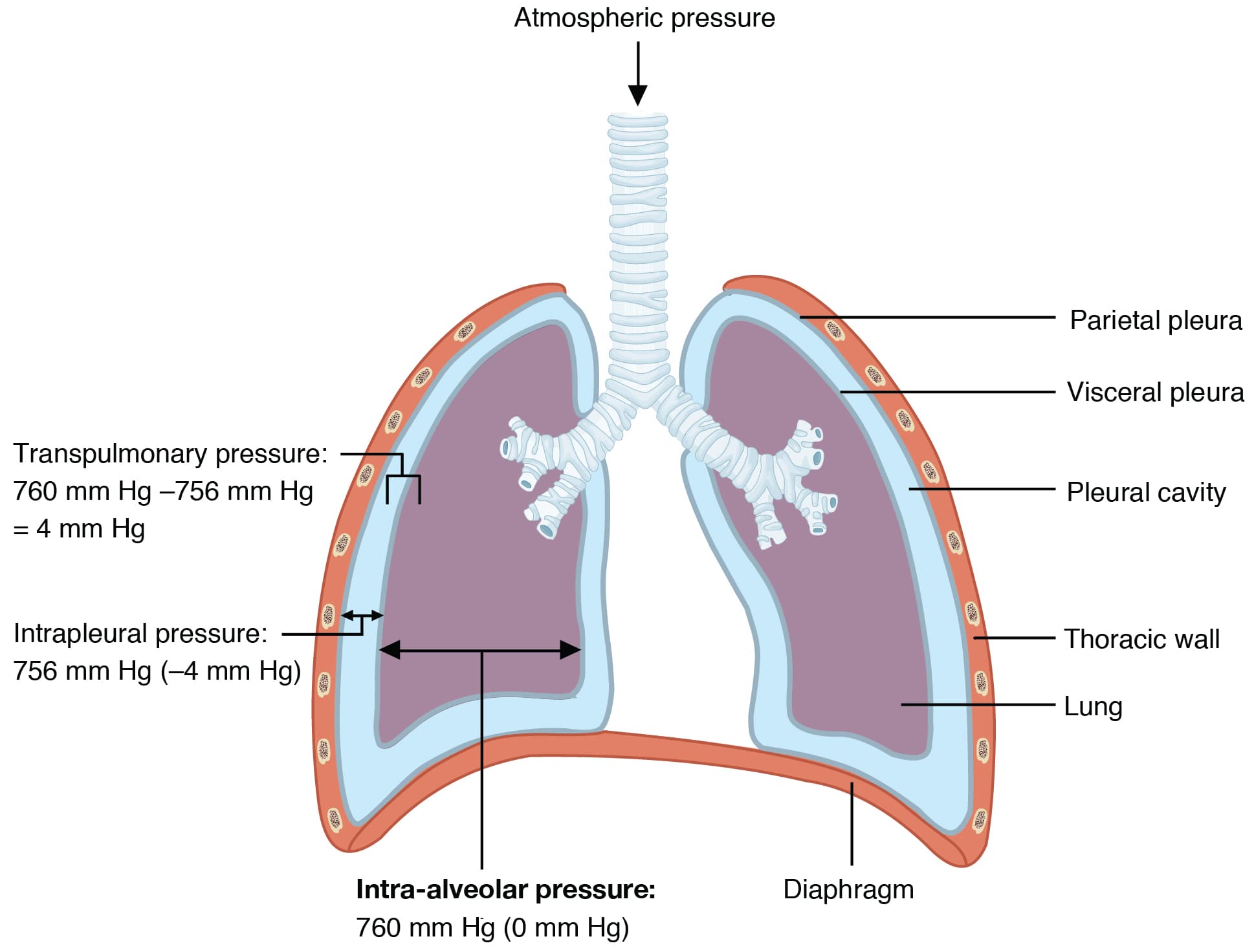
The Process of Breathing · Anatomy and Physiology View original
Is this image relevant?
Mechanics of Breathing | Boundless Anatomy and Physiology View original
Is this image relevant?
The Process of Breathing | Anatomy and Physiology II View original
Is this image relevant?
The Process of Breathing · Anatomy and Physiology View original
Is this image relevant?
Pressure Differences Drive Airflow
Air moves in and out of the lungs because of pressure differences between the atmosphere and the alveoli. This is the fundamental principle behind all breathing mechanics: gas flows from regions of higher pressure to regions of lower pressure.
- The size of the pressure gradient determines how fast air flows. A larger difference means faster airflow; a smaller difference means slower airflow.
- At rest, the pressure differences involved are surprisingly small, typically just 1–3 mmHg below or above atmospheric pressure.
Inhalation Mechanics
During inhalation, your respiratory muscles actively create a low-pressure zone inside the lungs:
- The diaphragm contracts and flattens downward, while the external intercostal muscles contract and lift the rib cage outward.
- These movements increase the volume of the thoracic cavity.
- Because volume and pressure are inversely related (Boyle's Law), the increased volume causes intrapulmonary pressure to drop below atmospheric pressure.
- Air flows down the pressure gradient, from the higher-pressure atmosphere into the lower-pressure lungs.
- Inhalation stops once pressure inside the lungs equalizes with atmospheric pressure.
Quiet inhalation is always an active process because it requires muscle contraction. Forced inhalation recruits additional muscles like the sternocleidomastoid and scalenes.
Exhalation Mechanics
Quiet exhalation works in reverse but is largely passive:
- The diaphragm and external intercostals relax, allowing the thoracic cavity to decrease in volume.
- The elastic recoil of the lungs and chest wall naturally compresses the alveoli.
- This compression raises intrapulmonary pressure above atmospheric pressure.
- Air flows from the higher-pressure lungs out to the lower-pressure atmosphere.
- Exhalation stops once pressures equalize again.
Forced exhalation (like blowing out candles) becomes an active process, recruiting the internal intercostals and abdominal muscles to push air out more forcefully.
Lung Volume and Intrapleural Pressure
Intrapleural Pressure Changes
Intrapleural pressure is the pressure within the pleural cavity, the thin fluid-filled space between the visceral pleura (on the lung surface) and the parietal pleura (lining the chest wall). This pressure is normally subatmospheric (negative), typically around at rest.
- During inhalation, as the chest wall expands, intrapleural pressure becomes more negative (drops to about ). This increasingly negative pressure counteracts the elastic recoil of the lungs, effectively pulling them open as the chest expands.
- During exhalation, as the chest wall recoils inward, intrapleural pressure becomes less negative (returns toward ). With less outward pull on the lungs, their elastic recoil is relatively unopposed, and the lungs deflate.
The key point: intrapleural pressure stays negative throughout normal breathing. If it ever reaches zero or becomes positive, the lungs lose the transmural pressure gradient that keeps them inflated.

Pressure-Volume Relationship
The relationship between lung volume and the pressure needed to achieve that volume is shown on a pressure-volume curve. The slope of this curve represents compliance, which is the ease of lung expansion:
- A steep curve = high compliance. Small pressure changes produce large volume changes. This is typical of young, healthy lungs.
- A flat curve = low compliance. You need large pressure changes to get even small volume changes. This is seen in conditions like pulmonary fibrosis, where the lungs become stiff.
Pathological Conditions Affecting Intrapleural Pressure
When intrapleural pressure is disrupted, breathing mechanics can fail:
- Pneumothorax: Air enters the pleural space (from a chest wound or ruptured bleb), equalizing intrapleural pressure with atmospheric pressure. Without the negative pressure holding the lung open, the lung collapses on the affected side.
- Pleural effusion: Fluid accumulates in the pleural space, compressing the lung and restricting its ability to expand.
- Atelectasis: Collapse of alveoli, which can result from airway obstruction (a mucus plug blocks airflow, and trapped air gets absorbed) or from prolonged shallow breathing that fails to keep alveoli inflated.
Compliance and Elastance in Lung Function
Compliance
Compliance is the change in lung volume per unit change in pressure (). Think of it as how "stretchy" the lungs are.
- High compliance means the lungs expand easily with little pressure. Emphysema is a classic example: destruction of alveolar walls and elastic tissue makes the lungs overly distensible. They inflate easily but have trouble deflating.
- Low compliance means the lungs resist expansion. Pulmonary fibrosis causes scarring that stiffens lung tissue, so patients must generate much greater pressure changes just to breathe normally.
Factors that affect compliance include age, disease states, and surfactant production. Surfactant, produced by type II alveolar cells, reduces surface tension in the alveoli. Without adequate surfactant (as in neonatal respiratory distress syndrome), compliance drops dramatically and the alveoli tend to collapse.
Elastance
Elastance is the reciprocal of compliance:
It represents the tendency of the lungs to recoil back to their resting shape after being stretched. Where compliance asks "how easily do the lungs expand?", elastance asks "how strongly do the lungs snap back?"
- High elastance = strong recoil, stiff lungs. Seen in restrictive diseases like fibrosis.
- Low elastance = weak recoil, floppy lungs. Seen in obstructive diseases like emphysema, where the lungs expand but don't effectively push air back out.
The balance between compliance and elastance determines how much work your respiratory muscles have to do during each breath.

Impact on Breathing Mechanics
- Decreased compliance (or increased elastance) means the respiratory muscles must work harder to ventilate the lungs. Over time, this increased work of breathing can lead to respiratory muscle fatigue.
- Uneven distribution of compliance across different lung regions causes ventilation-perfusion (V/Q) mismatching: some areas get too much air relative to blood flow, while others get too little. This leads to inefficient gas exchange and can cause hypoxemia (low blood oxygen) or hypercapnia (elevated blood ).
- Clinicians assess compliance and elastance using pulmonary function tests, including spirometry and lung volume measurements, to help diagnose and monitor respiratory disorders.
Factors Influencing Airway Resistance
Airway resistance determines how much pressure is needed to push a given flow of air through the bronchial tree. Even small changes in airway diameter have a huge effect because resistance is inversely proportional to the fourth power of the radius. That means cutting the airway radius in half increases resistance roughly 16-fold.
Factors That Increase Airway Resistance
- Bronchoconstriction: Smooth muscle contraction narrows the airways. Triggers include cold air, irritants, allergens, and parasympathetic stimulation. This is the hallmark of asthma attacks.
- Mucus hypersecretion: Excessive or abnormally thick mucus physically obstructs the airway lumen. Chronic bronchitis is a prime example.
- Inflammation: Swelling of the airway walls reduces the internal diameter. This occurs in bronchitis, pneumonia, and allergic reactions.
- Structural changes: Tumors, airway remodeling in chronic asthma, or loss of radial traction on airways (as in emphysema, where surrounding alveolar walls are destroyed) can permanently increase resistance.
Factors That Decrease Airway Resistance
- Bronchodilation: Medications like beta-2 agonists (albuterol) relax airway smooth muscle, widening the airways. Anticholinergics (ipratropium) block parasympathetic-driven constriction.
- Posture: Sitting upright optimizes airway diameter compared to lying supine, which is why patients in respiratory distress instinctively sit up and lean forward.
- Breathing techniques: Pursed-lip breathing creates back-pressure that helps keep small airways from collapsing during exhalation. This is especially useful for COPD patients.
- Airway clearance: Coughing, huffing, and chest physiotherapy remove mucus and debris, reducing obstruction.
Effects on Breathing
- Increased airway resistance forces the respiratory muscles to generate larger pressure gradients to maintain adequate airflow. This raises the work of breathing and can contribute to V/Q mismatching.
- Decreased airway resistance allows air to flow more freely, reducing the effort of breathing and improving ventilation efficiency.
- Clinicians measure airway resistance using spirometry (particularly FEV1/FVC ratio), body plethysmography, or forced oscillation techniques. These measurements are essential for diagnosing and tracking obstructive airway diseases like asthma and COPD.
See Fiveable more often in Google
Mark Fiveable as a preferred source and Google is more likely to show you our guides in Top Stories, with a "preferred" badge in AI Mode and AI Overviews.