11.1 Digital modulation techniques

📡Advanced Signal Processing Unit 11 Review
11.1 Digital modulation techniques
📡 Advanced Signal Processing
Basics of digital modulation
Digital modulation maps digital information (sequences of bits) onto an analog carrier signal so that data can travel through real-world channels like radio links, optical fiber, or copper wire. The carrier's amplitude, frequency, or phase is altered in a controlled way to encode the bits.
Why does this matter? Physical channels transmit continuous waveforms, not raw ones and zeros. Digital modulation bridges that gap while preserving the benefits of digital processing: error correction, encryption, compression, and adaptive rate control.
Digital vs analog modulation
Analog modulation (AM, FM) directly impresses a continuous message signal onto the carrier. Digital modulation instead switches the carrier among a finite set of states, each representing a specific bit pattern.
Because the receiver only needs to distinguish between discrete states rather than track a continuous waveform, digital modulation provides:
- Stronger noise immunity (small perturbations don't change which discrete state is detected)
- Straightforward integration with DSP-based error correction and coding
- The ability to trade spectral efficiency against robustness by choosing different modulation orders
Advantages of digital modulation
- Noise immunity — Discrete symbol decisions are inherently more robust than continuous-valued detection.
- Higher data capacity — Advanced schemes like M-QAM pack many bits into each symbol, increasing throughput without proportionally increasing bandwidth.
- DSP compatibility — Error-correcting codes, encryption, and compression all operate naturally on digital streams.
- Adaptability — Modern systems (e.g., LTE, Wi-Fi 6) switch modulation order on the fly to match current channel conditions, a technique called adaptive modulation and coding (AMC).
Applications of digital modulation
- Cellular networks (4G/5G) — Use OFDM with QAM subcarriers to deliver high-speed mobile data.
- Wi-Fi / Bluetooth — Rely on PSK and QAM variants for local wireless connectivity.
- Satellite communication — Typically uses BPSK or QPSK for their strong noise performance over long, power-limited links.
- Optical fiber — High-order QAM (e.g., 64-QAM) in coherent optical systems pushes data rates beyond 100 Gbps per channel.
- Digital broadcasting — DVB (TV) and DAB (radio) use OFDM with embedded digital modulation.
Types of digital modulation
Digital modulation schemes are classified by which carrier parameter they vary:
| Parameter varied | Scheme | Key trade-off |
|---|---|---|
| Amplitude | ASK | Simple but noise-sensitive |
| Frequency | FSK | Robust but bandwidth-hungry |
| Phase | PSK | Good balance of efficiency and robustness |
| Amplitude + Phase | QAM | Highest spectral efficiency but demands clean channels |
Each scheme also comes in binary (2 states) and multilevel/M-ary ( states) variants. Going to higher packs more bits per symbol ( bits) but shrinks the distance between constellation points, making the system more sensitive to noise.
Amplitude shift keying (ASK)
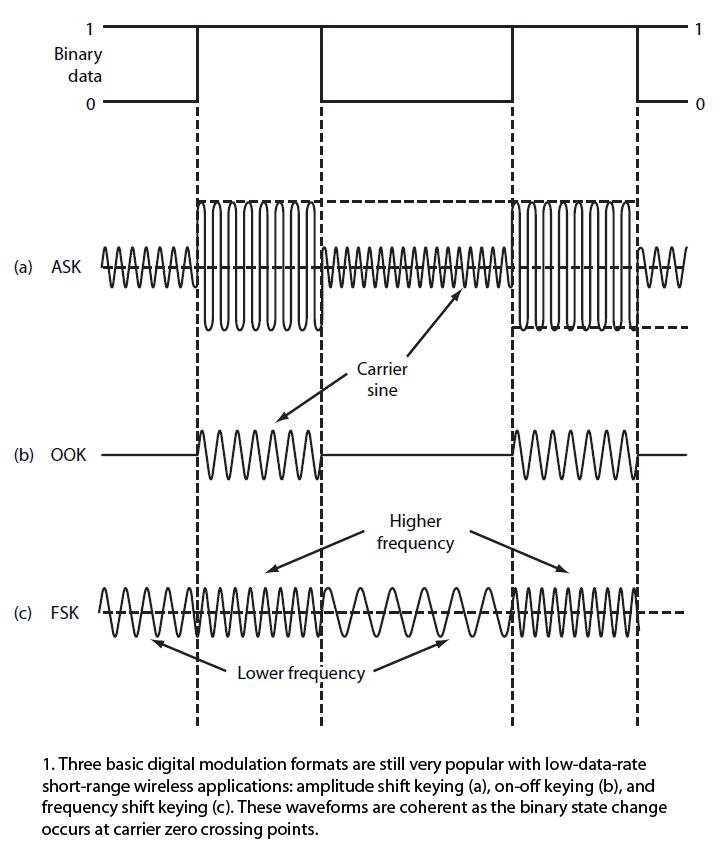
ASK encodes data by switching the carrier's amplitude among a set of discrete levels. It's the simplest digital modulation to implement but also the most vulnerable to noise and fading, since noise directly corrupts the amplitude dimension the receiver is trying to detect.
ASK modulation process
- Group the incoming bit stream into symbols of bits each.
- Map each symbol to one of predefined amplitude levels.
- Multiply the carrier by the selected amplitude level to produce the transmitted waveform.
Binary ASK (BASK)
BASK uses just two amplitude levels, typically 0 and . This is also called on-off keying (OOK) when one of the levels is zero.
The transmitted signal is:
where is the binary data signal and is the carrier frequency. When , no carrier energy is sent; when , the full carrier is transmitted.
BASK is easy to generate and demodulate, which is why it appears in low-cost systems like infrared remote controls. However, it wastes power (half the symbols carry zero energy on average) and offers only 1 bit per symbol.
Multilevel ASK (M-ASK)
M-ASK extends BASK to amplitude levels, transmitting bits per symbol:
Higher increases the data rate for the same symbol rate, but the amplitude levels crowd together, reducing the minimum distance between symbols and degrading BER performance at a given SNR.
ASK demodulation techniques
Coherent detection:
- Multiply the received signal by a locally generated carrier that is phase-locked to the transmitter.
- Low-pass filter the product to extract the baseband amplitude.
- Sample at the symbol rate and compare against decision thresholds to recover the transmitted symbols.
Non-coherent (envelope) detection:
- Rectify the received signal (or use a square-law device) to extract the envelope.
- Low-pass filter to smooth the result.
- Sample and threshold to decide the symbol.
Non-coherent detection avoids the need for carrier phase recovery, which simplifies the receiver, but it performs a few dB worse in SNR than coherent detection.
Advantages and disadvantages of ASK
- Advantages: Simple hardware, low cost, straightforward implementation.
- Disadvantages: Most noise-sensitive of the four main schemes; limited spectral efficiency; amplitude fading in wireless channels directly degrades performance.
Frequency shift keying (FSK)
FSK encodes data by switching the carrier's frequency among discrete values. Because information lives in frequency rather than amplitude, FSK produces a constant-envelope signal that is robust to nonlinear amplification and amplitude fading.

FSK modulation process
- Group the incoming bit stream into symbols of bits.
- Map each symbol to one of predefined frequencies .
- Transmit a sinusoid at the selected frequency for the duration of one symbol period.
Binary FSK (BFSK)
BFSK uses two frequencies, and :
The frequency separation controls the trade-off between bandwidth and orthogonality. The minimum separation for orthogonal signaling is (for coherent detection) or (for non-coherent detection), where is the symbol duration.
Multilevel FSK (M-FSK)
M-FSK uses distinct frequencies, each separated by at least the minimum orthogonal spacing. Each symbol carries bits, so the bit rate increases with . The catch: total bandwidth grows roughly as , making M-FSK spectrally inefficient for large .
An interesting property: M-FSK BER actually improves as increases for a fixed , at the cost of bandwidth. This makes it attractive in power-limited (but not bandwidth-limited) scenarios.
FSK demodulation techniques
Coherent detection (bank of matched filters):
- Pass the received signal through matched filters, each tuned to one of the frequencies.
- Sample the output of every filter at the end of each symbol period.
- Select the filter with the largest output as the detected symbol.
Non-coherent detection (frequency discriminator or envelope detectors):
- Pass the received signal through bandpass filters centered on each frequency.
- Envelope-detect each filter output.
- Choose the branch with the largest envelope as the detected symbol.
Non-coherent FSK detection is widely used because it avoids carrier phase tracking and still performs well.
Advantages and disadvantages of FSK
- Advantages: Good noise immunity; constant envelope suits nonlinear power amplifiers; simpler synchronization than PSK.
- Disadvantages: Poor spectral efficiency (bandwidth grows with ); not practical for high-data-rate, bandwidth-constrained links.
Phase shift keying (PSK)
PSK encodes data by shifting the carrier's phase among discrete values while keeping amplitude constant. This gives PSK a constant envelope (like FSK) combined with better spectral efficiency, making it one of the most widely used modulation families.
PSK modulation process
- Group the bit stream into symbols of bits.
- Map each symbol to one of equally spaced phase values: , for .
- Transmit the carrier at the selected phase for one symbol period.
Binary PSK (BPSK)
BPSK uses two phases separated by 180°:
where . This is equivalent to multiplying the carrier by or , so BPSK can also be written as .
BPSK has the largest possible distance between its two constellation points for a given signal energy, giving it the best BER performance of any PSK order. Its BER in AWGN is:
where is the Q-function, is energy per bit, and is the one-sided noise spectral density.
Quadrature PSK (QPSK)
QPSK uses four phases (0°, 90°, 180°, 270°), encoding 2 bits per symbol:
QPSK can be decomposed into two independent BPSK streams on the in-phase (I) and quadrature (Q) carriers. This means QPSK doubles the bit rate of BPSK for the same bandwidth without degrading the BER per bit. That's why QPSK (and its offset/differential variants) is the workhorse modulation in satellite, cellular, and deep-space links.
Multilevel PSK (M-PSK)
For , the phase states crowd closer together on the unit circle. 8-PSK, for example, carries 3 bits per symbol but the angular separation drops to 45°, requiring about 4 dB more SNR than QPSK for the same BER. As grows, the SNR penalty increases rapidly, which is why high-order pure PSK is rarely used. Systems needing more than 2 bits/symbol typically switch to QAM instead.
PSK demodulation techniques
Coherent detection:
- Generate a local carrier locked in frequency and phase to the transmitter (using a carrier recovery loop, e.g., Costas loop or squaring loop).
- Multiply the received signal by the local I and Q references.
- Low-pass filter and sample to obtain the I/Q baseband values.
- Map the sampled point to the nearest constellation point to decide the symbol.
Differential PSK (DPSK):
Instead of recovering absolute phase, DPSK encodes information in the phase difference between consecutive symbols. The receiver compares each symbol's phase to the previous one, eliminating the need for an absolute phase reference. The trade-off is roughly a 1–3 dB SNR penalty compared to coherent PSK.
Advantages and disadvantages of PSK
- Advantages: Constant envelope; good spectral efficiency (especially QPSK); strong BER performance for low-order variants.
- Disadvantages: Requires accurate carrier phase recovery; susceptible to phase noise; high-order M-PSK suffers steep SNR penalties.
Quadrature amplitude modulation (QAM)
QAM encodes data in both the amplitude and phase of the carrier, placing constellation points across a 2D I/Q plane rather than just around a circle. This lets QAM pack more symbols into the same signal space than pure PSK, achieving the highest spectral efficiencies of the standard modulation families.
QAM modulation process
- Group the bit stream into symbols of bits.
- Map each symbol to a point in the I/Q constellation.
- Transmit: .
The I and Q components are independent, so QAM is effectively two PAM (pulse amplitude modulation) signals transmitted simultaneously on orthogonal carriers.
Square QAM constellations
Square QAM arranges points on a regular grid. Common orders:
| Scheme | Points | Bits/symbol | Typical use |
|---|---|---|---|
| 16-QAM | 4×4 grid | 4 | Wi-Fi (802.11a/g), LTE |
| 64-QAM | 8×8 grid | 6 | LTE, cable modems |
| 256-QAM | 16×16 grid | 8 | DOCSIS 3.1, Wi-Fi 6 |
| 1024-QAM | 32×32 grid | 10 | Wi-Fi 6E, 5G NR |
Square constellations are preferred because Gray coding maps naturally onto the grid, minimizing bit errors when a symbol is mistaken for an adjacent neighbor.
Rectangular QAM constellations
Non-square constellations (e.g., 32-QAM with a cross-shaped arrangement, 128-QAM) are used when the desired number of bits per symbol doesn't correspond to a perfect square. These constellations are slightly less regular, which complicates Gray mapping and can reduce average power efficiency, but they fill gaps between square orders.
QAM demodulation techniques
Coherent detection:
- Recover the carrier frequency and phase (e.g., via a pilot-aided or decision-directed PLL).
- Down-convert the received signal to baseband, producing I and Q samples.
- Equalize the channel (compensate for ISI, frequency-selective fading).
- Slice the equalized I/Q samples against the constellation grid to decide each symbol.
Blind equalization adapts the equalizer without training symbols. Common algorithms:
- Constant Modulus Algorithm (CMA) — minimizes deviation from a constant envelope; good for initial convergence.
- Decision-Directed LMS (DD-LMS) — uses tentative symbol decisions as a reference to refine equalizer taps; takes over after CMA converges.
Advantages and disadvantages of QAM
- Advantages: Highest spectral efficiency of the standard schemes; flexible constellation design; dominant in modern broadband systems.
- Disadvantages: Varying envelope makes it sensitive to amplifier nonlinearity (requires linear PAs or back-off); demands accurate I/Q balance, carrier recovery, and channel equalization; BER degrades quickly with channel impairments at high orders.
Performance analysis of digital modulation
Choosing a modulation scheme means navigating trade-offs among BER, required SNR, spectral efficiency, and power efficiency. This section covers the key metrics used to evaluate and compare schemes.
Bit error rate (BER)
BER is the number of bit errors divided by the total number of transmitted bits. It's the primary reliability metric for any digital link.
BER depends on the modulation order, the channel's SNR, the type of fading, and whether error-correction coding is applied. Typical target BERs:
- Voice communication: (before coding)
- Data communication: to
- Optical transport: (after FEC)
For AWGN channels, closed-form BER expressions exist for most standard schemes. For example, BPSK BER is , while 16-QAM BER is approximately .
Signal-to-noise ratio (SNR)
SNR (or more precisely , energy per bit to noise spectral density) is the standard way to compare modulation schemes on a fair, per-bit basis.
Higher-order schemes need more to achieve the same BER. For instance, at a BER of :
- BPSK/QPSK require about 9.6 dB
- 16-QAM requires about 13.5 dB
- 64-QAM requires about 17.8 dB
This increasing SNR requirement is the fundamental cost of packing more bits per symbol.
Constellation diagrams
A constellation diagram plots each symbol as a point on the I/Q plane. You can read several things directly from the diagram:
- Minimum distance () between adjacent points controls noise robustness. Larger means fewer symbol errors at a given noise level.
- Symmetry reveals whether the scheme has a constant envelope (points on a circle = PSK) or varying envelope (points on a grid = QAM).
- Noise clouds around each point in a measured constellation show the effective SNR and any impairments like I/Q imbalance or phase noise.
Spectral efficiency
Spectral efficiency is measured in bits per second per Hertz (bps/Hz):
where is the bit rate and is the occupied bandwidth. For Nyquist-rate signaling, bps/Hz in theory. Practical values are lower due to pulse shaping, guard bands, and coding overhead.
Higher spectral efficiency means more data in less bandwidth, which is critical in crowded spectrum environments. But it always comes at the cost of higher required SNR.
Power efficiency
Power efficiency measures how much transmit energy is needed per bit to achieve a target BER. Schemes with widely spaced constellation points (like BPSK) are the most power-efficient. Constant-envelope schemes (FSK, PSK) also benefit from being able to use efficient nonlinear amplifiers without distortion.
The core trade-off in modulation design:
Spectral efficiency and power efficiency work against each other. Higher-order QAM is spectrally efficient but power-hungry. Low-order FSK is power-efficient but wastes bandwidth. System designers pick the modulation that best fits their constraints: a satellite link (power-limited) favors BPSK/QPSK, while a cable modem (bandwidth-limited) uses 256-QAM or higher.
See Fiveable more often in Google
Mark Fiveable as a preferred source and Google is more likely to show you our guides in Top Stories, with a "preferred" badge in AI Mode and AI Overviews.