26.1 Introduction to the Adrenal Cortex, Pituitary, and Hypothalamus

💊Pharmacology for Nurses Unit 26 Review
26.1 Introduction to the Adrenal Cortex, Pituitary, and Hypothalamus
💊 Pharmacology for Nurses
Hypothalamus, Pituitary Gland, and Adrenal Cortex
The hypothalamus, pituitary gland, and adrenal cortex form a tightly coordinated system that regulates metabolism, growth, stress response, and much more. Many drug therapies either replace, suppress, or mimic the hormones these structures produce.

Top images from around the web for Key functions in regulating endocrine system
The Pituitary Gland and Hypothalamus | Anatomy and Physiology I View original
Is this image relevant?
The Pituitary Gland and Hypothalamus | Anatomy and Physiology I View original
Is this image relevant?
Overview of the Endocrine System | Boundless Anatomy and Physiology View original
Is this image relevant?
The Pituitary Gland and Hypothalamus | Anatomy and Physiology I View original
Is this image relevant?
The Pituitary Gland and Hypothalamus | Anatomy and Physiology I View original
Is this image relevant?
Key Functions in Regulating the Endocrine System
Hypothalamus
The hypothalamus is the primary link between the nervous system and the endocrine system. It receives signals from the brain and body, then translates those signals into hormonal commands. Specifically, it secretes releasing hormones and inhibiting hormones that tell the pituitary gland what to do. Beyond endocrine control, the hypothalamus also regulates body temperature, hunger, thirst, sleep, and circadian rhythms.
Pituitary Gland
The pituitary sits just below the hypothalamus and coordinates many endocrine signals through two functionally distinct lobes:
- Anterior lobe — Produces and secretes its own hormones (GH, TSH, ACTH, FSH, LH, prolactin) in direct response to hypothalamic releasing hormones.
- Posterior lobe — Does not actually make hormones. Instead, it stores and releases two hormones (ADH and oxytocin) that are manufactured in the hypothalamus and transported down to the posterior lobe for release.
This distinction matters clinically. Damage to the anterior lobe affects hormone production, while damage to the posterior lobe or the nerve tracts from the hypothalamus affects hormone release.
Adrenal Cortex
The adrenal cortex is the outer layer of the adrenal glands, which sit on top of each kidney. It produces three categories of steroid hormones:
- Glucocorticoids (primarily cortisol) — regulate glucose metabolism, immune/inflammatory responses, and the stress response
- Mineralocorticoids (primarily aldosterone) — regulate blood pressure and electrolyte balance by controlling sodium retention and potassium excretion
- Androgens (primarily DHEA) — serve as precursors to sex hormones like testosterone and estrogen

Major Hormones and Their Primary Effects
Hypothalamic Hormones
| Hormone | Target | Primary Effect |
|---|---|---|
| TRH (thyrotropin-releasing hormone) | Anterior pituitary | Stimulates TSH release → regulates thyroid function |
| CRH (corticotropin-releasing hormone) | Anterior pituitary | Stimulates ACTH release → regulates adrenal cortex function |
| GnRH (gonadotropin-releasing hormone) | Anterior pituitary | Stimulates FSH and LH release → regulates reproductive function |
| ADH / vasopressin | Kidneys, blood vessels | Promotes water reabsorption (concentrates urine) and raises blood pressure |
| Oxytocin | Uterus, mammary glands | Stimulates uterine contractions during labor and milk ejection during breastfeeding |
Note that ADH and oxytocin are produced in the hypothalamus but released from the posterior pituitary.
Anterior Pituitary Hormones
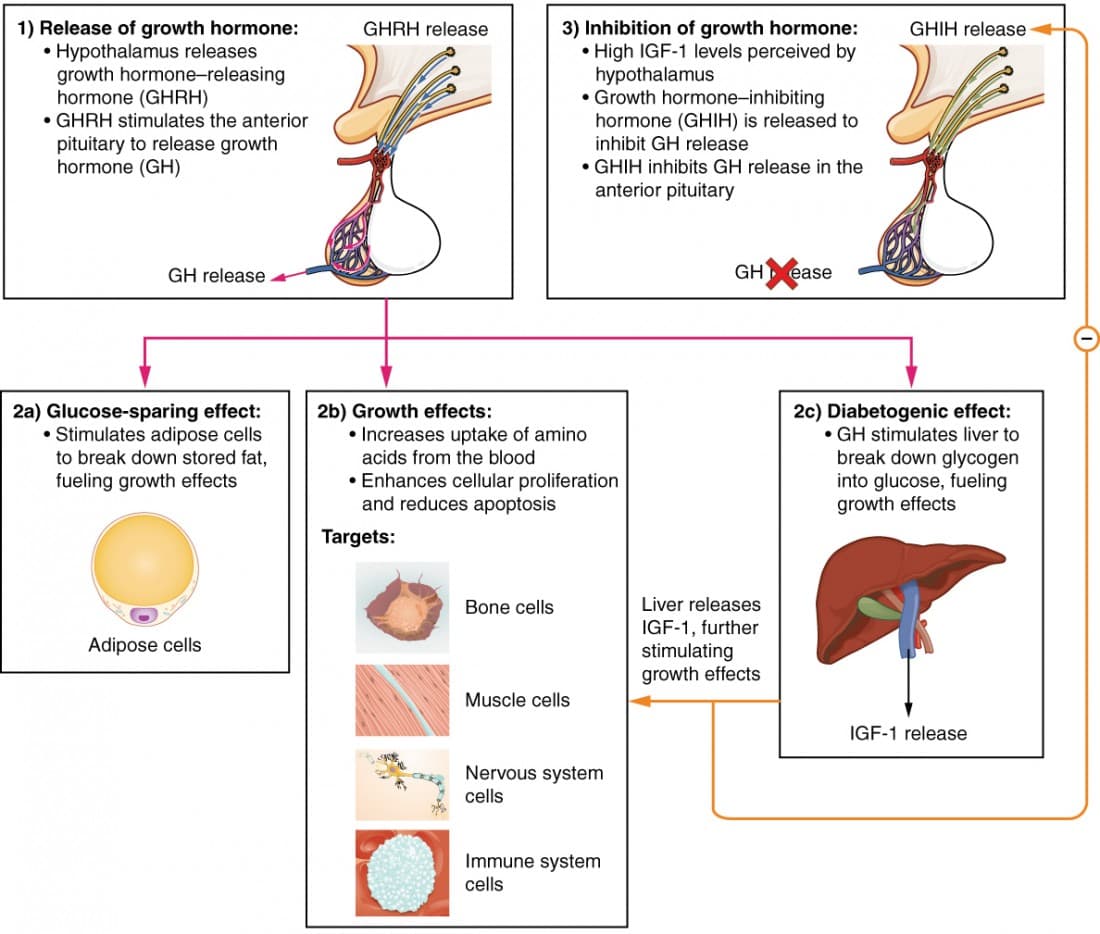
- GH (growth hormone) — Promotes bone and muscle growth; regulates glucose, protein, and fat metabolism.
- TSH (thyroid-stimulating hormone) — Stimulates the thyroid gland to produce T3 and T4, which control metabolic rate.
- ACTH (adrenocorticotropic hormone) — Stimulates the adrenal cortex to produce cortisol. This is the key hormone in the stress-response pathway.
- FSH and LH — Regulate reproductive function. In females, they drive follicle development, ovulation, and estrogen/progesterone production. In males, they regulate spermatogenesis and testosterone production.
- Prolactin (PRL) — Stimulates milk production in the mammary glands after childbirth.
Adrenal Cortex Hormones
- Cortisol (glucocorticoid) — Raises blood glucose to provide energy, suppresses inflammation, and helps the body cope with physical and psychological stress. Cortisol follows a diurnal pattern, peaking in the early morning.
- Aldosterone (mineralocorticoid) — Acts on the kidneys to retain sodium (and water) while excreting potassium. This directly influences blood volume and blood pressure.
- DHEA (androgen) — A weak androgen that serves mainly as a building block for testosterone and estrogen. Its clinical effects are mild compared to cortisol and aldosterone.

Maintaining Homeostasis and Responding to Stress
The HPA Axis
The hypothalamic-pituitary-adrenal (HPA) axis is the body's central stress-response system. Here's how it works step by step:
- A stressor (physical injury, infection, emotional stress) activates the hypothalamus.
- The hypothalamus secretes CRH.
- CRH travels to the anterior pituitary and stimulates release of ACTH.
- ACTH enters the bloodstream and stimulates the adrenal cortex to produce and release cortisol.
- Cortisol acts throughout the body: it raises blood glucose for energy, suppresses the immune/inflammatory response, and mobilizes energy stores (fat and protein breakdown).
- As cortisol levels rise, they exert negative feedback on both the hypothalamus (reducing CRH) and the anterior pituitary (reducing ACTH). This prevents runaway cortisol production.
Why this matters clinically: When patients take exogenous glucocorticoids (like prednisone) for extended periods, the constant high cortisol level suppresses the HPA axis through this same negative feedback. The adrenal cortex becomes suppressed. If the drug is stopped abruptly, the patient's own adrenal glands can't respond quickly enough, potentially causing adrenal crisis — a life-threatening drop in cortisol. This is why glucocorticoid therapy must be tapered gradually.
Homeostatic Regulation
The HPA axis is just one example of a broader principle: the hypothalamus constantly monitors physiological parameters like body temperature, blood glucose, and blood pressure. When something drifts out of range, it adjusts hormone secretion to bring conditions back to normal.
The pituitary responds to these hypothalamic signals by releasing hormones that target downstream glands (thyroid, adrenals, gonads) and tissues (liver, muscle, bone). Those downstream glands then produce their own hormones, which circle back to inhibit the hypothalamus and pituitary through negative feedback loops.
This layered feedback system keeps hormone levels within a narrow optimal range. When disease or drug therapy disrupts any point in the loop, the effects can cascade through the entire axis. That's why understanding these connections is so important when administering or monitoring hormone-related medications.
See Fiveable more often in Google
Mark Fiveable as a preferred source and Google is more likely to show you our guides in Top Stories, with a "preferred" badge in AI Mode and AI Overviews.