2.6 Interval Inversion and Compound Intervals

🎶AP Music Theory Unit 2 Review
2.6 Interval Inversion and Compound Intervals
🎶 AP Music Theory
2.1
Minor Scales: Natural, Harmonic, and Melodic
2.2
Relative Keys: Determining Relative Minor Key and Notating Key Signatures
2.3
Key Relationships: Parallel, Closely Related, and Distantly Related Keys
2.4
Other Scales: Chromatic, Whole-Tone, and Pentatonic
2.5
Interval Size and Quality
2.6
Interval Inversion and Compound Intervals
2.7
Transposing Instruments
2.8
Timbre
2.9
Melodic Features
2.10
Melodic Transposition
2.11
Texture and Texture Types
2.12
Texture Devices
2.13
Rhythmic Devices
Interval inversion means flipping an interval so the lower note jumps up an octave, or the upper note drops down. The size numbers of an interval and its inversion always add up to 9, and the quality flips in a predictable way: major becomes minor, augmented becomes diminished, and perfect stays perfect.
Why This Matters for the AP Music Theory Exam
Being able to invert intervals and name compound intervals supports both the aural and notated sides of AP Music Theory. You will identify interval inversions and compound intervals in performed music (by ear) and in notated music (on the staff). This skill speeds up your work later with chords, voice leading, and harmonic analysis, since a compound interval like a tenth sounds like its simple version (a third) one octave higher. Recognizing that link helps you read wide spacing in scores and connect what you hear to what you see.
Key Takeaways
- To invert an interval, move the lower note up an octave (or the upper note down an octave).
- An interval plus its inversion equals a perfect octave, so the two size numbers always add to 9 (3 + 6, 2 + 7, 4 + 5).
- Quality flips when you invert: major ↔ minor, augmented ↔ diminished, and perfect stays perfect.
- A simple interval is an octave or smaller; a compound interval is a simple interval with one or more octaves added.
- Compound intervals keep the same quality as their simple version (a major third becomes a major tenth).
- Because the added octave only changes register, a compound interval sounds similar to its simple version.
Interval Inversions


When you name an interval, you usually measure it going up. C up to E is a major third. But what about E up to C? Looking at the notes, that is a minor sixth. There is a steady relationship between an interval and the interval you get when you flip it.
Interval inversion is the process of taking an interval (the distance between two pitches) and turning it upside down. You do this by moving the lower note up an octave, or by moving the upper note down an octave. Either way, the two notes trade places.
Two quick rules handle every inversion:
- The size numbers add up to 9. A third inverts to a sixth (3 + 6 = 9). A second inverts to a seventh (2 + 7 = 9). A fourth inverts to a fifth (4 + 5 = 9).
- The quality flips, except for perfect intervals:
- perfect stays perfect (P ↔ P)
- major becomes minor, and minor becomes major (M ↔ m)
- augmented becomes diminished, and diminished becomes augmented (A ↔ d)
So the inversion of a major third is a minor sixth. The inversion of a perfect fifth is a perfect fourth. The inversion of an augmented fourth is a diminished fifth.
A common pair worth memorizing is the P5 and P4. If you have a perfect fifth, like G up to D, and you switch the notes so D is on the bottom, you get a perfect fourth (D up to G).
Try It
Invert each interval using the two rules above (answers at the end):
- diminished 4th
- major 6th
- minor 7th
- perfect 5th
- major 2nd
- augmented 4th
Inversions and Descending Intervals
Inversions also connect to descending motion. The inversion of a perfect fifth is a perfect fourth, so moving down by a perfect fifth lands on the same pitch class as moving up by a perfect fourth. Starting on G and going up by fifths gives G, D, A, and so on. Going down by fifths from G gives G, C, F, which is the same as moving up by perfect fourths.
Compound Intervals
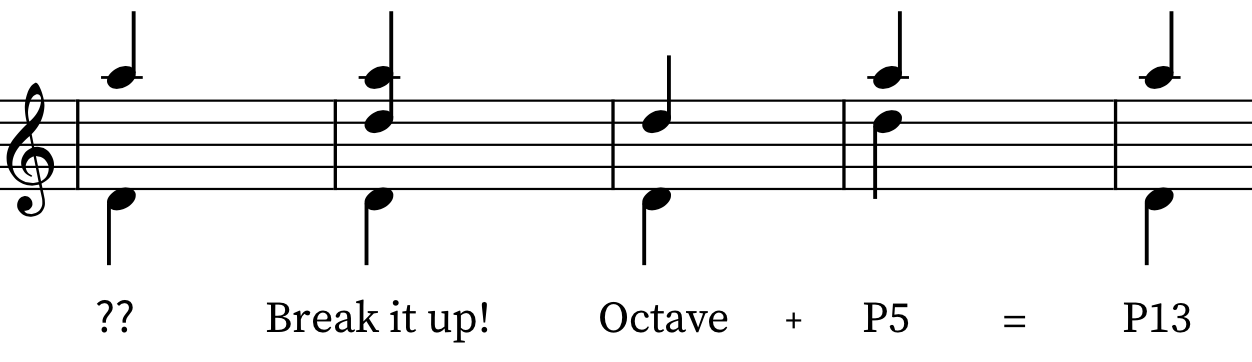

Compound intervals are intervals larger than an octave. They are just a simple interval with one or more octaves added on top. Saying two notes are a "twenty-fourth" apart is not very useful, but saying they are three octaves plus a third makes the sound clear. The third is what gives the interval its character. Shifting a note up or down by an octave does not change the basic quality or the consonant/dissonant feel.
For example, an octave added to a major third gives a major tenth. The two intervals share the same letter-name pitches in different octaves, so they sound similar.
Naming a Compound Interval
A perfect octave by itself is an 8th. Each time you stack another octave, the number grows by 7, so the perfect octaves are the 8th, 15th, 22nd, 29th, and so on. To name a compound interval, find which simple interval it equals after removing full octaves.
- A 9th is an octave plus a 2nd.
- A 10th is an octave plus a 3rd.
- A 13th is an octave plus a 6th. You can also call this a "compound 6th."
The quality stays the same as the simple interval. A minor 13th is a compound minor 6th. A major 13th is a compound major 6th.
Quick Check
- Name the interval from F♯ up to B.
- Name the interval from G up to the D♭ two octaves above it.
How to Use This on the AP Music Theory Exam
Aural Recognition
When you hear a wide interval, remember that a compound interval sounds like its simple version one or more octaves higher. If a leap sounds like a third but spans a big range, it may be a tenth. Train your ear on the simple interval first, then account for the octave.
Notated Music
On the staff, count carefully through ledger lines and clefs. For inversions, the fastest check is the sum-to-9 rule plus the quality flip. For compound intervals, remove whole octaves until you reach a simple interval, name that, then add the octave label back.
Common Trap
Do not change the quality when you build a compound interval. A major third stays major when it becomes a major tenth. Quality only flips during inversion, not when you add octaves.
Common Misconceptions
- Misconception: Inversion changes the quality of perfect intervals.Actually: Perfect intervals stay perfect when inverted. Only major/minor and augmented/diminished pairs swap.
- Misconception: The interval numbers add to 8 when inverted.Actually: They add to 9, because a unison counts as 1, not 0. A second inverts to a seventh, not an eighth.
- Misconception: Compound intervals get a new quality.Actually: The quality is the same as the simple interval. A minor 6th becomes a minor 13th.
- Misconception: A 9th is just an octave.Actually: An octave is an 8th. A 9th is an octave plus a second, since the extra step pushes it past the octave.
- Misconception: Inverting an interval changes the pitches involved.Actually: Inversion uses the same two letter names; you only move one of them by an octave so they trade high and low positions.
Answers
Inversion practice:
- augmented 5th
- minor 3rd
- major 2nd
- perfect 4th
- minor 7th
- diminished 5th
Quick check: F♯ up to B is a perfect 4th. G up to D♭ two octaves above is a compound diminished 5th.
Related AP Music Theory Guides
Practice Questions for 2.6
1 of 10
A composer transforms a harmonic interval of a Major 6th by moving the bottom pitch up one octave. What is the quality and size of the resulting interval?
A.
Major 3rd
B.
Major 6th
C.
Minor 6th
D.
Minor 3rd
Vocabulary
The following words are mentioned explicitly in the AP® course framework for this topic.Term | Definition |
|---|---|
augmented interval | An interval quality that becomes diminished when inverted. |
compound interval | An interval larger than an octave, created by adding an octave to a simple interval. |
diminished interval | An interval quality that becomes augmented when inverted. |
interval inversion | The result of transferring the lower note of an interval up an octave, creating a new interval where the original interval and its inversion together equal a perfect octave. |
major interval | An interval quality that becomes minor when inverted. |
minor interval | An interval quality that becomes major when inverted. |
octave | The interval spanning eight letter names, representing a doubling or halving of frequency. |
perfect interval | A harmonic interval (unison, fourth, fifth, or octave) that is considered consonant and stable. |
simple interval | An interval whose size is smaller than or equal to an octave. |
Frequently Asked Questions
What is interval inversion?
Interval inversion means flipping an interval by moving the lower note up an octave or the upper note down an octave. The two notes trade places, creating a related interval.
Why do interval inversions add up to 9?
An interval and its inversion complete an octave, so their size numbers add to 9. A 3rd inverts to a 6th, a 2nd inverts to a 7th, and a 4th inverts to a 5th.
What does a major interval invert to?
A major interval inverts to a minor interval. For example, a major 3rd inverts to a minor 6th because 3 + 6 = 9 and major changes to minor.
What is an interval inversion chart?
An interval inversion chart shows the two rules: size numbers add to 9, and quality changes in pairs. Major becomes minor, minor becomes major, augmented becomes diminished, diminished becomes augmented, and perfect stays perfect.
What are compound intervals?
Compound intervals are intervals larger than an octave, such as a 9th, 10th, or 13th. They keep the same basic quality as their simple interval version plus one or more octaves.
How do you simplify a compound interval?
Subtract 7 from the compound interval number until the result is an octave or smaller. A 10th becomes a 3rd, so a major 10th has the same quality as a major 3rd.