9.2 Social Security and Pension Systems

🫘Intro to Public Policy Unit 9 Review
9.2 Social Security and Pension Systems
🫘 Intro to Public Policy
Social Security and pension systems provide financial security for elderly, disabled, and dependent populations. Understanding how these programs are funded, who they cover, and why they're under pressure is central to any policy discussion about poverty and income security.
These systems vary widely across countries, but they all face a similar tension: populations are aging, work patterns are shifting, and the math behind traditional funding models is getting harder to sustain.
Social Security and Pension Systems

Top images from around the web for History and purpose
FDR Quote on Social Security | Luther Gulick Memorandum re: … | Flickr View original
Is this image relevant?
Social Security Act - Wikipedia View original
Is this image relevant?
New Deal - Wikipedia View original
Is this image relevant?
FDR Quote on Social Security | Luther Gulick Memorandum re: … | Flickr View original
Is this image relevant?
Social Security Act - Wikipedia View original
Is this image relevant?
History and Purpose
The concept of social insurance originated in late 19th-century Germany under Chancellor Otto von Bismarck, who introduced the first national old-age insurance program. The idea was straightforward: workers and employers contribute during working years, and the state guarantees income in old age.
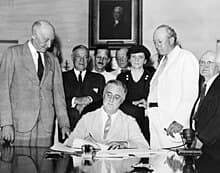
In the United States, President Franklin D. Roosevelt signed the Social Security Act into law in 1935 as part of the New Deal. It created the Social Security program, which remains the largest single source of retirement income for most Americans.
Over time, both public and private pension systems evolved to supplement social security and provide additional retirement income. The primary purposes across all these systems are to:
- Alleviate poverty among the elderly and disabled
- Promote social stability by preventing destitution in old age
- Ensure a basic standard of living for vulnerable populations
Types and Evolution
Pension systems generally fall into two categories: public and private.
Public pension plans for government employees are usually funded through a combination of employee contributions, employer (government) contributions, and investment returns.
Private pension plans come in two main forms:
- Defined benefit (DB) plans guarantee a specific benefit amount based on factors like years of service and salary. The employer bears the investment risk.
- Defined contribution (DC) plans, such as 401(k)s, rely on employee contributions (sometimes with employer matches). The employee bears the investment risk.
The balance between public and private systems varies by country. Some nations rely heavily on government-funded social security, while others place greater emphasis on individual and employer contributions through private pensions.
Structure and Funding of Social Security
Funding Mechanisms
Social security programs are typically funded through payroll taxes, with contributions split between employees and employers.
In the United States, the Federal Insurance Contributions Act (FICA) mandates these payroll taxes:
- Social Security: Employees and employers each pay 6.2% of wages, up to a taxable maximum ( in 2023)
- Medicare: Each side pays 1.45% of wages, with no taxable maximum
Some countries go beyond payroll taxes. Norway, for example, invests surplus oil and gas revenues in its Government Pension Fund Global, one of the world's largest sovereign wealth funds, to help finance future pension obligations.

Benefit Calculations and Eligibility
Social Security benefits in the US are based on a worker's average indexed monthly earnings (AIME) over their 35 highest-earning years. "Indexed" means past earnings are adjusted upward to account for wage growth over time.
The Primary Insurance Amount (PIA) is then calculated as a percentage of AIME. The formula is progressive: lower earners receive a higher replacement percentage than higher earners.
Eligibility and timing matter a lot:
- Full retirement age ranges from 66 to 67, depending on birth year
- Early retirement is available at age 62, but benefits are permanently reduced
- Delayed retirement past full retirement age increases benefits by 8% per year, up to age 70
- The maximum monthly benefit for a worker retiring at full retirement age in 2023 was $3,627
Sustainability and Adequacy of Social Security
Demographic Challenges
Most social security systems operate on a pay-as-you-go basis, meaning current workers' taxes fund current retirees' benefits. This model depends on having enough workers relative to retirees, and that ratio is shrinking.
Two trends are driving the problem:
People are living longer. In 1940, a 65-year-old American male could expect to live another 12.7 years. By 2020, that figure had risen to 18.2 years. For females, it went from 14.7 to 20.8 years. That's decades of additional benefits the system wasn't originally designed to pay.
Fewer children are being born. The US fertility rate dropped from 3.65 births per woman in 1960 to 1.64 in 2020, well below the replacement level of 2.1. This pattern holds across most developed countries, meaning fewer future workers will be supporting more retirees.
Benefit Adequacy Concerns
Even setting sustainability aside, there's a question of whether benefits are enough. Social Security replaces only about 37% of pre-retirement earnings for the average American worker. Most financial advisors recommend a 70-80% replacement rate for a comfortable retirement. That gap has to be filled by personal savings, pensions, or continued work.
The shift from DB to DC pension plans has made this harder. When employees bear the investment risk, retirement outcomes depend on individual decisions and market performance, which creates wide disparities in preparedness.
Several other factors compound the problem:
- Wage stagnation: Median real wages in the US grew only 6.1% between 1979 and 2019, while productivity increased by 69.6%
- The gig economy: Gig workers often lack access to employer-sponsored retirement plans and face income volatility
- Income inequality: Higher earners can save more, while lower earners depend more heavily on Social Security

Reforms and Alternatives for Social Security
Parametric Reforms
Parametric reforms adjust the existing system's rules without changing its fundamental structure:
- Raising the retirement age to reflect longer life expectancies. The US is already gradually increasing full retirement age from 66 to 67 for those born in 1960 or later.
- Increasing payroll tax rates or removing the taxable earnings cap. Eliminating the taxable maximum alone would close about 71% of Social Security's projected long-term deficit.
- Means-testing benefits, so higher-income retirees receive reduced or no benefits. This would target resources to those most in need, but critics argue it could undermine the program's universal character and erode political support.
Structural Reforms
Structural reforms change how the system fundamentally works:
- Transitioning from pay-as-you-go to funded systems, where contributions are invested to build reserves. Chile privatized its pension system in the 1980s, and Sweden created a notional defined contribution system. These transitions require careful planning to ensure current retirees still receive benefits during the shift.
- Exploring alternative funding sources beyond payroll taxes. Australia's superannuation system requires employers to contribute a percentage of employee earnings to individual retirement accounts, which are invested in diversified portfolios and supplement the means-tested Age Pension.
Encouraging Work and Savings
Policy can also nudge individuals toward better retirement preparation:
- Automatic enrollment in employer-sponsored retirement plans significantly boosts participation. The US Pension Protection Act of 2006 encouraged auto-enrollment and auto-escalation of contribution rates.
- Financial education programs help people make informed savings and investment decisions. Countries like New Zealand and Denmark have implemented national financial education strategies.
- Flexible retirement options ease the transition out of work. Germany's partial retirement scheme allows older workers to reduce hours while receiving partial pension benefits.
- Supporting longer productive lives through policies around caregiving, lifelong learning, and healthy aging. Singapore's SkillsFuture program, for instance, provides subsidies for continuing education throughout a person's career.
See Fiveable more often in Google
Mark Fiveable as a preferred source and Google is more likely to show you our guides in Top Stories, with a "preferred" badge in AI Mode and AI Overviews.