5.2 Economic Instruments: Subsidies and Taxation

🫘Intro to Public Policy Unit 5 Review
5.2 Economic Instruments: Subsidies and Taxation
🫘 Intro to Public Policy
Economic instruments like subsidies and taxes are two of the most common tools governments use to shape behavior. Subsidies reward actions policymakers want to encourage, while taxes raise the cost of actions they want to discourage. Both can be effective, but they come with trade-offs in terms of cost, fairness, and political feasibility that policymakers have to navigate carefully.
Subsidies as Policy Tools

Top images from around the web for Forms and Advantages of Subsidies
Subsidies | Marginal Revolution University View original
Is this image relevant?
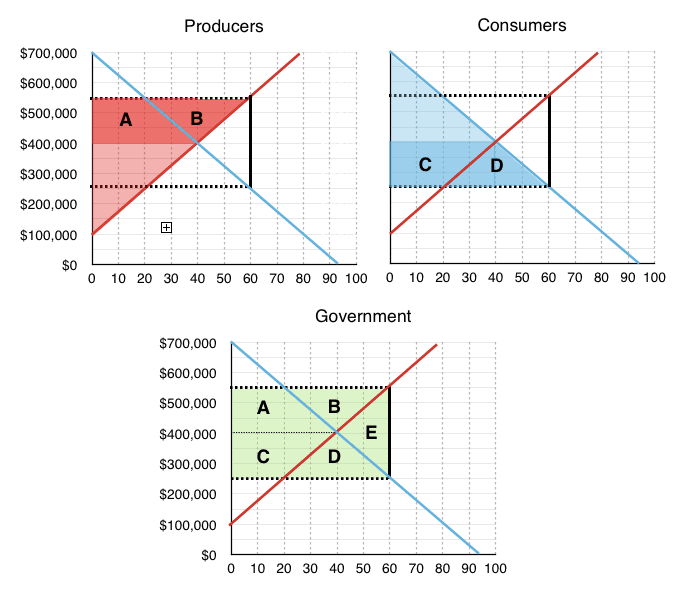
4.7 Taxes and Subsidies – Principles of Microeconomics View original
Is this image relevant?
4.7 Taxes and Subsidies – Principles of Microeconomics View original
Is this image relevant?
Subsidies | Marginal Revolution University View original
Is this image relevant?
4.7 Taxes and Subsidies – Principles of Microeconomics View original
Is this image relevant?
Forms and Advantages of Subsidies
A subsidy is a financial incentive provided by a government to encourage actions or behaviors considered beneficial to society or the economy. Subsidies come in several forms, each with different strengths:
- Direct payments: Cash transfers to recipients, such as payments to farmers or low-income households
- Tax credits: Reductions in what someone owes in taxes for doing something the government wants to encourage, like installing solar panels or buying an electric vehicle
- Low-interest loans: Below-market borrowing terms for specific investments, such as small business expansion or energy-efficient home upgrades
- In-kind benefits: Non-monetary assistance, like free public transportation or subsidized housing
The form matters because it affects who actually benefits. A tax credit, for example, only helps people who owe enough in taxes to claim it, which can exclude lower-income households.
Objectives and Design Considerations
Governments use subsidies to promote a wide range of goals:
- Encouraging adoption of renewable energy (wind, solar)
- Supporting low-income households (food stamps, housing assistance)
- Fostering research and development (grants for startups, R&D tax credits)
- Maintaining domestic production in strategic industries (agriculture, defense manufacturing)
How a subsidy is designed matters just as much as whether one exists. Poorly targeted subsidies can backfire. A country that subsidizes fossil fuels while simultaneously trying to cut emissions is working against itself. Overly generous subsidies can also create dependency, where industries or individuals rely on government support rather than adapting to market conditions.
To evaluate whether a subsidy program is actually working, policymakers look at several factors:
- Uptake: How many people or organizations are actually using it?
- Cost-benefit ratio: Do the societal benefits justify the expense?
- Fraud risk: Are there safeguards against misuse of funds?
- Long-term sustainability: Will the desired behavior continue after the subsidy ends, or will people revert?
Taxation for Behavior Modification

Influencing Behavior Through Taxation
Taxes influence behavior by changing cost-benefit calculations. When something becomes more expensive, people tend to do less of it. Governments commonly use taxes to discourage:
- Consumption of harmful goods (tobacco taxes, alcohol taxes)
- Pollution and congestion (carbon taxes, congestion charges)
Whether a tax actually changes behavior depends on a few key factors:
- Elasticity of demand: If demand is inelastic (people buy it regardless of price, like gasoline in car-dependent areas), a tax won't change behavior much. If demand is elastic (people are price-sensitive), the tax will have a bigger effect.
- Availability of substitutes: If cheaper, untaxed alternatives exist, people will switch. If they don't, people just pay more.
- Size of the tax relative to income: A $2-per-pack cigarette tax hits a minimum-wage worker much harder than a high earner.
Tax Policy Design and Unintended Consequences
The details of tax design shape how well the policy works:
- Tax rate: Higher rates produce stronger behavioral responses but also increase the incentive to evade or avoid the tax.
- Tax base: A broad base (taxing all carbon emissions) is more effective than a narrow one (taxing only gasoline), but broader bases tend to face more political opposition.
- Exemptions and loopholes: Special carve-outs can undermine the policy's goals and create perceptions of unfairness.
Taxes can also produce unintended consequences that policymakers need to anticipate:
- Avoidance and evasion: People and businesses find ways around the tax (offshore havens, black markets)
- Substitution effects: Consumers shift to untaxed alternatives that may not be much better (switching from cigarettes to e-cigarettes, cross-border shopping)
- Regressive burden: Taxes on necessities like food or energy take a larger share of income from low-income households
Subsidies vs. Taxes: Policy Outcomes

Incentive Mechanisms and Political Feasibility
Subsidies and taxes both aim to change behavior, but they work through opposite mechanisms:
- Subsidies create positive incentives, making desired behaviors more attractive or affordable. Examples include electric vehicle purchase rebates and feed-in tariffs for renewable energy producers.
- Taxes create negative incentives, making undesired behaviors more costly. Examples include high cigarette taxes and congestion pricing for driving in city centers.
Politically, subsidies are almost always easier to pass. They give direct benefits to identifiable groups (farmers, homebuyers, clean energy companies), which builds political support. Taxes, by contrast, are perceived as a burden, and the groups being taxed tend to push back hard.
Cost and Revenue Implications
This political advantage comes with a fiscal trade-off:
- Subsidies cost money. They require ongoing government spending, which can strain budgets or contribute to deficits.
- Taxes generate revenue. That revenue can fund other programs or reduce deficits.
Their distributional effects also differ. Subsidies tend to benefit specific industries or groups (renewable energy producers, first-time homebuyers), which can create resentment among those who don't qualify. Taxes can be structured to be progressive (higher earners pay more) or regressive (everyone pays the same rate, which hits lower earners harder proportionally), depending on how they're designed.
Distributional Effects of Economic Instruments
Varying Impacts on Different Populations
Economic instruments don't affect everyone equally. The impact depends on:
- Income level: Low-income households are more sensitive to price changes. A gas tax that barely registers for a high earner can be a real burden for someone living paycheck to paycheck.
- Consumption patterns: People who consume more of a taxed or subsidized good feel the policy more. Heavy smokers are hit harder by tobacco taxes than occasional smokers.
- Geographic location: A carbon tax affects coal-dependent rural communities very differently than urban areas with access to public transit.
Subsidies can be targeted to address these disparities. Subsidized childcare for low-income working parents or student loan forgiveness for people working in underserved communities are examples of this approach. But targeting also creates its own problems. Electric vehicle subsidies, for instance, often benefit higher-income households who can afford the upfront cost of a new car. Agricultural subsidies frequently flow disproportionately to large agribusinesses rather than small family farms.
Tax Incidence and Progressivity
Tax incidence refers to who actually bears the economic burden of a tax, which isn't always the person or business that writes the check.
- Progressive taxes (like graduated income tax brackets or luxury goods taxes) take a larger percentage from high earners, helping reduce inequality.
- Regressive taxes (like sales taxes or flat-rate fees) take a larger percentage from low earners, potentially worsening inequality.
The burden can shift through the market in two ways:
- Forward shifting: Businesses pass the tax cost to consumers through higher prices. This is common when demand is inelastic, since consumers keep buying even at higher prices. Cigarette taxes are a classic example.
- Backward shifting: Businesses absorb the tax through lower profits or reduced wages. This happens more in highly competitive markets where businesses can't easily raise prices.
The degree of shifting depends on the elasticities of supply and demand in that particular market. Policymakers need to account for these dynamics to avoid designing instruments that look fair on paper but end up placing the heaviest burden on the people least able to bear it.
See Fiveable more often in Google
Mark Fiveable as a preferred source and Google is more likely to show you our guides in Top Stories, with a "preferred" badge in AI Mode and AI Overviews.