9.4 Welfare Reform and Work Incentives

🫘Intro to Public Policy Unit 9 Review
9.4 Welfare Reform and Work Incentives
🫘 Intro to Public Policy
Historical Context of Welfare Reform

Top images from around the web for Momentum for Reform in the 1990s
Celebrating Civil Discourse on Welfare Reform - Niskanen Center View original
Is this image relevant?
The Welfare State | Boundless Political Science View original
Is this image relevant?
Effects of welfare reform in terms of costs and mortality: Data analysis - The Journalist's Resource View original
Is this image relevant?
Celebrating Civil Discourse on Welfare Reform - Niskanen Center View original
Is this image relevant?
The Welfare State | Boundless Political Science View original
Is this image relevant?
Momentum for Reform in the 1990s
By the early 1990s, dissatisfaction with the U.S. welfare system had become a bipartisan issue. The main target was Aid to Families with Dependent Children (AFDC), a federal program that provided cash assistance to low-income families with children. Critics on both sides of the aisle argued that AFDC fostered long-term dependency on government aid and did too little to encourage recipients to find work.
The concerns were straightforward: welfare caseloads and costs were rising, and the system appeared to lack meaningful incentives for recipients to transition into employment. The political consensus shifted toward promoting personal responsibility and self-sufficiency rather than open-ended cash assistance.
The Personal Responsibility and Work Opportunity Reconciliation Act (PRWORA) of 1996
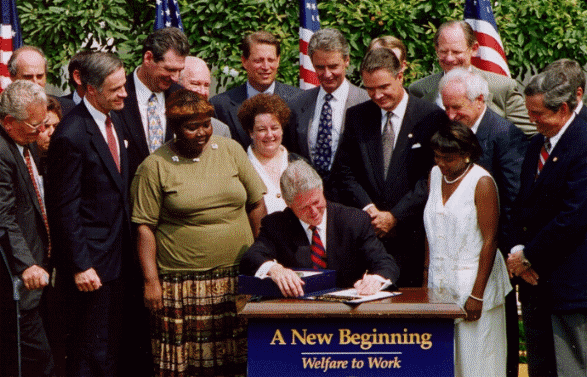
President Bill Clinton signed PRWORA into law in 1996, fundamentally restructuring federal welfare policy. The key changes:
- Replaced AFDC with Temporary Assistance for Needy Families (TANF), a block grant program giving states significant flexibility in designing and running their own welfare programs
- Imposed work requirements, meaning most recipients had to engage in work or work-related activities to receive benefits
- Set time limits on benefit receipt, typically capping lifetime federal assistance at five years
- Shifted authority to the states, letting them decide how to allocate TANF funds and structure their programs
The overarching goal was to move people from welfare rolls into the workforce and reduce long-term reliance on government support.
The Case Supporters Made
Proponents of reform argued that emphasizing work and personal responsibility would help break cycles of poverty. They expected the changes to increase employment, reduce poverty over time, and improve outcomes for families. From their perspective, the old system's open-ended benefits were part of the problem, and restructuring was a necessary correction.
Welfare Reform's Impact
Effects on Poverty Rates
The results on poverty were genuinely mixed. In the late 1990s and early 2000s, some studies found modest reductions in poverty, helped along by a strong economy. But the picture wasn't uniformly positive. The most disadvantaged families, those facing the greatest barriers to employment, often experienced increased hardship as they lost access to benefits without finding stable work to replace them.

Employment and Job Quality
Employment rates among single mothers, the primary population affected by reform, rose significantly in the late 1990s. Welfare caseloads dropped dramatically. On the surface, this looked like success.
The deeper story was more complicated:
- Many of the jobs recipients found were low-wage positions that didn't provide enough income to escape poverty
- Job instability was common, with recipients cycling between short-term positions
- Barriers like limited education, lack of job skills, and inadequate child care access made it hard for many recipients to find or keep employment
- The decline in caseloads didn't automatically mean families were better off; some simply lost benefits without gaining economic security
Family Structure and Child Well-being
Research on how reform affected children and families pointed in different directions. Some studies found modest improvements in children's school achievement and behavior when parents moved into employment. Other research found that the stress of juggling low-wage work and parenting, especially for single mothers, took a toll on family functioning and child development. The net effect depended heavily on the quality of employment parents found and the support services available to them.
The Self-Sufficiency Question
Whether welfare reform actually produced lasting self-sufficiency remains contested. Many families that left welfare for work stayed stuck in low-wage jobs with few benefits and limited paths to advancement. They were working, but they were still economically insecure. This raised a fundamental question: does moving people off welfare rolls count as success if they remain in poverty?
Effectiveness of Work Incentives
Earned Income Tax Credit (EITC)
The Earned Income Tax Credit (EITC) is a refundable tax credit for low-income workers. It boosts take-home pay and directly rewards employment, since you only receive it if you have earned income. Research consistently shows the EITC has been effective at increasing employment rates, particularly among single mothers, and at reducing poverty. It has grown into one of the largest anti-poverty programs in the country, providing substantial financial support to millions of low-income working families.

Child Care Subsidies
Access to affordable child care is one of the biggest practical barriers to employment for low-income parents. Programs like the Child Care and Development Block Grant (CCDBG) help subsidize child care costs for working families. Studies have found that these subsidies increase both employment rates and job stability, especially among single mothers. Without reliable child care, holding down a job becomes extremely difficult.
Limits of Work Incentives Alone
Work incentive programs do increase employment and earnings among low-income families. That much is well-supported by evidence. But their track record on promoting long-term economic mobility is less convincing. Many recipients who benefit from these programs still end up in low-wage jobs with limited advancement opportunities.
Critics point out that work incentives address only one piece of the puzzle. They don't fix:
- Low wages in the jobs available to former welfare recipients
- Limited job opportunities in many communities
- Inadequate access to education and training that could lead to higher-paying careers
The argument is that lasting economic security requires combining work incentives with policies that tackle these deeper structural barriers.
Challenges of Welfare Reform
Caseload Reduction vs. Economic Security
A central criticism of welfare reform is that it measured success primarily by shrinking caseloads and boosting employment numbers, without paying enough attention to whether families were actually better off. Many people who left welfare found themselves in low-wage jobs with few benefits and little room for growth. They were technically employed and off the welfare rolls, but still unable to make ends meet.
Barriers to Employment
Time limits and work requirements hit hardest for recipients who faced the most significant obstacles to working:
- Limited education or job skills made it difficult to compete for anything beyond entry-level positions
- Health problems, including mental health challenges, reduced the ability to maintain steady employment
- Caregiving responsibilities, such as caring for young children or elderly family members, created scheduling conflicts that many low-wage jobs couldn't accommodate
Critics argue that reform didn't invest enough in education and training programs that could have helped these recipients build skills for better-paying, more stable careers.
State-by-State Variation
Because TANF operates as a block grant, states have wide latitude in how they spend the money and design their programs. This has produced significant variation in outcomes. Some states invested heavily in work supports, job training, and transitional services. Others focused primarily on cutting caseloads and restricting access to benefits. The result is that a family's experience with welfare depends heavily on which state they live in.
The Case for a More Comprehensive Approach
The recurring theme across critiques of welfare reform is that work incentives alone aren't enough. Addressing poverty and economic inequality requires tackling root causes, not just moving people into any available job. A more comprehensive strategy might include:
- Greater investment in education and job training to help workers qualify for higher-paying positions
- Policies that support higher wages, such as minimum wage increases
- Expanded access to affordable child care and health care so that working families can stay stable
- Job creation efforts in communities with limited employment opportunities
The debate isn't really about whether work matters. Nearly everyone agrees it does. The question is whether the policy framework built around welfare reform provides enough support for work to actually lead to economic security.
See Fiveable more often in Google
Mark Fiveable as a preferred source and Google is more likely to show you our guides in Top Stories, with a "preferred" badge in AI Mode and AI Overviews.