1.1 What Is Philosophy?

🤔Intro to Philosophy Unit 1 Review
1.1 What Is Philosophy?
🤔 Intro to Philosophy
Philosophy spans cultures and eras, exploring life's big questions. From ancient Greece to China, thinkers have pondered reality, knowledge, and ethics. Their ideas laid the groundwork for modern science and shaped our understanding of the world.
Philosophy aims to create a holistic worldview by examining interconnected aspects of human experience. It tackles fundamental questions about existence, morality, and the nature of reality. These inquiries have global origins, from Mesopotamia to Africa, influencing diverse cultures and traditions.
Historical and Cultural Perspectives on Philosophy

Top images from around the web for Philosophical approaches across traditions
Philosophy - Wikipedia View original
Is this image relevant?
Philosophical realism - Wikipedia View original
Is this image relevant?
Eastern Philosophy Timeline | Rob Loftis | Flickr View original
Is this image relevant?
Philosophy - Wikipedia View original
Is this image relevant?
Philosophical realism - Wikipedia View original
Is this image relevant?
Philosophical approaches across traditions
Philosophy didn't develop in just one place. Different cultures asked similar big questions but approached them in distinct ways.
- Western philosophy
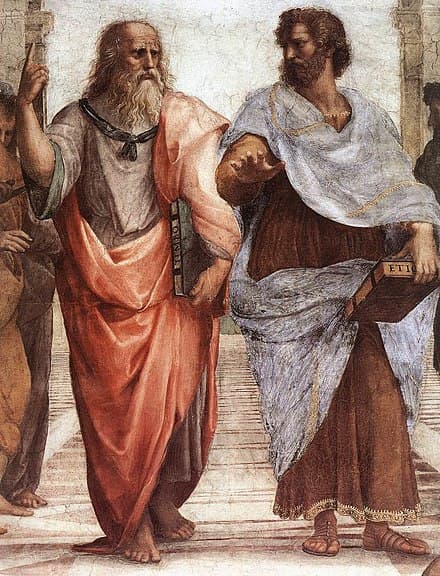
- Ancient Greek philosophy focused on understanding the nature of reality, knowledge, and ethics. Key figures like Socrates, Plato, and Aristotle asked questions such as What is justice? and What can we truly know?
- Medieval philosophy was shaped by Christian theology and Islamic philosophy, with thinkers like Augustine, Aquinas, and Averroes working to reconcile faith and reason.
- Modern philosophy shifted toward new frameworks: rationalism (Descartes argued that knowledge comes from reason), empiricism (Hume argued it comes from sensory experience), and Kant's critical philosophy, which tried to bridge the two.
- Eastern philosophy
- Indian philosophy focused on the nature of the self, reality, and liberation from suffering. Major schools include Vedanta, Buddhism, and Jainism.
- Chinese philosophy emphasized social harmony (Confucianism), living in balance with nature (Taoism), and moral order, with key figures like Confucius, Lao Tzu, and Zhuangzi.

Ancient philosophy's scientific foundations
Many ideas we now consider "science" started as philosophy. Early thinkers tried to explain the natural world through reason rather than myth.
- Ancient Greek philosophy
- Thales and the Milesian school sought natural explanations for phenomena instead of mythological ones, laying the foundation for empirical observation and rational inquiry. For example, Thales proposed that water was the fundamental substance of all things, a wrong answer but a revolutionary kind of answer.
- Aristotle developed the basis for formal logic and deductive reasoning. He also classified natural phenomena (plants, animals, forms of government), setting the stage for scientific taxonomy.
- Islamic Golden Age scholars translated and expanded on Greek philosophical and scientific works. They developed new ideas in mathematics (Al-Khwarizmi helped establish algebra), astronomy, and medicine (Ibn Sina's Canon of Medicine was used in European universities for centuries). Ibn Rushd (Averroes) wrote influential commentaries on Aristotle that shaped both Islamic and European thought.
_Mausoleum_-_Hamadan_-_Western_Iran_(7423560860).jpg)
Philosophy as holistic understanding
Philosophy isn't just one subject. It's a collection of connected inquiries that together aim to provide a comprehensive worldview.
- Metaphysics asks: What is the nature of reality? (Do we have free will? What exists beyond the physical world?)
- Epistemology asks: What is knowledge, and how do we get it? (Can we trust our senses? What counts as evidence?)
- Ethics asks: What is right and wrong? (How should we treat each other? What makes an action moral?)
- Logic studies the principles of valid reasoning, giving us tools to tell good arguments from bad ones.
These branches are interconnected. Your view of reality (metaphysics) shapes what you think we can know (epistemology), which in turn affects how you reason about right and wrong (ethics).
Global origins of philosophical thought
Philosophical thinking arose independently across many civilizations, not just in Greece.
- Ancient civilizations
- Mesopotamia produced early reflections on justice and ethics. Hammurabi's Code (c. 1750 BCE) is one of the earliest written legal codes, raising questions about fairness and punishment that philosophers still debate.
- Egypt developed the concept of ma'at, meaning harmony, balance, and truth, which guided both personal conduct and governance. Texts like the Book of the Dead explored questions about the afterlife and moral judgment.
- Eastern traditions
- Indian philosophy evolved from the Vedic period (the Upanishads explored the nature of the self and ultimate reality) through the development of Hindu thought (the Bhagavad Gita) and Buddhist thought (the Four Noble Truths address the nature and cessation of suffering).
- Chinese philosophy emerged during the Warring States period, a time of political chaos that spurred thinkers to ask how society should be organized. Confucianism emphasized social harmony, Taoism emphasized natural balance, and Mohism advocated universal love and care for all people.
- African philosophy emphasizes communal values, oral traditions, and the interconnectedness of all things. Ubuntu, for instance, captures the idea that a person's identity is shaped through their relationships with others. The Négritude movement affirmed African identity and culture in response to colonialism.
- Latin American philosophy draws on indigenous thought (such as Aztec cosmology), European philosophy, and post-colonial perspectives. It explores themes of identity, liberation, and social justice, with key figures like Enrique Dussel, Leopoldo Zea, and Gloria Anzaldúa.
Core philosophical skills and concepts
These are the basic tools you'll use throughout any philosophy course.
- Critical thinking: The ability to analyze, evaluate, and construct arguments. This means not just accepting claims at face value but asking Why should I believe this?
- Wisdom: The pursuit of deep understanding and practical knowledge about life and the world. The word "philosophy" itself comes from the Greek philosophia, meaning "love of wisdom."
- Reason: The use of logic and evidence to form judgments and reach conclusions.
- Argument: Not a shouting match. In philosophy, an argument is a set of premises (reasons) offered in support of a conclusion. For example: All humans are mortal. Socrates is a human. Therefore, Socrates is mortal.
- Truth: The correspondence between a belief or statement and reality. Figuring out what truth is and how we recognize it is one of philosophy's central goals.
See Fiveable more often in Google
Mark Fiveable as a preferred source and Google is more likely to show you our guides in Top Stories, with a "preferred" badge in AI Mode and AI Overviews.