4.3 Hasty generalization and false cause

💬Speech and Debate Unit 4 Review
4.3 Hasty generalization and false cause
💬 Speech and Debate
continue practicing 4.3
Multiple choice
Definition of hasty generalization
A hasty generalization is a logical fallacy where someone draws a broad conclusion from too little evidence. The sample is either too small or not representative enough to support the claim being made. You'll encounter this constantly in debates, advertisements, and everyday arguments.
Inductive reasoning in hasty generalization
Inductive reasoning works by observing specific cases and building toward a general conclusion. That process is perfectly valid when done well. Hasty generalization is what happens when the inductive process goes wrong: the person jumps from a handful of examples to a sweeping claim about an entire group or phenomenon.
Insufficient sample size
For a generalization to hold up, it needs to be based on enough data points to actually reflect the larger population. The fewer cases you look at, the less reliable your conclusion becomes. A survey of 5 people can't tell you much about a city of 500,000. Hasty generalizations also fail to account for the natural diversity and variability within any population.
Anecdotal evidence vs. statistical data
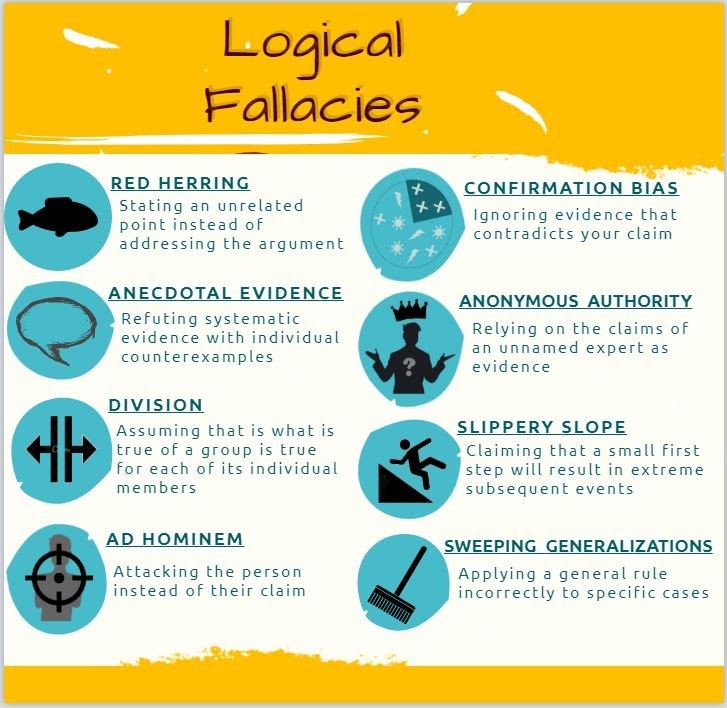
- Anecdotal evidence consists of personal stories or individual observations used to support a claim. It can feel persuasive, but one person's experience doesn't prove a pattern.
- Statistical data involves collecting and analyzing a large, representative sample to identify real trends.
Hasty generalizations tend to lean on anecdotes instead of data. "My uncle smoked his whole life and lived to 95" doesn't disprove the link between smoking and lung cancer. The plural of anecdote is not data.
Examples of hasty generalization
Stereotyping based on limited experience
Stereotyping is one of the most common forms of hasty generalization. If someone meets one rude tourist from a particular country and concludes that everyone from that country is rude, they've generalized from a sample size of one. This ignores the individuality within any group and can fuel prejudice and discrimination.
Overgeneralization from personal anecdotes
"I tried that study method and it didn't work, so it's useless." This kind of reasoning treats a single personal experience as proof of a universal truth. Individual differences, circumstances, and even luck all play a role. What failed for one person might succeed for thousands of others.
Faulty conclusions from small sample sizes
Imagine surveying 10 students at your school and then claiming the results represent the views of every teenager in your state. That sample is far too small and too narrow to support such a broad conclusion. Small samples are more vulnerable to outliers and random variation, making any generalization drawn from them unreliable.
Definition of false cause
False cause (also called the causal fallacy) occurs when someone incorrectly assumes that one event or variable directly causes another. Just because two things happen together, or one follows the other, doesn't mean one caused the other. This fallacy leads to misguided conclusions in debates, policy arguments, and everyday reasoning.
Correlation vs. causation
- Correlation means two variables tend to occur together or change in relation to each other.
- Causation means one variable directly produces a change in the other.
The false cause fallacy treats correlation as if it were causation. Two things might be related without one causing the other. For instance, ice cream sales and drowning rates both rise in summer, but ice cream doesn't cause drowning. Hot weather (a third factor) drives both.
.svg.png)
Post hoc ergo propter hoc
This Latin phrase means "after this, therefore because of this." It's the fallacy of assuming that because Event B followed Event A, A must have caused B.
Classic example: a rooster crows, then the sun rises. The rooster didn't cause the sunrise. The sequence is real, but the causal link is not. Whenever someone argues that the timing alone proves causation, they're committing this fallacy.
Confounding variables in causal relationships
A confounding variable is a hidden factor that influences both variables you're looking at, creating the illusion of a direct causal link between them. The ice cream and drowning example above is a perfect case: hot weather is the confounding variable. If you don't account for confounders, you'll draw false conclusions about what's actually causing what.
Examples of false cause
Superstitious beliefs and false causality
Superstitions are textbook false cause reasoning. "I wore my lucky socks and aced the test, so the socks caused my success." In reality, studying and preparation drove the result. The socks just happened to be there. There's no mechanism connecting the socks to the grade, but the coincidence feels meaningful.
Misattributing causation in complex systems
Complex systems like economies, ecosystems, or public health involve dozens of interrelated factors. Pointing to a single cause is almost always an oversimplification. Claiming that one policy change caused an economic downturn, for example, ignores global market conditions, consumer confidence, trade dynamics, and countless other variables. Real-world outcomes rarely have a single cause.
Ignoring alternative explanations for events
False cause often thrives when people stop looking for other possible explanations. If someone attributes rising crime rates solely to one demographic group while ignoring poverty, unemployment, education gaps, and policing changes, they've locked onto one explanation and dismissed everything else. Strong reasoning requires considering multiple potential causes before settling on one.
Identifying hasty generalization and false cause
Spotting these fallacies is one of the most practical skills you can develop for debate. Here are three strategies to sharpen that ability.
Questioning sample size and representativeness
When you hear a generalization, ask two questions:
- How many cases is this based on?
- Are those cases representative of the whole group?
If the answer to either question is "not enough" or "not really," you're likely looking at a hasty generalization. A claim about all college students based on a survey of 12 people at one school should raise immediate red flags.
Examining the strength of causal claims
When someone asserts that X causes Y, push on the evidence:
- Is there a direct, demonstrated mechanism linking X to Y?
- Could the relationship be coincidental?
- Are there confounding variables that haven't been addressed?
- Has the claim been tested with controlled studies, or is it based on observation alone?
If the causal claim rests only on timing or correlation, it's likely a false cause fallacy.
Considering alternative explanations
For both fallacies, the most powerful question is: What else could explain this? If you can identify plausible alternative explanations that the argument hasn't ruled out, the original claim is weakened. Train yourself to generate at least two or three alternative hypotheses whenever you encounter a causal claim or broad generalization.
Avoiding hasty generalization and false cause
Gathering sufficient and representative data
Before making a broad claim, make sure your evidence actually supports it. That means using a sample that's large enough and diverse enough to reflect the population you're generalizing about. In a debate context, this means citing studies with real sample sizes rather than relying on a few cherry-picked examples.
Controlling for confounding variables
To establish genuine causation, you need to isolate the variable you're interested in and hold other factors constant. This is why controlled experiments are the gold standard in science. In debate, you can point out when an opponent's causal argument fails to account for obvious confounders.
Steps for thinking through confounders:
- Identify the claimed cause and effect.
- List other variables that could influence the outcome.
- Ask whether those variables have been accounted for.
- If they haven't, the causal claim is on shaky ground.
Suspending judgment until adequate evidence is available
Resist the urge to draw conclusions before you have enough information. This is harder than it sounds because our brains naturally look for patterns and explanations. In practice, this means seeking out additional sources, looking for contradictory evidence, and being willing to say "the evidence isn't strong enough yet" rather than committing to a flawed conclusion.
Consequences of hasty generalization and false cause
Perpetuating stereotypes and prejudices
Hasty generalizations about groups of people reinforce stereotypes. When those stereotypes go unchallenged, they can lead to discrimination, social exclusion, and real harm to individuals who are judged by their group membership rather than their own actions and character.
Making poor decisions based on faulty reasoning
Both fallacies can lead to bad decisions at every level. A business might invest in the wrong strategy because it misidentified what caused a competitor's success. A government might implement a policy targeting the wrong cause of a social problem. The costs of acting on flawed reasoning can be enormous.
Hindering scientific progress and understanding
In research, hasty generalizations from small samples produce findings that don't replicate. False causal claims misdirect funding and attention. Both slow down genuine understanding of complex problems, from medical treatments to climate science to social policy. Getting the reasoning right isn't just an academic exercise; it has real consequences.
See Fiveable more often in Google
Mark Fiveable as a preferred source and Google is more likely to show you our guides in Top Stories, with a "preferred" badge in AI Mode and AI Overviews.