1.5 Argument analysis and evaluation

💬Speech and Debate Unit 1 Review
1.5 Argument analysis and evaluation
💬 Speech and Debate
continue practicing 1.5
Multiple choice
Types of Arguments
Different arguments follow different logical structures, and recognizing those structures is the first step toward building your own case or picking apart someone else's.
Deductive vs. Inductive Reasoning
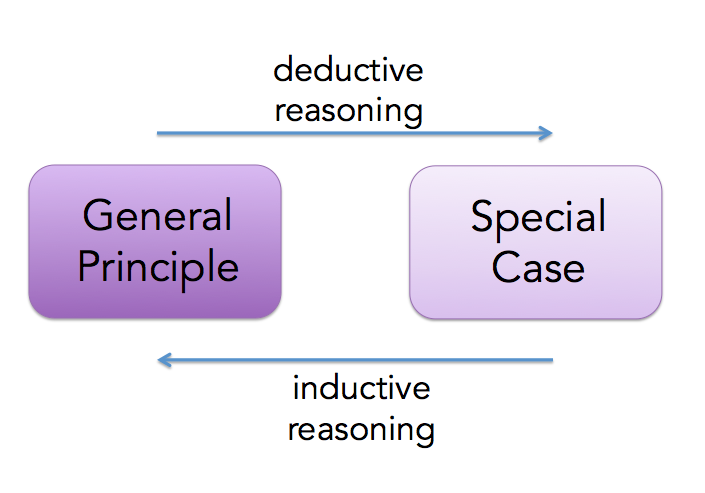
Deductive reasoning moves from general premises to a specific conclusion. Think of it as top-down logic: you start with a broad rule and apply it to a particular case. If the premises are true and the logic is valid, the conclusion must be true.
All mammals are warm-blooded. Dogs are mammals. Therefore, dogs are warm-blooded.
Inductive reasoning works in the opposite direction, moving from specific observations to a general principle. This is bottom-up logic. The conclusion isn't guaranteed; it's only as strong as the evidence behind it.
Every swan observed so far has been white. Therefore, all swans are probably white.
Notice the difference: deductive conclusions are certain (if the argument is valid), while inductive conclusions are probable. In a debate round, you'll use both, but you need to know which one you're relying on so you can defend it properly.
Validity and Soundness
These two terms apply specifically to deductive arguments.
- Validity is about structure. An argument is valid if the conclusion logically follows from the premises, regardless of whether those premises are actually true.
- Soundness is the full package. An argument is sound if it's valid and all its premises are true. Only a sound argument guarantees a true conclusion.
A valid but unsound argument might look like: All birds can fly. Penguins are birds. Therefore, penguins can fly. The logic holds, but the first premise is false, so the argument isn't sound.
Strength and Cogency
These are the inductive equivalents of validity and soundness.
- Strength measures how much support the premises give the conclusion. A strong inductive argument makes the conclusion highly probable; a weak one barely supports it.
- Cogency combines strength with truth. A cogent argument is strong and has premises that are actually acceptable or plausible.
Identifying Premises and Conclusions
Before you can evaluate any argument, you need to find its building blocks: the premises (the reasons) and the conclusion (the claim those reasons support).
Explicit vs. Implicit Premises
Explicit premises are stated directly. They're right there in the argument, easy to spot.
All mammals are warm-blooded. Whales are mammals. Therefore, whales are warm-blooded.
Both premises are spelled out clearly.
Implicit premises are unstated assumptions the argument depends on. These are trickier because you have to figure out what's being taken for granted.
We should reduce our carbon footprint. Therefore, we should use public transportation more often.
The hidden premise here is that using public transportation reduces your carbon footprint. If that assumption turns out to be false or questionable, the whole argument weakens. In debate, targeting an opponent's implicit premises is one of the most effective strategies you can use.
Argument Structure and Flow
- A basic argument has one or more premises leading to a single conclusion.
- Complex arguments layer multiple premises, intermediate conclusions (sometimes called sub-conclusions), and a final conclusion.
The flow of an argument describes how each piece connects to the next. A clear, logical flow makes your case easier to follow and more persuasive. A disjointed flow confuses your audience and gives opponents easy targets.
Diagramming Arguments
Diagramming is a visual method for mapping out an argument's structure. Here's a simple approach:
- Number each premise and the conclusion.
- Draw arrows from each premise to the conclusion it supports.
- If a premise supports an intermediate conclusion that then supports the final conclusion, chain the arrows accordingly.
This process reveals hidden assumptions, exposes gaps in reasoning, and highlights which premises are doing the most work. It's especially useful when you're prepping for a round and need to quickly break down a dense argument.
Evaluating Arguments
Once you've identified the parts of an argument, you need to judge how well they hold together.

Assessing Relevance of Premises
Relevance asks: does this premise actually support the conclusion, or is it just... there?
- Relevant premises provide direct, meaningful support for the conclusion.
- Irrelevant premises don't contribute to the conclusion's truth or probability, even if they sound impressive.
Two useful tests:
- Is the premise necessary? Without it, does the argument fall apart?
- Is the premise sufficient? If true, does it provide enough support on its own to establish the conclusion?
Examining Assumptions and Biases
Assumptions are beliefs the arguer takes for granted without stating them. Every argument rests on some assumptions, but the question is whether those assumptions are reasonable.
Biases are preconceived leanings that shape how someone builds or interprets an argument. Bias can lead a debater to favor certain evidence, ignore counterevidence, or draw conclusions the evidence doesn't actually support. Watch for bias in your opponents' arguments, but also check your own.
Considering Counterarguments
Strong debaters don't just build a case; they anticipate how it'll be attacked.
- Identify potential weaknesses or limitations in the original argument.
- Consider evidence or reasoning that contradicts the argument.
- Think about alternative explanations or conclusions that might be more plausible.
Addressing counterarguments proactively shows the judge you've thought deeply about the issue. It also takes ammunition away from your opponent.
Checking for Logical Fallacies
Logical fallacies are flaws in reasoning that undermine an argument's validity or strength. They can hide in the premises, the conclusion, or the connection between them. The three main categories:
- Fallacies of relevance (ad hominem, appeal to emotion, red herring)
- Fallacies of presumption (begging the question, false cause, hasty generalization)
- Fallacies of ambiguity (equivocation, amphiboly, composition/division)
Each of these is covered in detail below.
Common Logical Fallacies
Knowing these fallacies helps you avoid them in your own arguments and call them out in your opponent's.
Fallacies of Relevance
- Appeal to emotion (argumentum ad passiones): Manipulating feelings instead of providing logical support.
- "If we don't pass this bill, thousands of children will suffer. You don't want that, do you?" The emotional pressure replaces actual evidence for why the bill is good policy.
- Ad hominem (argument against the person): Attacking the arguer's character instead of addressing the argument itself.
- "We can't trust her opinion on healthcare; she's not even a doctor." Her credentials might be relevant context, but they don't automatically refute her reasoning.
- Red herring: Introducing an irrelevant topic to distract from the actual issue.
- "While my opponent focuses on the economy, let's not forget about the importance of national security." If the debate is about economic policy, national security is a diversion.
Fallacies of Presumption
- Begging the question (petitio principii): The conclusion is smuggled into the premises, so the argument just goes in a circle.
- "This news source is unreliable because you can't trust what they report." The premise and conclusion say the same thing.
- False cause (post hoc, ergo propter hoc): Assuming that because one event followed another, the first caused the second.
- "I wore my lucky socks, and my team won. The socks must be the reason." Sequence alone doesn't prove causation.
- Hasty generalization: Drawing a broad conclusion from too little evidence.
- "I met two rude New Yorkers. All New Yorkers must be rude." Two people can't represent millions.
Fallacies of Ambiguity
- Equivocation: Shifting the meaning of a word mid-argument.
- "Feathers are light. What is light cannot be dark. Therefore, feathers cannot be dark." "Light" means something different in each premise.
- Amphiboly: Exploiting grammatical ambiguity to mislead.
- "The police were told to stop drinking on campus." Does this mean the police should stop their own drinking, or stop others from drinking? The sentence structure creates confusion.
- Composition/Division: Assuming what's true of the parts is true of the whole (or vice versa).
- "Each player on the team is talented. Therefore, the team as a whole is unbeatable." Individual talent doesn't automatically produce team success.
Analyzing Evidence and Sources
An argument is only as good as the evidence behind it. You need to evaluate both the quality of the evidence and the credibility of where it comes from.
Types and Strength of Evidence
- Empirical evidence comes from observations, experiments, or data (scientific studies, statistics, real-world examples). Its strength depends on methodology, sample size, and whether the findings can be reproduced.
- Logical evidence comes from reasoning and logical principles (deductive arguments, analogies, thought experiments). Its strength depends on the validity and soundness of the reasoning.
- Anecdotal evidence comes from personal experiences or individual cases (testimonials, stories). This is generally the weakest type because a single case may not be representative or generalizable. It can illustrate a point, but it rarely proves one.
Credibility of Sources
Four key factors to evaluate:
- Authority: Does the source have expertise and qualifications in the relevant field? A peer-reviewed journal carries more weight than a personal blog.
- Objectivity: Is the source impartial, or does it have a bias or conflict of interest? An independent research organization is more trustworthy than a company-funded study about its own product.
- Currency: Is the information up to date? A 2024 government report is more useful than a textbook from 2005 on a fast-changing topic.
- Relevance: Does the source actually apply to the specific argument being made? A scholarly article on your exact topic beats a general news story.
Detecting Misleading Information
- Cherry-picking: Selecting only the evidence that supports a conclusion while ignoring contradictory findings. Citing one favorable study while disregarding ten that disagree is a red flag.
- False equivalence: Treating two positions as equally valid when the evidence overwhelmingly supports one. Giving equal weight to scientific consensus and a fringe theory is a common example.
- Misrepresentation: Distorting information or quoting it out of context to change its meaning.
- Fabrication: Inventing evidence or citing sources that don't exist. If a statistic sounds too perfect, verify it.
Constructing Strong Arguments
Knowing how to analyze arguments is half the battle. The other half is building your own.
Developing Clear Thesis Statements
Your thesis statement is a concise summary of your main claim. It should be specific, arguable, and clearly state your position.
"The government should invest more in renewable energy to combat climate change and stimulate economic growth."
This works because it's specific (renewable energy investment), arguable (not everyone agrees), and clear about the speaker's position. Your thesis acts as a roadmap for the rest of your argument, guiding which evidence you select and how you organize it.
Organizing Supporting Evidence
- Lead with your strongest points to establish credibility and capture attention early.
- Group related evidence together so your argument builds a clear narrative rather than jumping between unrelated claims.
- Use transitions to link ideas and maintain a smooth flow.
- Explain each piece of evidence by clarifying how it connects to and supports your thesis. Don't just drop a statistic and move on; tell the audience what it means.
Anticipating Objections
- Identify the weakest parts of your own argument. Where would you attack it?
- Consider the most common counterarguments or alternative perspectives.
- Decide whether to refute each objection (offer a convincing rebuttal) or concede minor points (which can actually boost your credibility).
- Use this process to refine your argument. If a valid objection exposes a real flaw, adjust your position rather than ignoring it.
Crafting Persuasive Conclusions
Your conclusion is your last chance to make an impression. Three things to accomplish:
- Restate your thesis and main points. Remind the audience of your central argument and the key evidence behind it.
- Connect to the bigger picture. Show why your argument matters beyond the specific debate topic. What are the broader implications or consequences?
- End memorably. A powerful quote, a striking statistic, or a direct call to action can leave a lasting impact. Avoid simply trailing off or repeating your introduction word for word.
See Fiveable more often in Google
Mark Fiveable as a preferred source and Google is more likely to show you our guides in Top Stories, with a "preferred" badge in AI Mode and AI Overviews.