
Linear inequalities help us compare quantities and find ranges of solutions. They're like equations, but with greater-than or less-than symbols instead of equals signs. We use them to set limits or boundaries in math problems.
Solving inequalities involves similar steps to solving equations, but with a few twists. We can graph them on number lines, use interval notation, and apply them to real-world situations. Understanding inequalities is key to tackling many practical math problems.
Linear Inequalities in One Variable
Graphing linear inequalities
- Inequalities compare two quantities using symbols
- represents "less than" (5 < 7)
- represents "greater than" (9 > 2)
- represents "less than or equal to" (x ≤ 4)
- represents "greater than or equal to" (y ≥ -1)
- Graphing inequalities on a number line involves
- Using an open circle (○) for strict inequalities ( or )
- Using a closed circle (●) for inclusive inequalities ( or )
- Shading the portion of the number line that satisfies the inequality
- Shade to the right for or (x > 3 shades values greater than 3)
- Shade to the left for or (y ≤ 0 shades values less than or equal to 0)
- The shaded portion represents the range of the inequality
- Interval notation expresses the solution set of an inequality concisely
- Use parentheses ( ) for strict inequalities (x < 5 is written as (-∞, 5))
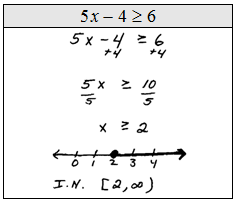
- Use brackets [ ] for inclusive inequalities (x ≥ -2 is written as [-2, ∞))
- represents negative infinity and represents positive infinity
- is written as in interval notation
Algebraic solutions for inequalities
- Solving linear inequalities algebraically is similar to solving linear equations
- Perform the same operation on both sides of the inequality to maintain the inequality (if x + 3 < 7, then x < 4)
- When multiplying or dividing by a negative number, reverse the inequality symbol
- If , then (dividing by -2 flips the inequality)
- Isolate the variable on one side of the inequality by
- Adding or subtracting the same value from both sides (x - 5 ≥ 1 becomes x ≥ 6)
- Multiplying or dividing both sides by the same positive value (2x < 10 becomes x < 5)
- Check your solution by substituting a value from the solution set into the original inequality (if x > 2, then 3 > 2 is true)
- The solution set represents the domain of the inequality
Linear Functions and Inequalities
- A linear function is represented by an equation in the form y = mx + b
- m represents the slope of the line
- b represents the y-intercept (where the line crosses the y-axis)
- Linear inequalities are closely related to linear functions
- They use the same symbols (>, <, ≥, ≤) to compare a linear expression to a constant or another linear expression
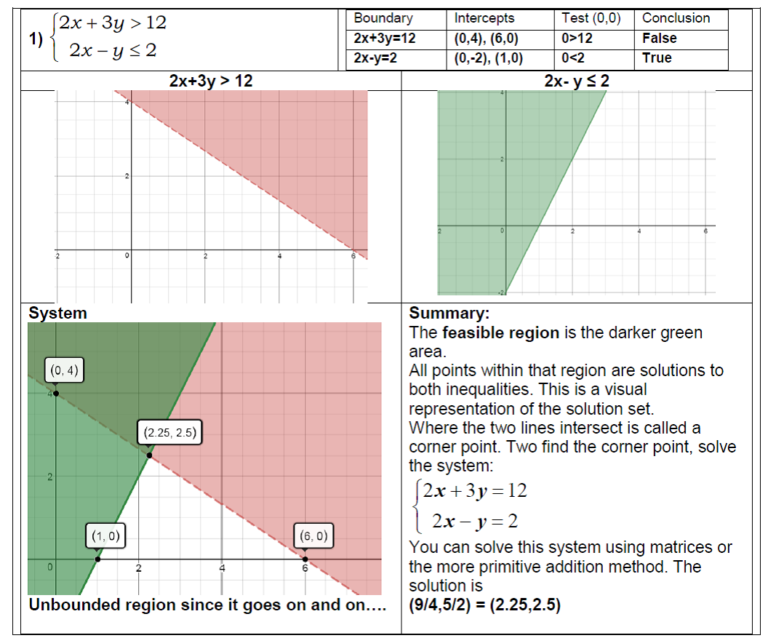
- A system of inequalities involves two or more inequalities that must be satisfied simultaneously
- A compound inequality combines two inequalities using "and" or "or"
- For example, 2 < x < 5 means x is greater than 2 and less than 5
Real-world applications of inequalities
- Identify the unknown quantity and assign a variable (let x represent the number of tickets sold)
- Write an inequality that represents the constraints or limits in the problem
- Translate verbal phrases into mathematical symbols
- "At least" means (the store needs to sell at least 50 items)
- "At most" means (the truck can carry at most 2,000 pounds)
- "More than" means (the company needs to produce more than 500 units)
- "Less than" means (the project must be completed in less than 30 days)
- Translate verbal phrases into mathematical symbols
- Solve the inequality algebraically (if 50 ≤ 2x + 10, then x ≥ 20)
- Interpret the solution in the context of the problem
- Check if the solution makes sense given the constraints (the company must produce at least 20 items to meet the minimum requirement)
- Example: A store requires a minimum purchase of $$50 to qualify for free shipping. If sales tax is 6\%, what is the minimum amount before tax needed to get free shipping?
- Let represent the amount spent before tax
- The total cost with tax must be at least 1.06x \geq 50$$
- Solve the inequality:
- Interpret the result: You need to spend at least \47.17 before tax to qualify for free shipping