
Numbers come in two flavors: rational and irrational. Rational numbers are fractions or decimals that end or repeat. Irrational numbers, like π or √2, go on forever without repeating. They're weird but important.
Irrational numbers pop up in math and real life more than you'd think. They're crucial in geometry, physics, and even music theory. Learning to work with them opens up a whole new world of mathematical possibilities.
Understanding Irrational Numbers
Rational vs irrational numbers
- Rational numbers expressed as a ratio of two integers , where (examples: , , )
- Decimal representations either terminate after a finite number of digits (, ) or repeat in a cyclical pattern (, )
- Irrational numbers cannot be expressed as a ratio of two integers
- Decimal representations never terminate and never repeat in a cyclical pattern, continuing infinitely without any discernible pattern
- Well-known examples include , , , (pi), and (Euler's number)
- Irrational numbers have unique decimal expansions that continue infinitely without repeating
Types of Irrational Numbers
- Algebraic numbers: irrational numbers that are roots of polynomial equations with rational coefficients (e.g., , )
- Transcendental numbers: irrational numbers that are not algebraic (e.g., , )
- Both algebraic and transcendental numbers can be represented using continued fractions, which are expressions involving infinite sequences of fractions
Simplification of square roots
- Perfect squares are numbers that result from multiplying an integer by itself (, , , , , etc.)
- Simplifying a square root involves factoring out the largest perfect square from the radicand (number under the square root symbol)
- Simplify the square root of the perfect square
- Leave the remaining factor under the square root symbol
- Example:
- factored as , where is a perfect square ()
- (simplified form)
Arithmetic with irrational numbers
- Addition and subtraction combine like terms, which are terms with the same irrational number ()
- Multiplication involves multiplying the coefficients and irrational parts separately ()
- Division requires rationalizing the denominator by multiplying numerator and denominator by the conjugate of the denominator
- Conjugate of is
- Example: (rationalized form)

Applying Irrational Number Concepts
Solve problems involving irrational numbers in real-world contexts
- Pythagorean theorem states that in a right triangle with legs and and hypotenuse ,
- If and are rational, may be irrational (, where is irrational)
- Trigonometric ratios (sine, cosine, tangent) of angles in a right triangle may be irrational (, which is irrational)
- Natural logarithms and exponential functions often involve the irrational number
- , but is irrational
- , but is irrational
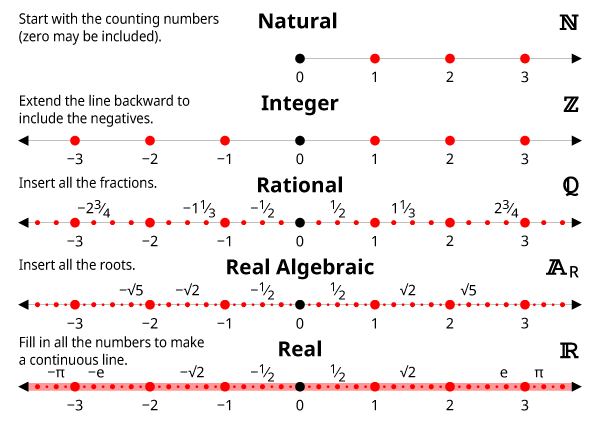
- Irrational numbers can be located on the real number line, filling in the gaps between rational numbers