23.4 Emerging technologies in cell biology research

🦠Cell Biology Unit 23 Review
23.4 Emerging technologies in cell biology research
🦠 Cell Biology
Advanced Imaging Techniques

Top images from around the web for Super-resolution microscopy techniques
Frontiers | Super-resolution Microscopy – Applications in Plant Cell Research View original
Is this image relevant?
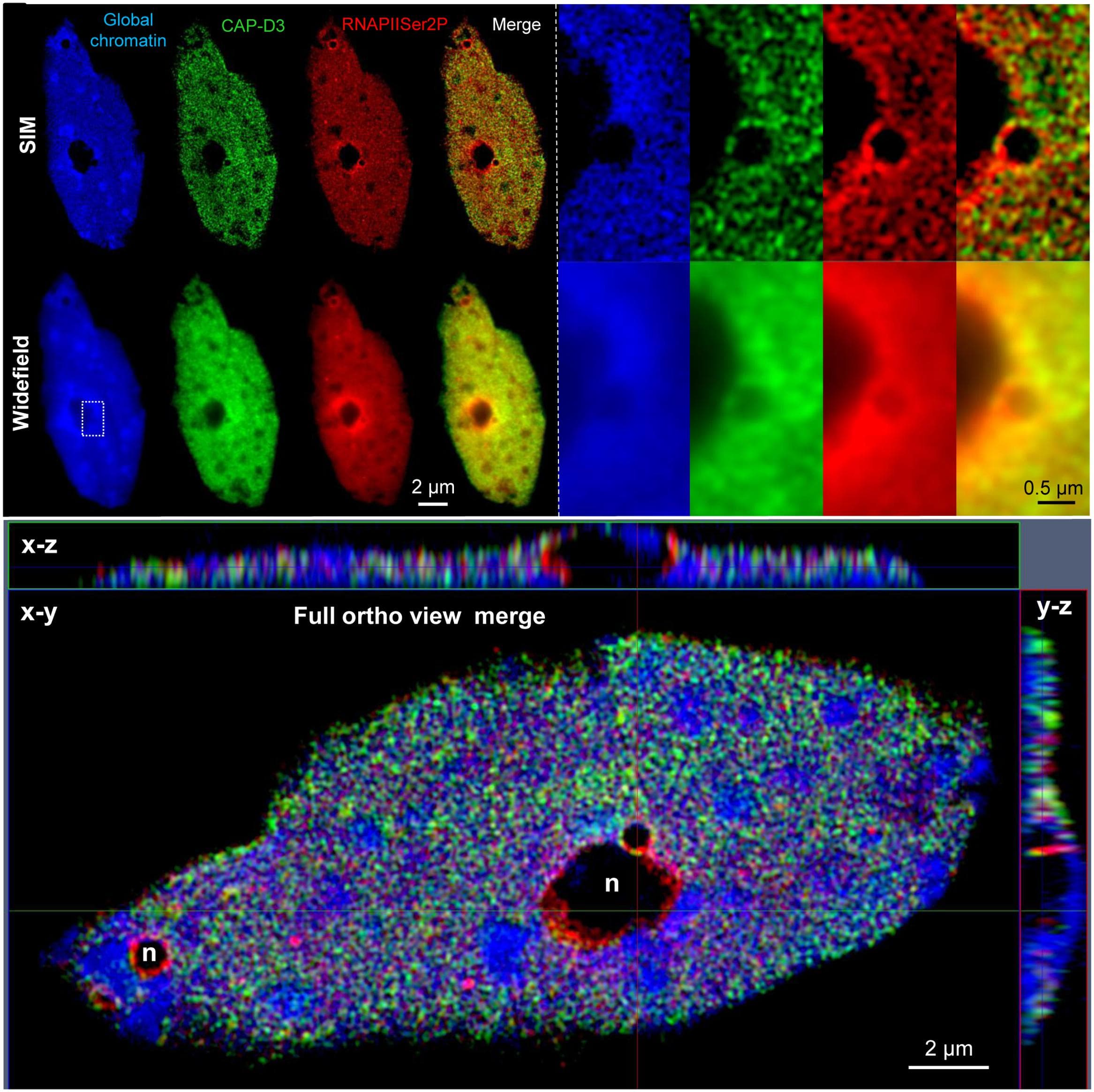
Frontiers | Super-resolution Microscopy – Applications in Plant Cell Research View original
Is this image relevant?
Super-resolution microscopy techniques
Traditional light microscopy hits a hard physical wall called the diffraction limit, which caps resolution at roughly 200–250 nm. That means any two structures closer together than that distance blur into one blob. Super-resolution microscopy techniques break past this barrier, letting researchers visualize cellular structures at the nanometer scale.
Stimulated Emission Depletion (STED) microscopy uses two lasers working together. An excitation laser lights up fluorescent molecules, while a donut-shaped depletion laser suppresses fluorescence everywhere except a tiny central spot. This effectively shrinks the point spread function (PSF), which is the blur pattern each point of light creates. The result: much sharper images of fine structures like actin filaments, membrane-bound ion channels, and mitochondrial architecture.
PALM and STORM take a completely different approach. Instead of sharpening the beam, they exploit the behavior of individual fluorescent molecules:
- A small, random subset of fluorophores is activated so they don't overlap with each other.
- Each activated fluorophore's precise position is mathematically determined.
- Those fluorophores are bleached (permanently turned off).
- The cycle repeats thousands of times with new random subsets.
- All the localized positions are compiled into a single super-resolved image.
- PALM (Photoactivated Localization Microscopy) uses photoactivatable fluorescent proteins.
- STORM (Stochastic Optical Reconstruction Microscopy) uses photoswitchable organic dyes.
Both techniques are powerful for studying protein clustering, molecular interactions within protein complexes, and dynamic processes like vesicle trafficking.
Emerging Tools for Cell Manipulation and Analysis
Optogenetics for cellular control
Optogenetics merges genetic engineering with optics to give researchers precise, light-based control over specific cellular activities. The core idea: introduce genes encoding light-sensitive proteins into target cells, then use light to switch those proteins on or off.
Two key protein families make this work:
- Channelrhodopsins are light-gated ion channels that activate cells when illuminated (e.g., triggering action potentials in neurons).
- Halorhodopsins are light-driven chloride pumps that inhibit cells by hyperpolarizing the membrane.
Because light can be focused on specific cells or regions and pulsed at precise times, optogenetics provides both spatial and temporal control that chemical or electrical stimulation can't match. Researchers use it to manipulate neuronal firing, control calcium signaling pathways, and investigate processes like cell migration (chemotaxis), stem cell differentiation, and apoptosis.
Microfluidics in cell biology
Microfluidics involves manipulating tiny volumes of fluid through micrometer-scale channels, valves, and pumps. For cell biologists, the key advantage is precise control over the cellular microenvironment: fluid flow rates (shear stress), chemical gradients (for studying chemotaxis), and mechanical forces (stretching or compression).
Organ-on-a-chip systems are the most ambitious application. These are microfluidic devices designed to mimic the structure and function of human organs. They achieve this by:
- Culturing multiple cell types together (co-culture) to replicate tissue complexity
- Incorporating 3D scaffolds made of extracellular matrix materials
- Running dynamic fluid flow (perfusion) through the channels to simulate blood circulation
These chips allow researchers to study paracrine signaling between cell types, tissue-level barrier properties (like those in the gut or blood-brain barrier), and disease processes such as tumor metastasis.
The practical benefits are significant:
- Miniaturization enables high-throughput experiments like drug screening on a single chip
- Improved physiological relevance compared to flat 2D cell cultures
- Personalized medicine potential using patient-derived cells
- Reduced reliance on animal models, addressing both ethical and cost concerns
AI integration for cell research
Modern cell biology generates enormous datasets from imaging, omics, and functional assays. AI and machine learning tools help researchers process, interpret, and connect this data far faster than manual analysis allows.
Image analysis and segmentation. AI algorithms can automatically detect and quantify cellular structures like nuclei (using DAPI staining), mitochondria, and microtubules. These tools are both faster and more consistent than manual counting or tracing.
Pattern recognition and classification. Machine learning models can distinguish cell populations (e.g., stem cells vs. differentiated cells) or phenotypes (e.g., cancerous vs. healthy) based on morphological or molecular features. They can also predict outcomes like differentiation fate or drug response.
Data integration and hypothesis generation. AI can combine data across different experimental platforms, such as microscopy images, transcriptomic profiles, and cell viability assays, to uncover relationships that wouldn't be obvious from any single dataset. This helps generate testable hypotheses and guides experimental design.
There are real challenges, though. Training data needs to be high-quality and standardized. AI-generated insights still require experimental verification, since models can find spurious correlations. And as datasets grow, questions around data privacy and responsible use become increasingly relevant.
See Fiveable more often in Google
Mark Fiveable as a preferred source and Google is more likely to show you our guides in Top Stories, with a "preferred" badge in AI Mode and AI Overviews.