23.2 CRISPR/Cas9 and genome editing

🦠Cell Biology Unit 23 Review
23.2 CRISPR/Cas9 and genome editing
🦠 Cell Biology
CRISPR/Cas9 System and Components
CRISPR/Cas9 is a programmable gene-editing tool that allows researchers to cut and modify DNA at precise locations. It has rapidly become the dominant method for genome editing because it's faster, cheaper, and more flexible than earlier approaches. Understanding how it works, what it can do, and where its limitations lie is central to modern cell biology.

Top images from around the web for Principles of CRISPR/Cas9 system
Frontiers | Principles, Applications, and Biosafety of Plant Genome Editing Using CRISPR-Cas9 View original
Is this image relevant?
Frontiers | Gene Editing and Crop Improvement Using CRISPR-Cas9 System View original
Is this image relevant?
Frontiers | The CRISPR-Cas Mechanism for Adaptive Immunity and Alternate Bacterial Functions ... View original
Is this image relevant?
Frontiers | Principles, Applications, and Biosafety of Plant Genome Editing Using CRISPR-Cas9 View original
Is this image relevant?
Frontiers | Gene Editing and Crop Improvement Using CRISPR-Cas9 System View original
Is this image relevant?
Principles of CRISPR/Cas9 System
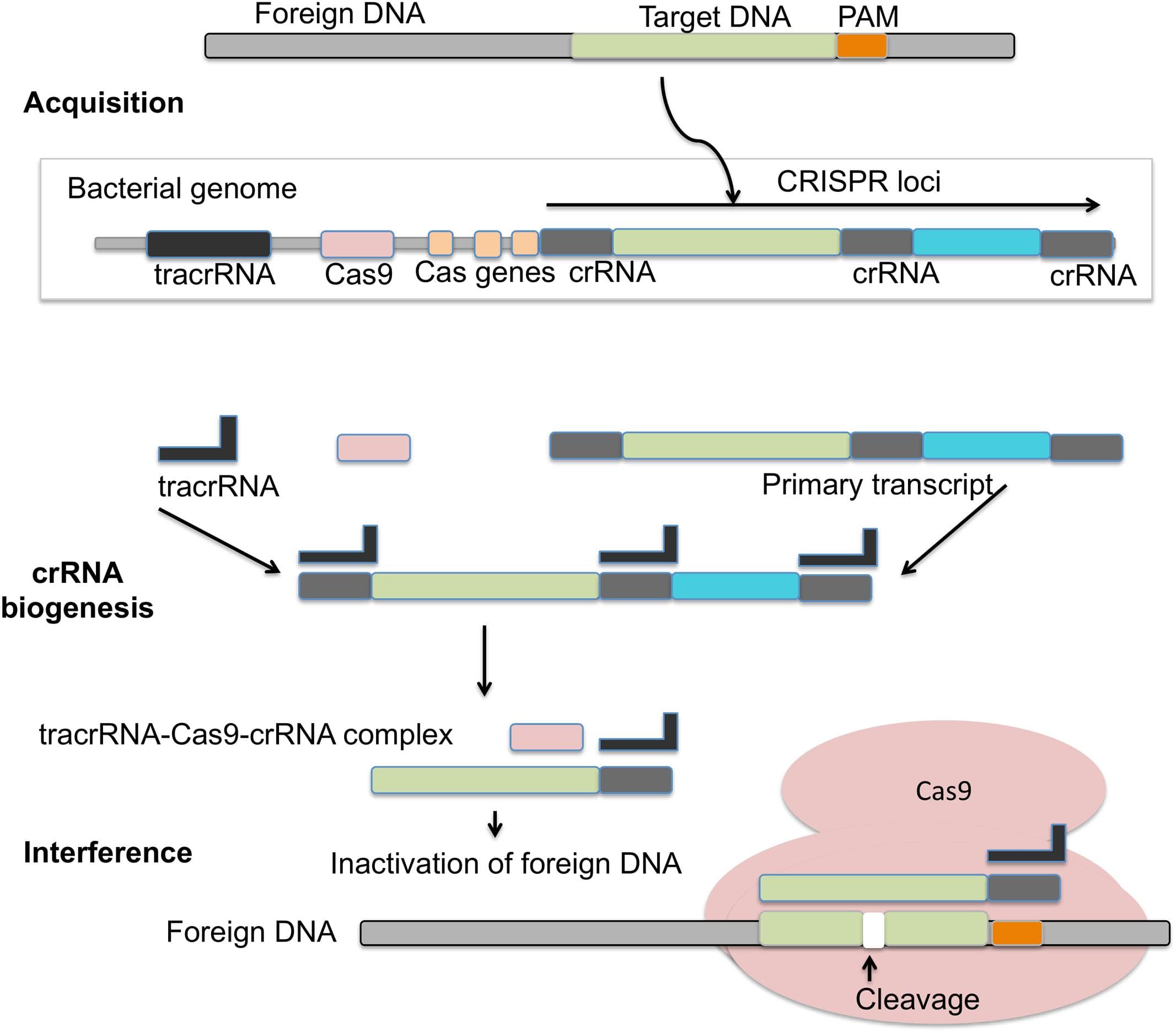
CRISPR originally evolved as an adaptive immune system in bacteria and archaea. When a bacterium survives a viral infection, it stores short sequences of the invader's DNA in its own genome within CRISPR arrays. If the same virus attacks again, the bacterium uses those stored sequences to recognize and destroy the viral DNA. Researchers have repurposed this natural defense system into a precise genome-editing tool.
The system has two core components:
- Guide RNA (gRNA): A short RNA molecule with two parts. The scaffold sequence binds to the Cas9 protein, and the spacer sequence (derived from crRNA) is complementary to the target DNA. The spacer is what directs the system to the right spot in the genome.
- Cas9 endonuclease: The enzyme that actually cuts the DNA. Cas9 makes a double-strand break (DSB) at the location specified by the gRNA.
One additional requirement: the target DNA must have a Protospacer Adjacent Motif (PAM) right next to the sequence the gRNA recognizes. For the most commonly used Cas9 (from Streptococcus pyogenes), the PAM is the sequence NGG. Without a PAM at the target site, Cas9 won't bind or cut.
How genome editing works, step by step:
- The gRNA is designed with a spacer complementary to the target DNA sequence.
- The gRNA binds to Cas9, forming a ribonucleoprotein complex.
- The complex scans the genome for sequences matching the gRNA spacer that are adjacent to a PAM.
- Cas9 unwinds the DNA and checks for complementarity. If the match is sufficient, Cas9 cuts both strands of the DNA.
- The cell's own repair machinery fixes the break through one of two pathways:
- Non-homologous end joining (NHEJ): The default repair pathway. It's error-prone and often introduces small insertions or deletions (indels) at the cut site. This typically disrupts the gene, producing a gene knockout.
- Homology-directed repair (HDR): If researchers supply a DNA repair template with the desired sequence, the cell can use it to make a precise edit. This allows for gene correction, insertion of new sequences, or specific base changes. HDR is less efficient than NHEJ and works best in dividing cells.

CRISPR/Cas9 vs. Other Editing Techniques
Before CRISPR, two main tools existed for targeted genome editing:
- Zinc-finger nucleases (ZFNs): Engineered proteins where each zinc-finger module recognizes a specific 3 bp DNA sequence. Multiple modules are assembled together to target a longer sequence, and the DNA-binding domain is fused to the FokI cleavage domain. Two ZFNs must bind on opposite strands for FokI to dimerize and cut.
- Transcription activator-like effector nucleases (TALENs): Similar in concept to ZFNs, but each TALE repeat recognizes a single nucleotide rather than a triplet. This makes design somewhat more straightforward than ZFNs, but they still require engineering a new protein for every target.
Both ZFNs and TALENs work, but they require designing and constructing custom proteins for each new target, which is expensive and time-consuming.
Why CRISPR/Cas9 largely replaced them:
- Simpler design: Targeting a new site requires only changing the 20-nucleotide spacer in the gRNA, rather than engineering an entirely new protein.
- Higher efficiency: CRISPR generally achieves higher editing rates in most cell types.
- Multiplexing: Multiple gRNAs can be delivered simultaneously to edit several genes at once. This is extremely difficult with protein-based nucleases.
- Lower cost and faster turnaround: A new gRNA can be designed and synthesized in days, whereas ZFN or TALEN construction takes weeks to months.

Applications and Ethics of CRISPR/Cas9
Research applications:
- Functional genomics: Knocking out individual genes to determine their function, knocking in reporter genes or tags, and modulating transcription using catalytically dead Cas9 (dCas9) fused to activators or repressors (CRISPRa/CRISPRi).
- Animal models: Generating knockout or knock-in mice, zebrafish, and other organisms to study gene function and disease mechanisms. CRISPR has dramatically reduced the time needed to create these models.
Disease modeling:
Researchers use CRISPR to introduce disease-causing mutations into cell lines or animals, creating models that recapitulate human diseases like Huntington's disease or cystic fibrosis. These models allow detailed study of disease pathogenesis and serve as platforms for testing potential therapies.
Gene therapy:
CRISPR can correct disease-causing mutations in somatic cells (non-reproductive cells). The most prominent clinical example so far is the treatment of sickle cell disease, where patient blood stem cells are edited ex vivo and reinfused. Other active areas include cancer immunotherapy (engineering T cells) and antiviral strategies targeting HIV.
Ethical considerations:
- Off-target effects: Cas9 can cut at unintended sites that partially match the gRNA, potentially causing harmful mutations. Improving specificity remains an active area of research.
- Germline editing: Editing embryos or reproductive cells means changes are heritable and passed to future generations. The 2018 case of He Jiankui, who used CRISPR to edit human embryos (resulting in live births), was widely condemned by the scientific community and highlighted the lack of international regulatory consensus.
- Equity and access: CRISPR-based therapies are currently extremely expensive. The first approved CRISPR therapy for sickle cell disease costs over $2 million per patient, raising serious questions about who will benefit.
- Societal concerns: Public debate continues over where to draw the line between treating disease and enhancing traits, and how to govern a technology that is relatively easy to use.
Advancements in CRISPR/Cas9 Technology
Two major refinements address key limitations of conventional CRISPR/Cas9:
Base editing enables single-nucleotide changes without creating a double-strand break. A catalytically impaired Cas9 (a "nickase" that cuts only one strand) is fused to a DNA deaminase enzyme. The deaminase chemically converts one base to another at the target position.
- Cytosine base editors (CBEs): Convert C·G base pairs to T·A.
- Adenine base editors (ABEs): Convert A·T base pairs to G·C.
Because no DSB is made, base editing avoids the indels and chromosomal rearrangements that can result from NHEJ. This is particularly useful for correcting the many human genetic diseases caused by single point mutations.
Prime editing goes further, enabling precise insertions, deletions, and all 12 possible base-to-base conversions without DSBs or a separate donor template. The system uses a Cas9 nickase fused to an engineered reverse transcriptase, guided by a prime editing guide RNA (pegRNA). The pegRNA contains both the targeting sequence and a template encoding the desired edit. After nicking one strand, the reverse transcriptase writes the new sequence directly into the genome.
Why these advancements matter:
- Reduced off-target effects and fewer unintended byproducts compared to standard Cas9 cutting.
- A much broader range of possible edits, covering the majority of known pathogenic human variants.
- Potential for safer gene therapy, since avoiding DSBs reduces the risk of large deletions, translocations, and activation of DNA damage responses like p53-mediated apoptosis.
See Fiveable more often in Google
Mark Fiveable as a preferred source and Google is more likely to show you our guides in Top Stories, with a "preferred" badge in AI Mode and AI Overviews.