1.2 Fundamental principles of cell biology

🦠Cell Biology Unit 1 Review
1.2 Fundamental principles of cell biology
🦠 Cell Biology
Cells are the building blocks of life, performing essential functions like metabolism, energy production, and protein synthesis. They divide, communicate, and specialize to form complex organisms. Understanding cells is the foundation for nearly everything else in biology.
Cell structure directly relates to function. The cell membrane controls what enters and exits, while organelles like mitochondria and the endoplasmic reticulum carry out specific tasks. This organization allows cells to efficiently perform their roles in organisms.
Fundamental Principles of Cell Biology
Cells as life's basic unit
Cells are the smallest functional units of living organisms. Every living thing, from a single bacterium to a blue whale, is composed of one or more cells, and each of those cells carries out the essential processes of life: metabolism, reproduction, and growth.
Cell theory is one of the most important unifying ideas in biology. It has three core tenets:
- All living organisms are composed of one or more cells.
- The cell is the basic unit of structure and function in living organisms.
- All cells arise from pre-existing cells through cell division (mitosis or meiosis).
Every cell also contains genetic material in the form of DNA, which directs the cell's activities. When a cell divides, its DNA is passed to the daughter cells, ensuring continuity of genetic information from one generation to the next.
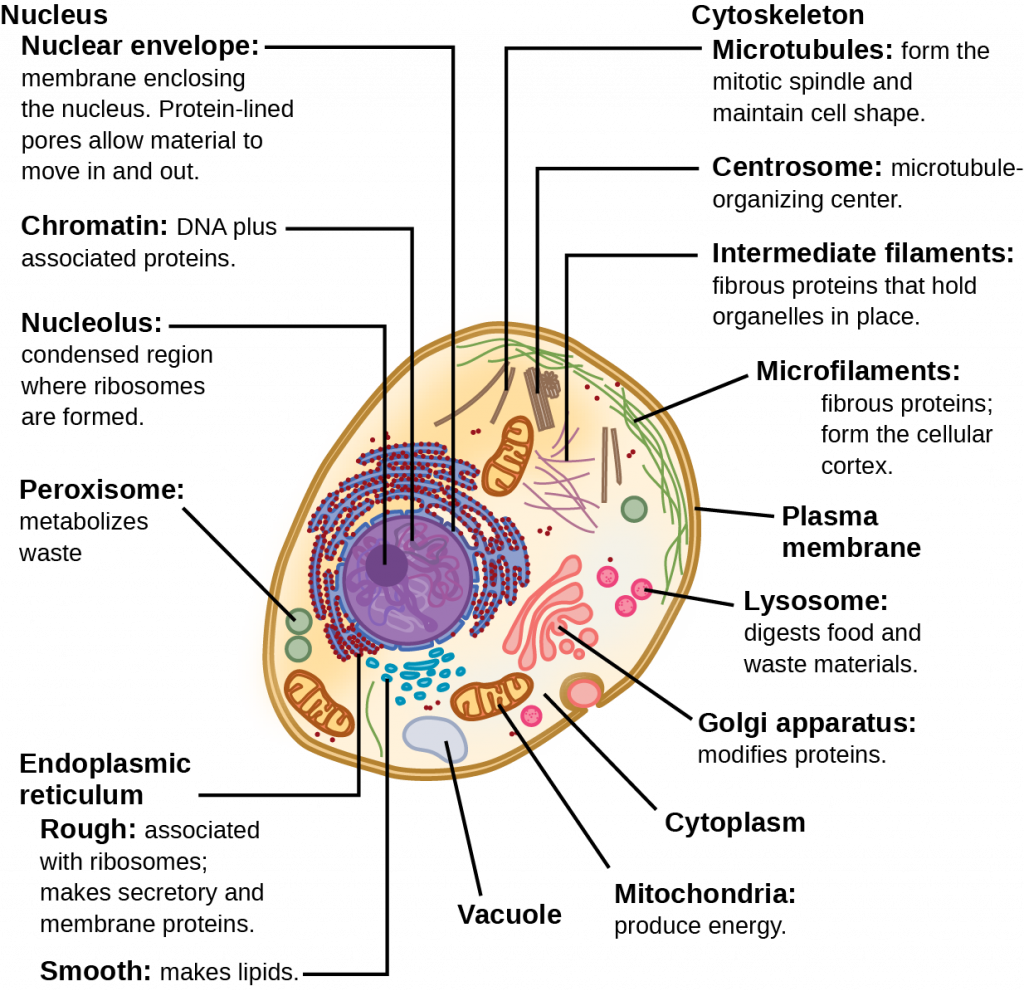
Essential functions of cells
Metabolism refers to the sum of all chemical reactions happening inside a cell. It has two sides:
- Catabolism breaks down complex molecules to release energy. For example, cells break down glucose and fatty acids to fuel their activities.
- Anabolism uses energy to build complex molecules the cell needs, such as proteins, lipids, and carbohydrates.
Energy production is how cells convert nutrients into usable energy, primarily in the form of .
- Cellular respiration breaks down glucose to produce through three main stages: glycolysis, the Krebs cycle, and the electron transport chain.
- Photosynthesis, found in plants and some microorganisms, converts light energy into chemical energy inside chloroplasts through light-dependent and light-independent reactions.
Protein synthesis is how cells build proteins based on genetic instructions. It happens in two key steps:
- Transcription: DNA is copied into inside the nucleus.
- Translation: Ribosomes in the cytoplasm read the and assemble the corresponding protein.
Cell division allows organisms to grow and replace damaged or dead cells.
- Mitosis divides somatic (body) cells, producing two genetically identical daughter cells. It proceeds through interphase, prophase, metaphase, anaphase, and telophase.
- Meiosis divides germ cells (the cells that produce eggs and sperm), resulting in four genetically diverse haploid cells through two rounds of division (meiosis I and meiosis II).
Cell signaling is how cells communicate with each other and respond to their environment. Receptors on the cell surface or inside the cell detect chemical signals like hormones and neurotransmitters. These signals are relayed through signal transduction pathways involving molecules like protein kinases and second messengers, which ultimately trigger a response inside the cell.

Cell specialization in organisms
In multicellular organisms, not every cell does the same job. Cell specialization means that cells develop specific structures and functions suited to particular tasks. This creates an efficient division of labor. For example:
- Nerve cells have long extensions (axons) for transmitting electrical signals across distances.
- Muscle cells contain contractile proteins that allow them to generate force and movement.
- Epithelial cells form tightly packed sheets that act as barriers lining organs and body surfaces.
Cell differentiation is the process by which a less specialized cell becomes a more specialized type. It occurs during embryonic development and continues throughout an organism's life. The key driver is differential gene expression: even though every cell carries the same DNA, transcription factors and epigenetic modifications determine which genes are turned on or off in each cell type.
The advantages of specialization and differentiation are significant:
- They allow complex tissues and organs to develop (brain, heart, lungs).
- They enable organisms to perform a wide range of functions efficiently, from digestion to locomotion.
- They help organisms adapt to different environments, whether aquatic, terrestrial, or aerial.
Cell structure vs function
A core theme in cell biology is that structure determines function. Each part of the cell is built to do a specific job.
Cell membrane: A selectively permeable barrier that controls what moves in and out of the cell. It's composed of a phospholipid bilayer with embedded proteins (both integral and peripheral). These membrane proteins also play roles in cell-cell communication and signaling through receptors and adhesion molecules.
Nucleus: The control center of the cell, housing DNA and directing cellular activities. It's surrounded by a double membrane called the nuclear envelope, which has nuclear pores to regulate transport between the nucleus and cytoplasm. Inside, the nucleolus is where ribosomal is synthesized and ribosomes begin to assemble.
Cytoskeleton: A network of protein filaments that gives the cell its shape, provides structural support, and enables movement.
- Microfilaments (actin filaments) are involved in cell movement and division, including muscle contraction and cytokinesis.
- Microtubules maintain cell shape and assist in intracellular transport. They also form centrioles and spindle fibers during cell division.
- Intermediate filaments provide mechanical strength and support. Examples include keratin in skin cells and lamin proteins lining the nuclear envelope.
Organelles are specialized structures that carry out specific functions:
- Mitochondria are the sites of cellular respiration and production. Their inner membrane folds into cristae, which increase surface area for energy-generating reactions, surrounding an interior space called the matrix.
- Endoplasmic reticulum () synthesizes and transports proteins and lipids. Rough is studded with ribosomes and focuses on protein production, while smooth handles lipid synthesis and detoxification.
- Golgi apparatus modifies, packages, and sorts proteins and lipids for transport. It has a directional structure: proteins enter at the cis face, move through medial cisternae, and exit at the trans face.
- Lysosomes contain digestive enzymes (hydrolases) that break down waste, cellular debris, and foreign material. They maintain an acidic internal pH to keep these enzymes active.
See Fiveable more often in Google
Mark Fiveable as a preferred source and Google is more likely to show you our guides in Top Stories, with a "preferred" badge in AI Mode and AI Overviews.