10.3 Alternative pathways and metabolic regulation

🦠Cell Biology Unit 10 Review
10.3 Alternative pathways and metabolic regulation
🦠 Cell Biology
Fermentation and Anaerobic Metabolism
Cellular respiration typically depends on oxygen as the final electron acceptor, but cells don't always have that luxury. When oxygen runs low, fermentation provides a workaround that keeps ATP production going. These alternative pathways also connect to broader regulatory systems that fine-tune energy metabolism depending on what the body needs at any given moment.

Top images from around the web for Fermentation pathways for NAD+ regeneration
17.1D: Large-Scale Fermentations - Biology LibreTexts View original
Is this image relevant?
Fermentation | Biology for Majors I View original
Is this image relevant?
Fermentation | Biology for Majors I View original
Is this image relevant?
17.1D: Large-Scale Fermentations - Biology LibreTexts View original
Is this image relevant?
Fermentation | Biology for Majors I View original
Is this image relevant?
Fermentation Pathways for NAD+ Regeneration
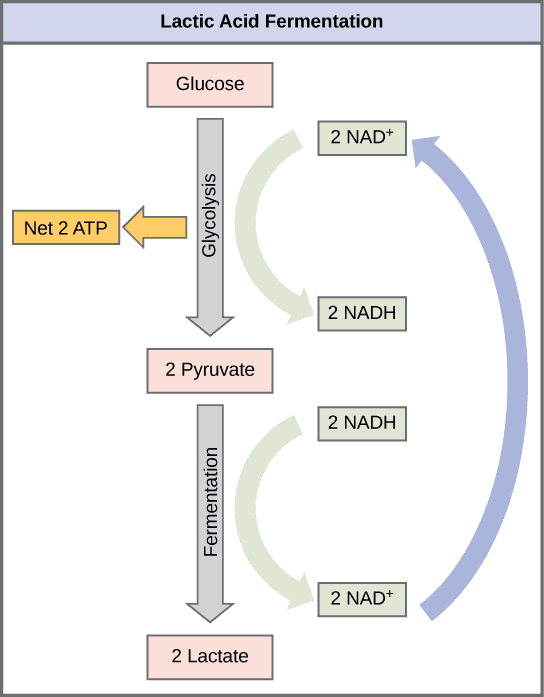
The real purpose of fermentation isn't to make extra ATP. It's to regenerate NAD+ so that glycolysis can keep running. Without NAD+, the glyceraldehyde-3-phosphate dehydrogenase step in glycolysis stalls, and ATP production from substrate-level phosphorylation stops entirely.
There are two main fermentation pathways:
- Lactic acid fermentation — Pyruvate is reduced directly to lactate by the enzyme lactate dehydrogenase. This reaction oxidizes NADH back to NAD+. It occurs in your skeletal muscle cells during intense exercise when oxygen delivery can't keep up with demand. It also happens in red blood cells, which lack mitochondria entirely.
- Alcoholic fermentation — Pyruvate is first decarboxylated to acetaldehyde (releasing ), then acetaldehyde is reduced to ethanol by alcohol dehydrogenase, oxidizing NADH to NAD+ in the process. Yeast and some plant cells use this pathway.
Both pathways yield only the 2 ATP per glucose from glycolysis, far less than the ~30–32 ATP from full aerobic respiration. That's the trade-off: fermentation is less efficient, but it keeps the cell alive when oxygen is unavailable.

Cori Cycle for Lactate Recycling
Lactate produced by fermentation doesn't just accumulate. The Cori cycle is a metabolic loop between skeletal muscle and the liver that recycles it:
- During intense exercise, muscle cells produce lactate via lactic acid fermentation.
- Lactate is released into the bloodstream and transported to the liver.
- In the liver, lactate dehydrogenase converts lactate back to pyruvate.
- The liver then uses pyruvate as a substrate for gluconeogenesis, synthesizing new glucose.
- This glucose is released back into the blood, where muscles and other tissues can take it up and use it again.
The Cori cycle serves two functions: it prevents dangerous lactate buildup in the blood, and it maintains glucose homeostasis by recycling carbon skeletons back into usable fuel. The energy cost of gluconeogenesis (6 ATP per glucose) is paid by the liver, effectively shifting the metabolic burden away from oxygen-starved muscles.

Regulation of Cellular Respiration
Cells don't run respiration at full speed all the time. They adjust the rate of each pathway based on current energy needs, and they do this primarily through allosteric regulation of key enzymes and hormonal signaling.
Allosteric Regulation of Key Enzymes
Allosteric enzymes have regulatory sites separate from their active sites. When molecules bind these regulatory sites, they change the enzyme's shape and either increase or decrease its activity.
The general logic is straightforward:
- High energy signals (ATP, NADH, citrate, acetyl-CoA) slow respiration down. The cell already has plenty of energy, so there's no need to burn more fuel.
- Low energy signals (AMP, ADP) speed respiration up. The cell needs more ATP.
Two enzymes are especially important control points:
- Phosphofructokinase-1 (PFK-1) catalyzes the conversion of fructose-6-phosphate to fructose-1,6-bisphosphate in glycolysis. This is the major committed step of glycolysis. PFK-1 is inhibited by ATP and citrate (signals of energy abundance) and activated by AMP, ADP, and fructose-2,6-bisphosphate (signals of energy deficit).
- Pyruvate dehydrogenase complex (PDC) converts pyruvate to acetyl-CoA, linking glycolysis to the citric acid cycle. PDC is inhibited by its own products: acetyl-CoA and NADH, as well as by ATP.
This pattern is called feedback inhibition: the end products of a pathway accumulate and inhibit enzymes earlier in that same pathway, preventing overproduction and maintaining homeostasis.
Insulin vs. Glucagon in Glucose Regulation
Beyond enzyme-level control, hormones coordinate energy metabolism across the whole body. Insulin and glucagon, both released by the pancreas, are the two main hormones regulating blood glucose and, by extension, cellular respiration.
Insulin is released when blood glucose is high (after a meal):
- Promotes glucose uptake by liver, skeletal muscle, and adipose tissue cells
- Stimulates glycolysis and glycogenesis (storing glucose as glycogen)
- Inhibits gluconeogenesis and glycogenolysis (breaking glycogen back into glucose)
The net effect is to lower blood glucose and shift cells toward energy storage.
Glucagon is released when blood glucose is low (between meals or during fasting):
- Stimulates glycogenolysis and gluconeogenesis in the liver, raising blood glucose
- Promotes lipolysis (lipid breakdown) in adipose tissue, releasing fatty acids as an alternative fuel source
- Increases the availability of both glucose and fatty acids for oxidation, enhancing cellular respiration
The balance between insulin and glucagon keeps blood glucose within a normal range (~70–100 mg/dL fasting) and ensures that cells have access to the right fuels at the right time. When you're resting after a meal, insulin dominates. When you're fasting or exercising, glucagon takes over.
See Fiveable more often in Google
Mark Fiveable as a preferred source and Google is more likely to show you our guides in Top Stories, with a "preferred" badge in AI Mode and AI Overviews.