10.2 Citric acid cycle and oxidative phosphorylation

🦠Cell Biology Unit 10 Review
10.2 Citric acid cycle and oxidative phosphorylation
🦠 Cell Biology
Citric Acid Cycle

Top images from around the web for Steps of citric acid cycle
Citric Acid Cycle | Biology for Majors I View original
Is this image relevant?
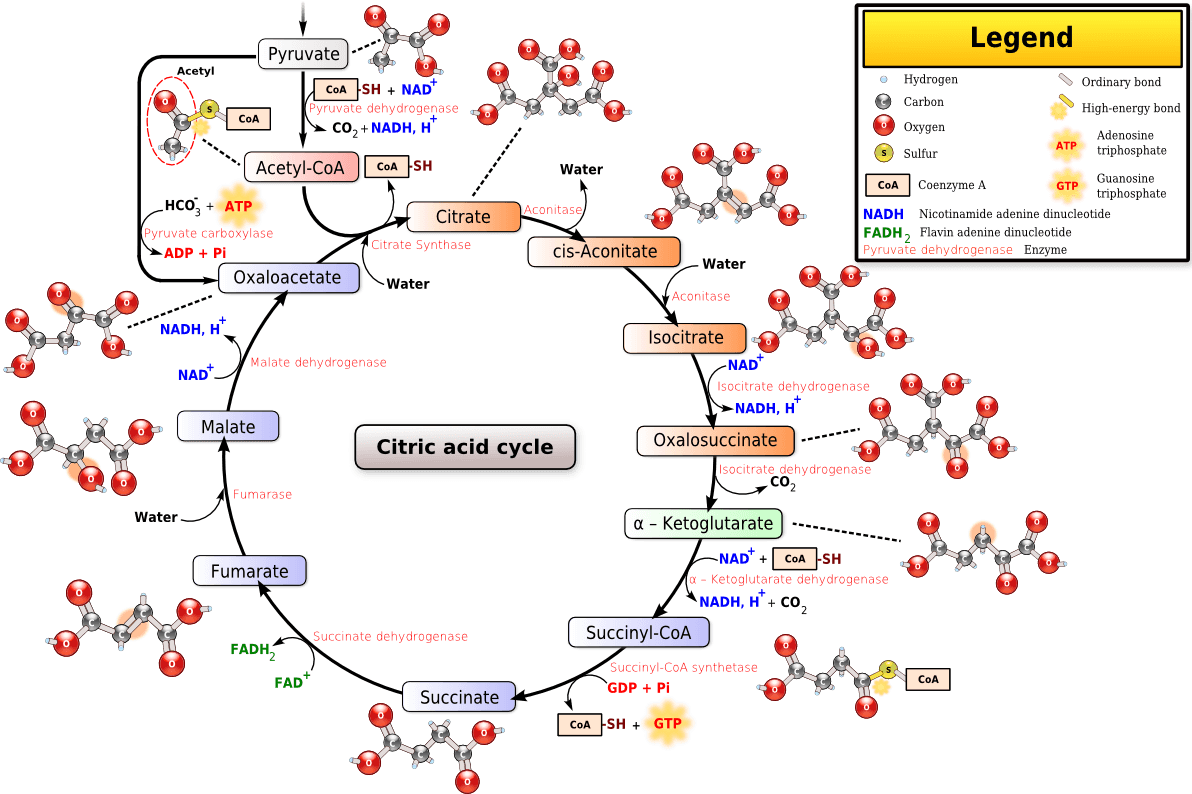
Citric acid cycle - wikidoc View original
Is this image relevant?
5.6C: Acetyl CoA and the Citric Acid Cycle - Biology LibreTexts View original
Is this image relevant?
Citric Acid Cycle | Biology for Majors I View original
Is this image relevant?
Citric acid cycle - wikidoc View original
Is this image relevant?
Steps of the Citric Acid Cycle
Before pyruvate can enter the citric acid cycle (also called the Krebs cycle or TCA cycle), it gets converted to acetyl-CoA by the pyruvate dehydrogenase complex. That acetyl-CoA is the actual fuel that feeds into the cycle. Each turn of the cycle strips high-energy electrons from carbon compounds and loads them onto carrier molecules (NADH and FADH₂), which then deliver those electrons to the electron transport chain.
Here are the eight steps of one turn of the cycle:
- Citrate synthase joins acetyl-CoA (2C) with oxaloacetate (4C) to form citrate (6C). This is the committed step of the cycle.
- Aconitase rearranges citrate into isocitrate through a cis-aconitate intermediate. No carbons are gained or lost here.
- Isocitrate dehydrogenase oxidatively decarboxylates isocitrate to -ketoglutarate (5C), releasing and generating the first NADH of the cycle.
- The -ketoglutarate dehydrogenase complex oxidatively decarboxylates -ketoglutarate to succinyl-CoA (4C), releasing another and producing the second NADH.
- Succinyl-CoA synthetase converts succinyl-CoA to succinate, generating one GTP (or ATP, depending on the tissue). This is the only step that produces a high-energy phosphate directly (substrate-level phosphorylation).
- Succinate dehydrogenase oxidizes succinate to fumarate, reducing FAD to . This enzyme is unique because it's also Complex II of the electron transport chain, embedded in the inner mitochondrial membrane.
- Fumarase hydrates fumarate (adds water) to form malate.
- Malate dehydrogenase oxidizes malate back to oxaloacetate, generating the third NADH and completing the cycle so oxaloacetate can accept another acetyl-CoA.
Reducing Equivalents from the Citric Acid Cycle
Each turn of the cycle produces 3 NADH, 1 , and 1 GTP (or ATP). Since one glucose generates two acetyl-CoA molecules, you double those numbers per glucose.
The three NADH-producing steps are:
- Isocitrate dehydrogenase (step 3)
- -ketoglutarate dehydrogenase complex (step 4)
- Malate dehydrogenase (step 8)
The single comes from succinate dehydrogenase (step 6).
These electron carriers (NADH and ) don't make ATP on their own. Their job is to shuttle high-energy electrons to the electron transport chain, where the real ATP payoff happens through oxidative phosphorylation.

Oxidative Phosphorylation
Structure of the Electron Transport Chain
The electron transport chain (ETC) sits in the inner mitochondrial membrane and consists of four large protein complexes plus two mobile electron carriers:
- Complex I (NADH dehydrogenase) accepts electrons from NADH and passes them to ubiquinone (also called coenzyme Q). It pumps per NADH into the intermembrane space.
- Complex II (succinate dehydrogenase) accepts electrons from and passes them to ubiquinone. It does not pump protons, which is why yields less ATP than NADH.
- Ubiquinone (coenzyme Q) is a small, lipid-soluble molecule that shuttles electrons from Complexes I and II to Complex III.
- Complex III (cytochrome complex) transfers electrons from ubiquinone to cytochrome c, pumping into the intermembrane space.
- Cytochrome c is a small, water-soluble protein on the outer face of the inner membrane that carries electrons from Complex III to Complex IV.
- Complex IV (cytochrome c oxidase) transfers electrons to the final electron acceptor, , reducing it to . It pumps per electron pair.
The net result of electron transport is that protons get pumped from the mitochondrial matrix into the intermembrane space, creating a proton-motive force: both a concentration gradient (more outside) and a charge gradient (more positive outside). This stored energy drives ATP synthesis.

Chemiosmosis and ATP Synthesis
Chemiosmosis is the process by which the proton gradient powers ATP production. Here's how it works:
- Electron transport pumps ions into the intermembrane space, building up the proton-motive force.
- Protons can only flow back into the matrix through ATP synthase, a channel-like enzyme complex.
- As protons flow through the subunit (the membrane-spanning channel), it physically rotates.
- That rotation drives conformational changes in the subunit (the catalytic head that protrudes into the matrix).
- These shape changes catalyze the binding of ADP and inorganic phosphate (), the formation of ATP, and the release of ATP into the matrix.
ATP synthase acts like a molecular turbine: proton flow spins the rotor, and the mechanical energy of rotation gets converted into chemical energy stored in ATP. About 4 must pass through ATP synthase to produce one ATP.
ATP Yield from Complete Glucose Oxidation
Here's a breakdown of ATP production per glucose molecule:
| Stage | Direct ATP | NADH produced | produced |
|---|---|---|---|
| Glycolysis | 2 (substrate-level) | 2 | 0 |
| Pyruvate dehydrogenase (×2) | 0 | 2 | 0 |
| Citric acid cycle (×2 turns) | 2 (as GTP/ATP) | 6 | 2 |
| Totals | 4 | 10 | 2 |
Now for the conversion to ATP via oxidative phosphorylation:
- Each NADH yields approximately 2.5 ATP (10 NADH × 2.5 = 25 ATP)
- Each yields approximately 1.5 ATP (2 × 1.5 = 3 ATP)
- Add the 4 ATP from substrate-level phosphorylation
Total: approximately 30–32 ATP per glucose.
The range (30–32) exists because the 2 NADH from glycolysis are produced in the cytoplasm and can't cross the inner mitochondrial membrane directly. They must use shuttle systems to transfer their electrons into the mitochondria. The malate-aspartate shuttle (used in heart and liver) delivers electrons to mitochondrial NADH, yielding 2.5 ATP each. The glycerol-3-phosphate shuttle (used in skeletal muscle and brain) delivers electrons to instead, yielding only 1.5 ATP each. Which shuttle a cell uses determines whether you get 30 or 32 ATP.
See Fiveable more often in Google
Mark Fiveable as a preferred source and Google is more likely to show you our guides in Top Stories, with a "preferred" badge in AI Mode and AI Overviews.