8.4 Shakespeare's Language and Dramatic Techniques

📜British Literature I Unit 8 Review
8.4 Shakespeare's Language and Dramatic Techniques
📜 British Literature I
Poetic and Dramatic Techniques
Shakespeare's language does more than sound pretty. His poetic devices, structural choices, and dramatic techniques all serve specific purposes: revealing character, building tension, and layering meaning into every scene. Understanding how these tools work will sharpen your reading of any Shakespeare play.

Top images from around the web for Poetic devices in Shakespeare's works
Poetic devices: imagery and the five senses View original
Is this image relevant?
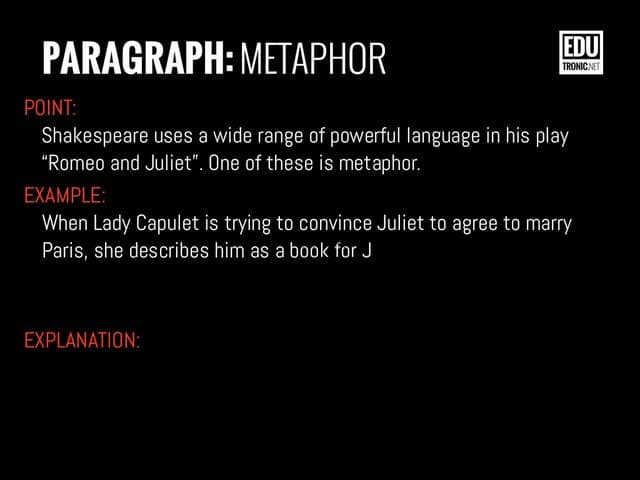
Year 8 English - Presentation exploring metaphor in Shakespeare's Romeo and Juliet on Vimeo View original
Is this image relevant?
Poetic Devices: imagery and emotions View original
Is this image relevant?
Poetic devices: imagery and the five senses View original
Is this image relevant?
Year 8 English - Presentation exploring metaphor in Shakespeare's Romeo and Juliet on Vimeo View original
Is this image relevant?
Poetic Devices in Shakespeare's Works
Shakespeare uses imagery to create sensory experiences that pull the audience into a scene. Different types of imagery target different senses:
- Visual imagery paints pictures with words. In Macbeth, "Is this a dagger which I see before me?" forces both Macbeth and the audience to confront something that may not physically exist.
- Auditory imagery builds atmosphere through sound. Caliban's speech in The Tempest ("The isle is full of noises, / Sounds and sweet airs, that give delight and hurt not") makes the island feel alive and enchanted.
- Tactile imagery conveys physical sensation. Lear's plea, "O, let me not be mad, not mad, sweet heaven!" carries the raw, almost physical desperation of a man losing his grip on sanity.
Not every sensory reference fits neatly into one category. Hamlet's "Something is rotten in the state of Denmark" uses the language of smell, but it's really a metaphor for political and moral corruption. That overlap between imagery and figurative language is constant in Shakespeare.
Metaphor compares two unlike things directly, without "like" or "as." When Hamlet says "Denmark's a prison," he's not being literal; he's expressing how trapped he feels. Shakespeare often extends metaphors across multiple lines. Sonnet 18 ("Shall I compare thee to a summer's day?") sustains the comparison between the beloved and summer throughout the entire poem, developing it with each new line.
Note: A conceit is an especially elaborate or surprising metaphor. John Donne is the classic example (his poem "The Flea" compares a flea bite to a marriage), but Shakespeare uses conceits too, particularly in the sonnets.
Symbolism gives objects or events a meaning beyond their literal one. These symbols gain power through repetition:
- Blood in Macbeth starts as a sign of battlefield courage, then becomes an inescapable mark of guilt. Lady Macbeth's obsessive hand-washing in Act 5 shows how the symbol has consumed her psyche.
- Storms in King Lear mirror Lear's mental collapse. The external chaos on the heath reflects his internal chaos.
- Yorick's skull in Hamlet makes death tangible. It's not an abstract idea anymore; Hamlet is literally holding it.
Shakespeare also uses sound devices to shape the rhythm and feel of his language:
- Alliteration (repeated initial consonants) creates emphasis: "From forth the fatal loins of these two foes" hammers the f sound to stress fate and conflict.
- Assonance (repeated vowel sounds) adds musicality. The long a sounds in "Shall I compare thee to a summer's day?" give the line a smooth, open quality.
- Personification makes abstract or non-human things feel alive. Romeo's "Arise, fair sun, and kill the envious moon" turns the sun and moon into rivals, mirroring his own romantic situation.

Soliloquies and Asides for Character Insight
A soliloquy is a speech delivered by a character alone on stage, speaking their thoughts aloud to the audience. It's Shakespeare's most direct way of showing us what a character is really thinking.
Soliloquies serve several functions at once:
- They reveal inner conflict. Hamlet's "To be, or not to be" isn't just philosophical musing; it shows a character genuinely weighing whether life is worth living. The audience sees his paralysis in real time.
- They expose hidden motives. Iago's soliloquies in Othello are chilling because he tells the audience exactly how he plans to destroy Othello, even while acting loyal to his face. This creates a disturbing intimacy between villain and viewer.
- They track character development. Comparing a character's early soliloquies to later ones can reveal how they've changed. Macbeth's language shifts from ambitious calculation to exhausted nihilism ("Tomorrow, and tomorrow, and tomorrow").
An aside is shorter and more targeted. It's a brief remark directed at the audience while other characters on stage supposedly can't hear. Asides create a sense of complicity: you're in on the secret. They often deliver quick commentary, a flash of true feeling, or a moment of irony.
Both devices break the boundary between stage and audience, making Shakespeare's plays feel less like something you watch and more like something you're part of.

Dramatic Irony's Audience Impact
Dramatic irony occurs when the audience knows something the characters don't. It's one of Shakespeare's most powerful tools for building tension, because you're watching characters make choices based on incomplete information.
The most devastating example in the tragedies: in Romeo and Juliet, the audience knows Juliet is alive when Romeo finds her in the tomb. His decision to drink poison becomes almost unbearable to watch because you know the truth he doesn't.
Shakespeare uses several related forms of irony:
- Verbal irony: a character says the opposite of what they mean. When the fatally wounded Mercutio calls his wound "a scratch," the understatement is darkly comic and heartbreaking at once.
- Situational irony: events turn out the opposite of what's expected. Oedipus (not Shakespeare, but the concept applies across tragedy) tries to escape a prophecy and fulfills it instead.
- Tragic irony: a specific form of dramatic irony where the audience foresees a disaster the character can't. This is what makes tragedies feel inevitable rather than random.
Dramatic irony doesn't just create suspense. It also deepens your emotional response. When you know what's coming, you feel pity for the character, frustration at their blindness, or dread at the approaching catastrophe. Shakespeare uses that gap between audience knowledge and character knowledge to manipulate exactly what you feel and when.
Comic Relief in Tragedies and Romances
Comic relief is the use of humor within serious or tragic works to give the audience an emotional break. But in Shakespeare, it almost always does more than just lighten the mood.
The most famous example is the Porter scene in Macbeth (Act 2, Scene 3). Right after Duncan's murder, a drunken porter rambles about answering the gate of hell. The comedy feels jarring at first, but it actually reinforces the horror: Macbeth's castle has become a kind of hell. The laughter makes the return to tragedy hit harder.
Shakespeare uses specific character types for comic relief:
- Fools and jesters often speak the most truth. Feste in Twelfth Night and the Fool in King Lear use jokes and riddles to say things no one else dares to say directly.
- Servants and lower-class characters provide earthy humor that contrasts with the elevated language of nobles. The Nurse in Romeo and Juliet is bawdy and rambling, but her warmth makes Juliet's isolation later in the play feel sharper.
- Clowns like Touchstone in As You Like It offer witty wordplay and physical comedy that keeps the pacing varied.
Comic relief serves structural purposes too. It controls pacing by preventing the audience from becoming emotionally numb to constant intensity. It creates thematic contrast, where humor and tragedy side by side make both feel more vivid. And Shakespeare's comic scenes are packed with puns and wordplay that showcase his love of language at its most playful.
Disguise and Identity in Plot Development
Disguise is one of Shakespeare's favorite plot engines. Characters change their appearance, and the consequences ripple through the entire story.
Cross-dressing is the most common form. In Twelfth Night, Viola disguises herself as the young man Cesario, which triggers a chain of romantic confusion: Olivia falls for Cesario (really Viola), while Viola falls for Duke Orsino, who thinks she's a man. On Shakespeare's stage, where male actors played female roles, a boy actor would be playing a woman disguised as a man, adding yet another layer of identity play.
Other forms of disguise include class-crossing (Prince Hal mingles with commoners in Henry IV to understand his future subjects) and deliberate deception (Don John's schemes in Much Ado About Nothing depend on making people believe false identities and staged scenes).
Mistaken identity works differently from deliberate disguise. In The Comedy of Errors, two sets of identical twins create confusion that no one intends. The humor comes from characters reacting logically to completely wrong information.
These plots almost always build toward a recognition scene, where true identities are revealed. These moments carry enormous dramatic weight because they resolve not just plot confusion but emotional tension. When Viola finally reveals herself in Twelfth Night, relationships that seemed impossible suddenly become possible.
At a thematic level, disguise plots explore the gap between appearance and reality. They ask: How much of identity is external? Can you become someone different by changing how you look? Shakespeare returns to these questions across comedies, romances, and tragedies alike, suggesting that who we appear to be and who we truly are rarely line up neatly.
See Fiveable more often in Google
Mark Fiveable as a preferred source and Google is more likely to show you our guides in Top Stories, with a "preferred" badge in AI Mode and AI Overviews.