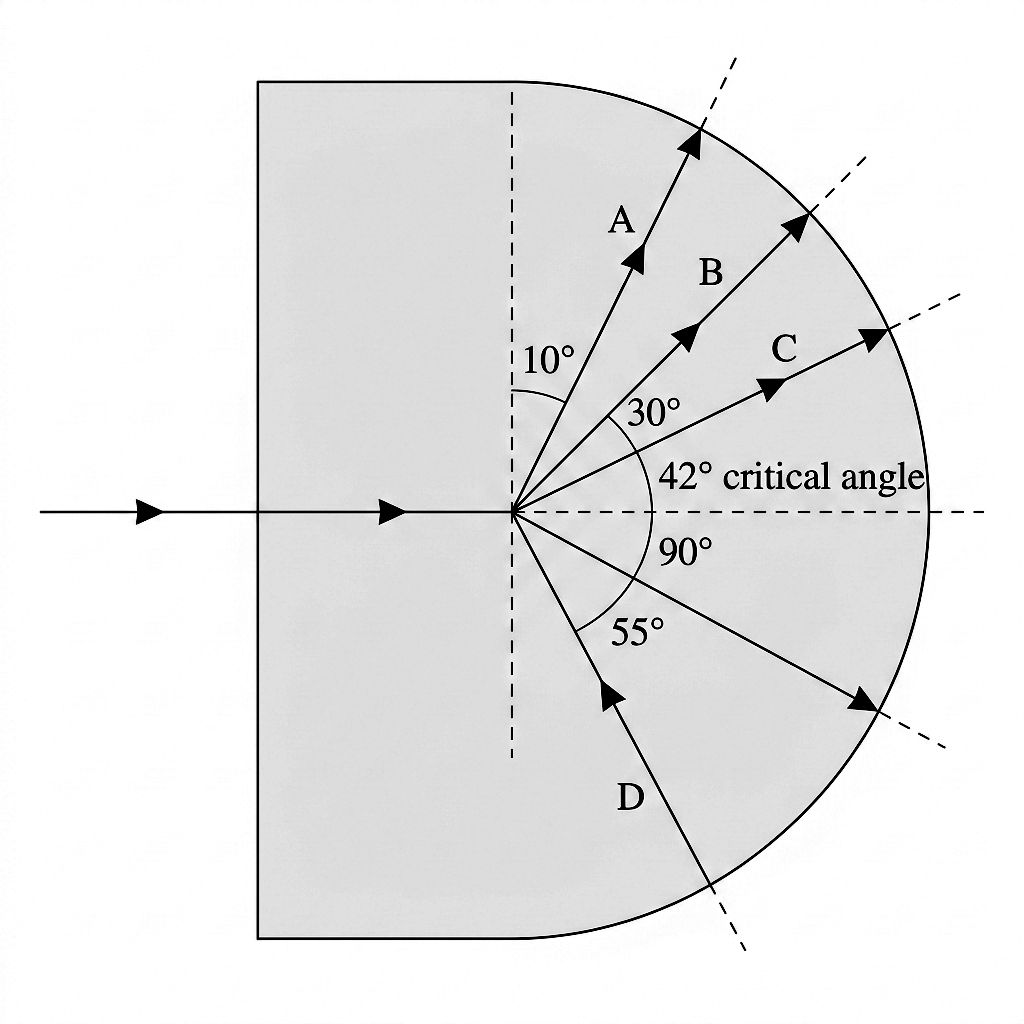
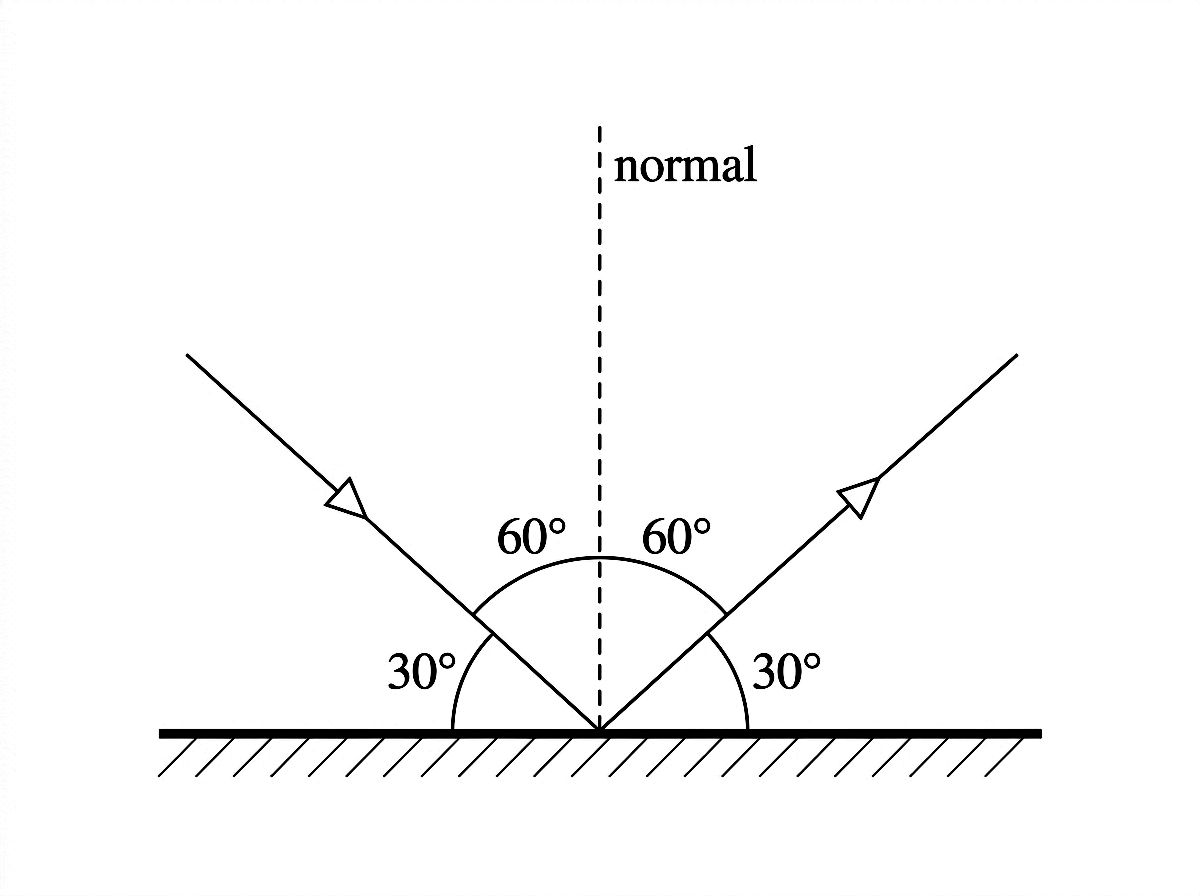
A light ray is a straight line perpendicular to the wavefront, pointing in the direction of wave travel. In geometric optics, the wave nature of light is ignored, so rays travel in straight lines until they hit a surface. A laser is a practical example of a single coherent, monochromatic beam that can be modeled as a ray. When a ray strikes a surface, the law of reflection applies: the angle of incidence equals the angle of reflection, both measured from the normal to the surface at the point of contact.
- Law of reflection: theta_i = theta_r; both angles measured from the normal, not the surface.
- Specular reflection: Occurs at smooth surfaces where the normal direction is constant; produces clear, mirror-like images.
- Diffuse reflection: Occurs at rough surfaces where the normal varies across the surface; light scatters in many directions.
- Ray diagram: A diagram using straight lines to show the path of light before and after interacting with a surface or optical element.
- Limits of the ray model: Rays cannot explain interference or diffraction; those phenomena require treating light as a wave (Unit 14).
Draw a ray hitting a flat surface at 35 degrees from the normal. Identify the incident ray, reflected ray, and normal, and label both angles.
| Type | Surface | Reflected rays | Result |
|---|
| Specular | Smooth | All parallel | Clear image |
| Diffuse | Rough | Many directions | Scattered light, no clear image |