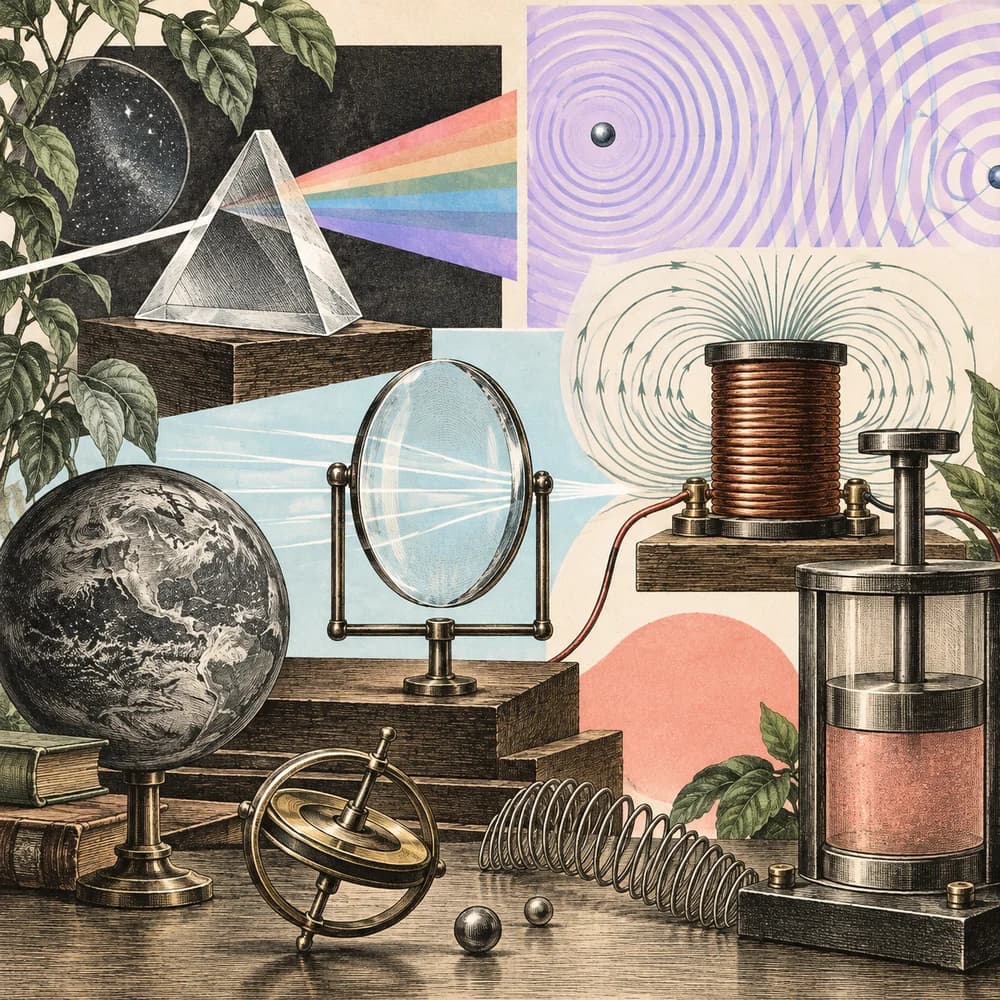
Waves, sound, and physical optics form the foundation of our understanding of energy transfer and light behavior. These concepts explain how energy moves through space and interacts with matter, from ocean waves to the intricate workings of our eyes and advanced optical technologies. This unit covers wave properties, sound propagation, electromagnetic radiation, and optical phenomena. Students will explore interference, diffraction, reflection, and refraction, gaining insights into the nature of light and its applications in everyday life and scientific instruments.
What topics are covered in AP Physics 2 Unit 14?
You’ll study Unit 14 (Waves, Sound, and Physical Optics), which covers topics 14.1–14.9 — full unit content is at https://library.fiveable.me/ap-physics-2-revised/unit-14. Key ideas include wave basics (pulse vs. periodic waves, speed, amplitude, transverse vs. longitudinal). You’ll also do periodic wave math (frequency, period, wavelength). Other topics: boundary behavior and polarization, electromagnetic waves and the spectrum, the qualitative Doppler effect, interference and standing waves (nodes/antinodes, harmonics, beats), single-slit diffraction, double-slit interference and diffraction gratings, and thin-film interference (normal incidence only). The unit is about 12%–15% of the exam and stresses translating between representations and using equations like v = fλ, beat frequency, and single/double-slit relations. For concise review and practice, check Fiveable’s Unit 14 study guide and practice bank.
Where can I find an AP Physics 2 Unit 14 review or PDF?
Check out the focused study guide on Fiveable (https://library.fiveable.me/ap-physics-2-revised/unit-14). That page summarizes Unit 14: Waves, Sound, and Physical Optics (topics 14.1–14.9) and lists key equations, concepts, and exam-weight info. The College Board’s Course and Exam Description PDF (https://apcentral.collegeboard.org/media/pdf/ap-physics-2-course-and-exam-description.pdf) is the official course document and shows Unit 14 content and recommended pacing. For extra practice and quick refreshers, Fiveable also offers cheatsheets, cram videos, and more practice questions (https://library.fiveable.me/practice/physics-2-revised) which are handy for reinforcing the unit review.
What are common Unit 14 progress check FRQ and MCQ question types?
You’ll commonly see progress-check FRQ and MCQ items that ask for quantitative wave calculations using v = fλ and string speed v = sqrt(FT/(m/ℓ)). Boundary/reflection questions ask about inversion and transmitted/reflected amplitude. Expect standing-wave and harmonic problems for strings and pipes (node/antinode spacing, fundamental and odd-only harmonics). Other frequent types: beats and qualitative Doppler reasoning; single-slit and double-slit/diffraction-grating geometry using a(y/L) ≈ mλ or d(y/L) ≈ mλ; thin-film interference with phase shifts and quarter-wave coatings (normal incidence only); polarization and intensity (Malus qualitatively); and interpreting/sketching wave representations. Many items mix graphs, sketches, and equations and ask for functional-dependence reasoning. For targeted practice and summaries, see https://library.fiveable.me/ap-physics-2-revised/unit-14 and extra practice at https://library.fiveable.me/practice/physics-2-revised.
How should I study Unit 14 for AP Physics 2 — best resources and strategies?
A good approach: start at https://library.fiveable.me/ap-physics-2-revised/unit-14 and use extra problems at https://library.fiveable.me/practice/physics-2-revised. Focus on core concepts: v = fλ, superposition, standing waves, interference/diffraction, Doppler, polarization, and EM waves. Make a one-page concept map linking formulas, conditions, and typical setups. Practice timed MCQs for speed and FRQ-style problems for algebra and explanations. Use simple demos (strings, tubes, slits, speakers) to visualize boundary behavior and standing waves. Drill two-source interference, single-slit minima, Doppler shifts, and node/antinode positions. Aim to cover the unit in roughly 14–23 class periods (CED guideline) and keep a mistake log to target weak spots. Fiveable’s study guide and practice questions are great for concise review and exam-style practice.
What's the hardest part of AP Physics 2 Unit 14 for most students?
Wave interference and diffraction are the parts students most often stumble on. See the unit overview (https://library.fiveable.me/ap-physics-2-revised/unit-14). People get tripped up distinguishing phase versus path difference when determining constructive or destructive interference, applying path-difference formulas to double-slit and single-slit setups, and converting between phase and distance. Related trouble spots include analyzing standing-wave nodes and antinodes, using superposition in multi-wave situations, and keeping sign conventions straight for path and phase. These topics are concept-heavy and demand both visual intuition and algebraic care—phasors can really help if you use them. Practice lots of different setups (double-slit, thin films, diffraction gratings) and make stepwise sketches of path differences. For focused review and worked problems with explanations, Fiveable’s Unit 14 study guide and practice questions (https://library.fiveable.me/ap-physics-2-revised/unit-14) are handy.
Where can I find AP Physics 2 Unit 14 practice questions and answers (Quizlet, answer keys)?
Yes, Quizlet hosts user-created sets for “AP Physics 2 Unit 14,” but there’s no single official Quizlet answer key—those sets are made by students and can vary in accuracy. College Board doesn’t publish multiple-choice answer keys publicly, so lean on reputable sources that include full explanations. You’ll find Unit 14 practice questions and worked explanations on Fiveable’s unit page at https://library.fiveable.me/ap-physics-2-revised/unit-14. For extra problems and complete answer explanations, try Fiveable’s broader practice bank at https://library.fiveable.me/practice/physics-2-revised. Also check the Unit 14 cheatsheets and cram videos on the unit page for quick review. When using Quizlet, cross-check answers against trusted explanations to make sure mistakes aren’t being copied.