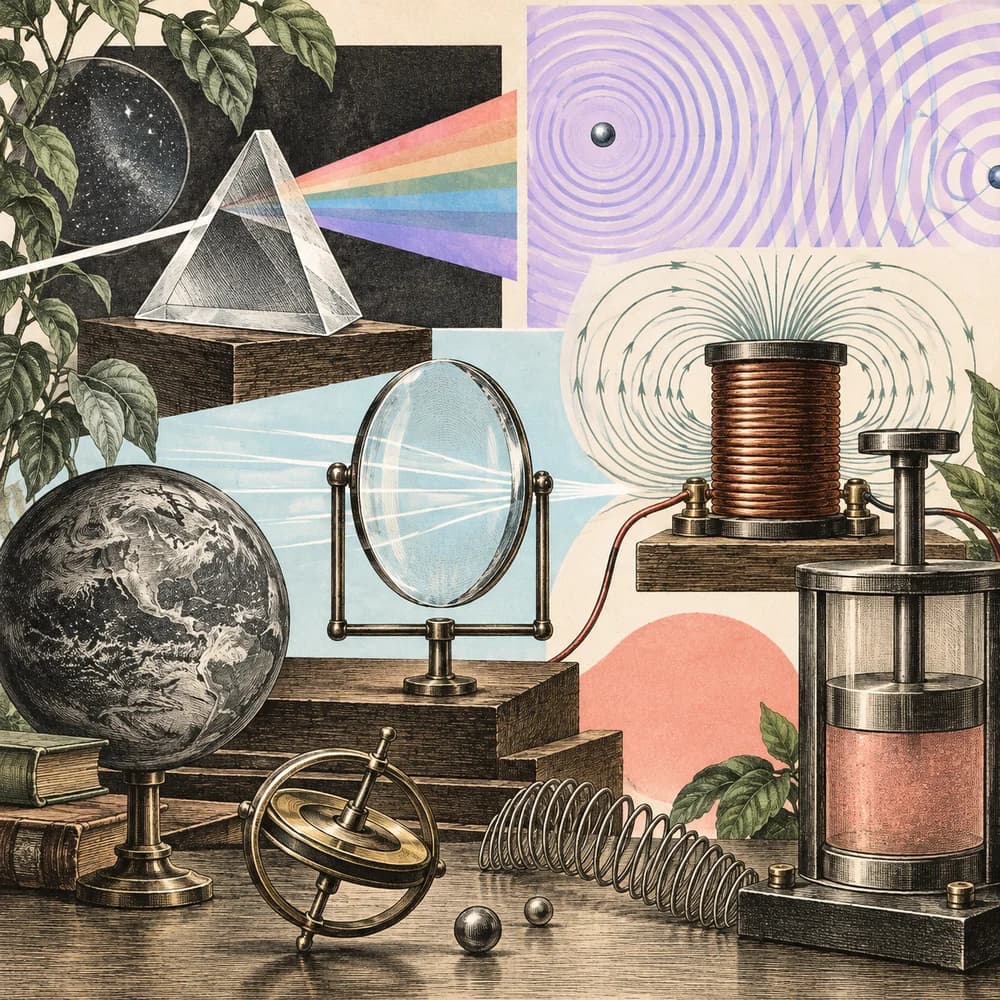
Geometric optics explores how light behaves as rays, interacting with mirrors, lenses, and various media. This unit covers reflection, refraction, and image formation, providing a foundation for understanding optical phenomena and instruments. Students learn about key concepts like focal points, magnification, and the laws governing light's behavior. These principles are applied to real-world examples, from cameras and telescopes to fiber optics and adaptive optics systems used in astronomy.
What topics are covered in AP Physics 2 Unit 13 (Geometric Optics)?
Unit 13 covers geometric optics: reflection, mirror images, refraction, and lens images. It includes the ray model of light; the law of reflection; specular versus diffuse reflection; image formation by plane, concave, and convex mirrors (including thin-mirror equations and magnification); Snell’s law and index of refraction; total internal reflection and the critical angle; and image formation by thin lenses (thin-lens equation, focal points, magnification, and principal ray constructions). Emphasis is on drawing ray diagrams, using consistent sign conventions, and applying equations to predict image type, size, orientation, and location. For a focused summary, Fiveable’s Unit 13 study guide and cram videos walk through the key equations and ray-diagram strategies (https://library.fiveable.me/ap-physics-2-revised/unit-13).
How much of the AP Physics 2 exam is Unit 13 (Geometric Optics)?
Unit 13 typically counts for about 12%–15% of the AP Physics 2 exam. The unit usually takes roughly 8–12 class periods and covers reflection, mirror images, refraction, and lens images (topics 13.1–13.4). On the exam expect both conceptual multiple-choice and problem-solving items that use ray diagrams, mirror and lens equations, and Snell’s law. When you study, prioritize ray construction, sign conventions for focal length and image distance, and index-of-refraction calculations. For a concise review, see Fiveable’s unit study guide at https://library.fiveable.me/ap-physics-2-revised/unit-13, and use the full AP Physics 2 practice bank at https://library.fiveable.me/practice/physics-2-revised for targeted timed practice.
What's the hardest part of Unit 13 in AP Physics 2?
Most students struggle with image formation for mirrors and lenses—especially switching between ray tracing and equation work. The tricky bits are applying mirror/lens equations with correct sign conventions (thin-lens equation 1/f = 1/do + 1/di and magnification m = -di/do), deciding when images are real versus virtual, and handling sign differences for converging versus diverging optics. Combining refraction across multiple surfaces adds another layer of difficulty. Best fixes: practice accurate ray diagrams, stick to one sign convention, and do lots of problems that translate between diagrams and algebra. For extra review and practice problems, check the Unit 13 guide (https://library.fiveable.me/ap-physics-2-revised/unit-13) and the AP Physics 2 practice bank (https://library.fiveable.me/practice/physics-2-revised).
How should I study Unit 13 (Geometric Optics) for AP Physics 2—best resources and practice?
Study Unit 13 by focusing on core skills: ray diagrams for reflection, mirrors, refraction, and lenses; the mirror/lens equation (1/f = 1/do + 1/di); magnification; sign conventions; and critical angle/total internal reflection. Start with clear, labeled ray-diagram practice for plane, concave, and convex mirrors and for thin lenses. Then do problems that mix object-distance signs and image types. Practice Snell’s law calculations and find critical angles for n1 > n2. Time-box 2–3 study sessions: concept notes, 20–30 worked problems, and a timed mixed-practice set. For extra practice and quick review, use Fiveable’s Unit 13 study guide and the practice question bank with cram videos at https://library.fiveable.me/practice/physics-2-revised.
Where can I find AP Physics 2 Unit 13 progress check multiple-choice questions and answers?
You can find practice multiple-choice questions and explained answers for Unit 13 on Fiveable’s practice page (https://library.fiveable.me/practice/physics-2-revised). Official AP Progress Check multiple-choice items and teacher-facing rationales are distributed through College Board’s AP Classroom; teachers assign the Unit 13 Progress Check there, and the College Board doesn’t publicly post MC answer keys outside AP Classroom. For targeted review around those question types, Fiveable also has a Unit 13 study guide plus cheatsheets and cram videos to help you practice similar MC questions and explanations (https://library.fiveable.me/ap-physics-2-revised/unit-13).
Are there common formula sheets or key equations I need to memorize for Unit 13 (Geometric Optics)?
Yes — the core equations you should memorize are: the law of reflection θ_i = θ_r; the thin-element (mirror/lens) equation 1/s_i + 1/s_o = 1/f; magnification M = h_i/h_o = s_i/s_o (often written with sign as M = -s_i/s_o for orientation); Snell’s law n_1 sinθ_1 = n_2 sinθ_2; index of refraction n = c/v; and the critical-angle relation θ_critical = sin^{-1}(n_2/n_1) for n1>n2. Also learn the ray rules for concave/convex mirrors and converging/diverging lenses, plus the sign conventions for f, s_o, and s_i. For a compact study guide and practice problems for Unit 13, check out the Fiveable unit page (https://library.fiveable.me/ap-physics-2-revised/unit-13). Fiveable also has cheatsheets, cram videos, and practice questions to drill these equations.
How long should I study Unit 13 in AP Physics 2 to feel fully prepared?
Aim for about 8–12 class periods (as the CED recommends) or roughly 6–15 hours of focused review for a typical student. If you’re starting from scratch, plan 12–20 hours spread over several weeks and include problem practice. Split your time: 25% on theory and definitions, 50% on ray-diagram practice and quantitative problems (mirror/lens equations and sign conventions), and 25% on mixed practice exams plus error review. Do active problem sets and timed questions to gauge readiness. If you keep making conceptual mistakes or sign errors, add targeted 1–2 hour sessions. For a structured review with summaries and practice questions, use Fiveable’s Unit 13 study guide (https://library.fiveable.me/ap-physics-2-revised/unit-13) and the practice bank (https://library.fiveable.me/practice/physics-2-revised).
Where can I find AP Physics 2 Unit 13 practice tests, notes, or PDFs?
You can find concentrated Unit 13 study notes and practice resources on Fiveable's unit page at https://library.fiveable.me/ap-physics-2-revised/unit-13. That page has a focused study guide for Geometric Optics (topics 13.1–13.4), cheatsheets, cram videos, and links to drills. For lots of practice questions, Fiveable’s practice bank is at https://library.fiveable.me/practice/physics-2-revised. For official past free-response question PDFs, sample responses, and scoring rubrics, go to College Board’s AP Central at https://apcentral.collegeboard.org. Use Fiveable for concentrated notes and drills, and AP Central for the real exam PDFs and scoring guidance.