Intermolecular Forces: Strength & Structure
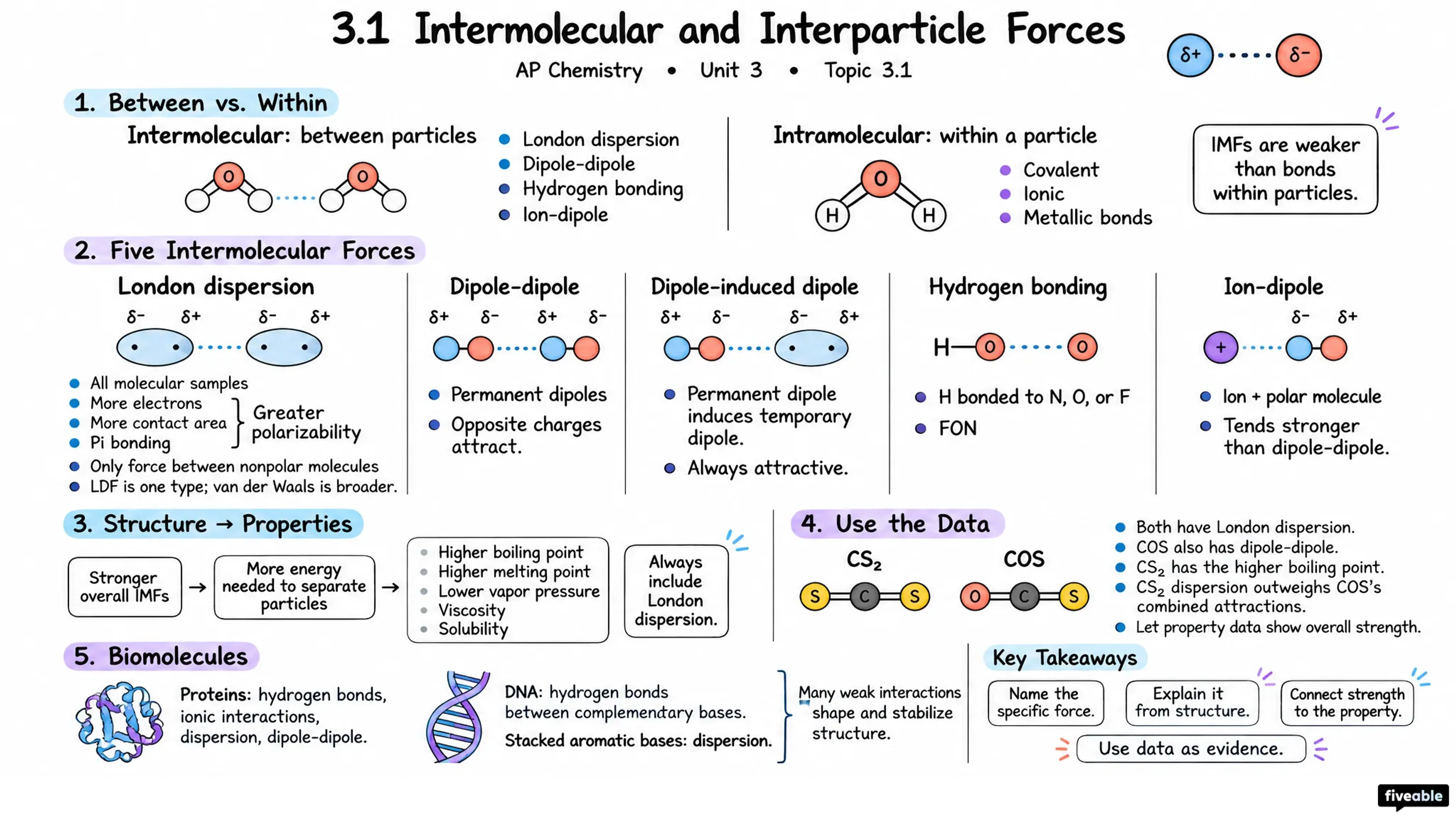
London Dispersion Forces
- Result from temporary, fluctuating dipoles (Coulombic interactions)
- Increase with contact area and polarizability
- Polarizability increases with: electron count, electron cloud size, pi bonding
- Often strongest net force in large molecules
Dipole-Based Forces
- Dipole-induced dipole: polar + nonpolar; strength depends on dipole magnitude and polarizability
- Dipole-dipole: between polar molecules; orientation-dependent; generally stronger than dispersion for molecules of similar size and polarizability.
- Ion-dipole: ions + polar molecules; typically strongest of these three
Hydrogen Bonding
- H covalently bonded to N, O, or F is attracted to the negative end of a dipole on an N, O, or F atom (its lone pair) in a different molecule or another region of the same molecule
- Critical in biomolecules and polymers